

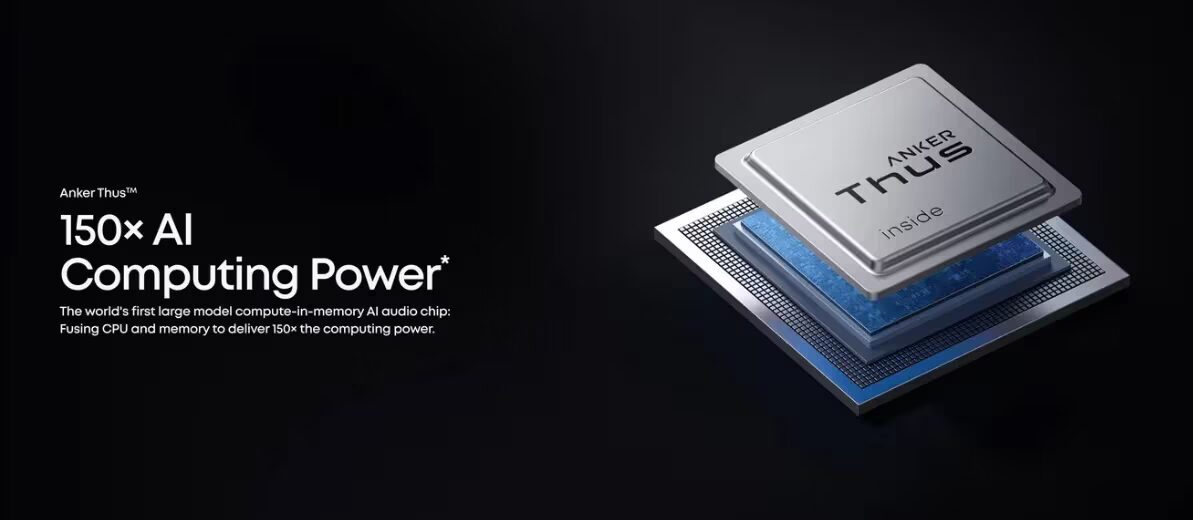
Anker Innovations is entering the custom silicon arena with Thus, its first in-house AI chip platform set to debut on May 21, 2026, at an event in New York. The move marks Anker’s push into designing specialized processors tailored for AI-powered devices.
The Thus chip is built around Compute-in-Memory (CIM) architecture, a design that merges processing and storage into one unit. By crunching data directly where it’s stored instead of shuttling it between separate components, this approach slashes latency, boosts speed, and cuts power consumption-critical for battery-operated compact devices.
Anker claims a 150x jump in AI computing performance over its previous audio solutions. A standout feature is on-device AI processing, eliminating the need to offload tasks to the cloud. This results in faster response times, more reliable operation, and tighter control over user privacy.
Thus AI chip powers Anker wireless earbuds
The Thus chip’s first outing will be in Anker’s new flagship wireless earbuds launching alongside the chip. These earbuds will feature a ”Clear Calls” system with AI-driven noise cancellation, eight microphones, and bone conduction sensors to enhance voice clarity.
Expanding AI chip use in mobile accessories and smart gadgets
Beyond audio gear, Anker plans to roll out the Thus chip across mobile accessories and other smart gadgets. The company aims to accelerate the adoption of local AI processing, making everyday electronics smarter and more efficient without relying heavily on cloud computing.
Growing trend of custom AI chips in consumer electronics
Custom AI chips are a growing trend as companies like Apple and Google increasingly shift AI workloads from cloud to device to boost privacy and performance. Anker’s entry with Thus signals a step toward competing in this space, especially within entry-level and mid-tier consumer gadgets where power efficiency and low latency are important.
Outlook for Anker’s Thus AI chip platform
Looking ahead, the success of Anker’s Thus chip could hinge on its ability to scale AI capabilities across diverse product lines beyond headphones and maintain a competitive edge against established silicon players. The May 2026 launch will be the first test of whether Anker can carve out a niche in the growing market for dedicated AI hardware in consumer electronics.