

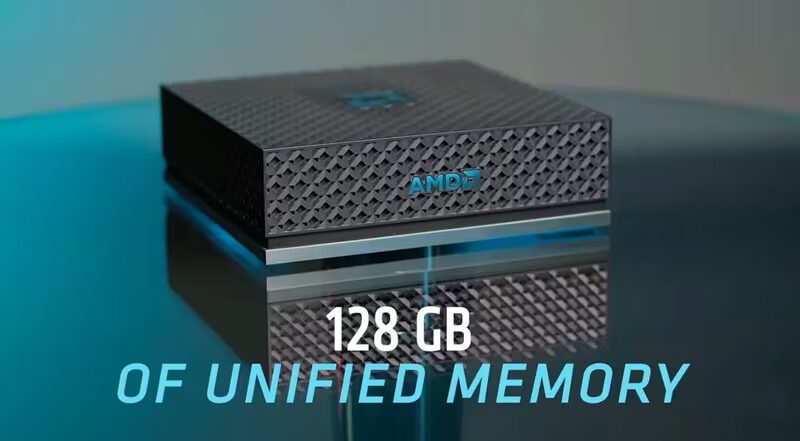
AMD has officially released its Ryzen AI Halo mini-PC, a compact powerhouse built for local AI model development. At its core is the flagship Ryzen AI Max+ 395 processor, paired with a standout 128GB of unified LPDDR5X-8000 memory shared between the CPU and integrated Radeon 8060S graphics. This beefy setup comes at a premium, priced at $3,999.99 at U.S. retailer Micro Center.
Designed as a workstation for developers who want to run AI workloads on-premises without relying on cloud services or discrete GPUs, the Ryzen AI Halo aims to hit a sweet spot. The Strix Halo family, which the Ryzen AI Max+ 395 belongs to, prioritizes massive shared memory capacity and powerful integrated graphics. For many local AI tasks, memory size matters more than raw speed, making this configuration particularly practical.
At launch, the Ryzen AI Halo comes in two configurations-Windows 11 Pro and Linux-with identical hardware specs according to product listings. Both versions feature a 2TB SSD, 10-gigabit Ethernet, Wi-Fi 7, Bluetooth 5.4, and run at a system-wide TDP of 120 watts.
AMD Ryzen AI Halo key specifications
- Ryzen AI Max+ 395 processor (up to 16 Zen 5 cores)
- 128GB LPDDR5X-8000 unified memory shared by CPU and integrated GPU
- Integrated Radeon 8060S graphics (RDNA 3.5 architecture)
- 2TB solid-state drive
- 10GbE Ethernet, Wi-Fi 7, Bluetooth 5.4 connectivity
- 120W total thermal design power (TDP)
The Ryzen AI Max+ 395 stands out by combining up to 16 Zen 5 CPU cores with robust integrated Radeon 8060S graphics based on the RDNA 3.5 architecture, alongside a neural processing unit (NPU) capable of delivering up to 50 trillion operations per second (TOPS). This makes the Ryzen AI Halo a rare x86 system designed explicitly with serious AI workloads in mind. AMD has not only developed this chip for partners but also launched its own complete platform.
However, there’s a catch clouding the launch. Despite the official product page announcing availability, Micro Center currently lists the Ryzen AI Halo as ”coming soon” and doesn’t offer it for purchase yet. Additionally, the retailer is initially offering only in-store pickup, which severely limits early U.S. availability.
This marks AMD’s first standalone system based on the Strix Halo chip family, which debuted over a year ago and has been incorporated into partner devices since. The compact AI PC segment has grown noticeably busier, with manufacturers aiming to bridge the gap between standard desktops and expensive server accelerators by delivering local AI inference in mini PC-sized packages.
Price-wise, AMD is positioning the Ryzen AI Halo firmly in the premium bracket. VideoCardz compares it to a similar-spec machine, the GMKtec EVO-X2, which also has 128GB of unified memory but costs roughly $600 less at around $3,400. The extra cost here isn’t just for hardware but for a turnkey platform with preinstalled OS and developer-oriented tools straight from AMD.


Moving forward, the Ryzen AI Halo’s success depends heavily on AMD’s ability to transition from ”coming soon” status to broad availability-and whether developers will pay a premium for a complete AMD-backed AI workstation. If AMD manages a quick rollout, this system could become the flagship showcase for the Strix Halo platform. If not, partner offerings already include lower-priced alternatives based on the same chips, which may continue to appeal more to the market.