

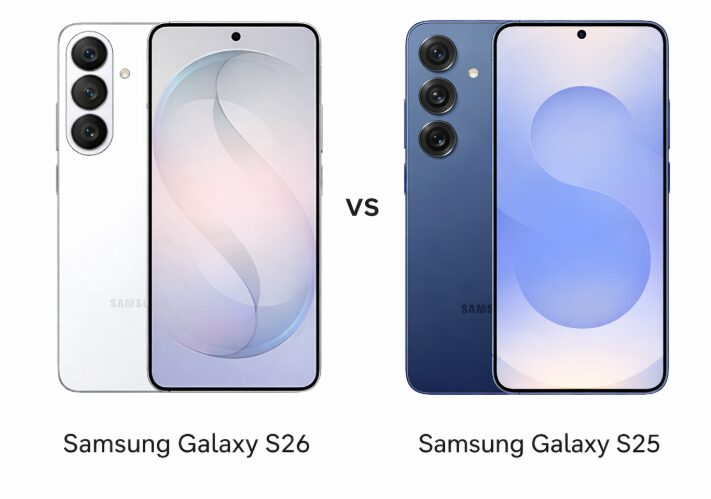
The Samsung Galaxy S26 vs S25 comparison does not look like the sort of upgrade that will make S25 owners sprint to the store. Instead, it leans on the boring but useful stuff: a newer chip, a bigger battery, slightly cleaner software, and a handful of camera refinements that should show up more in daily use than in spec-sheet bragging rights. Samsung seems to be betting that buyers care more about speed, efficiency, and longevity than another dramatic redesign.
That’s a smart bet, even if it’s not a glamorous one. Flagship phone upgrades across the market have been drifting toward incremental gains for a while, and Samsung’s own S-series has often followed that pattern when the hardware platform is already strong. The real question here is whether the S26 offers enough extra polish to justify the higher price, or whether the S25 remains the better deal by doing almost everything right.
Galaxy S26 display and design changes
On the outside, the two phones are close cousins. The S26 keeps the same premium, compact feel, uses Gorilla Glass Victus 2, and adds Armor Aluminum 2, while the display grows from 6.2″ to 6.3″. Resolution stays at 1080 × 2340 on both models, and peak brightness is still 2600 nits, so the upgrade is more about a slightly roomier canvas than a major visual leap.
That’s not a bad thing. A phone that already looks and feels like a flagship doesn’t need a cosplay-level redesign every cycle, and Samsung appears to have spent its effort on making the newer model feel more polished rather than radically different. The S25 still looks fully current, which makes the S26’s job harder and more interesting at the same time.
Snapdragon 8 Elite Gen 5 and the battery bump
This is where the S26 pulls away. It moves to Snapdragon 8 Elite Gen 5 or Exynos 2600, depending on the region, while the S25 uses Snapdragon 8 Elite. Samsung also raises the battery from 4000mAh to 4300mAh, which is the kind of change you notice long before you ever care about benchmark charts.
- Galaxy S26: Snapdragon 8 Elite Gen 5 / Exynos 2600, 4300mAh battery
- Galaxy S25: Snapdragon 8 Elite, 4000mAh battery
- Both phones: 25W wired charging and 15W wireless charging
The catch, because there is always a catch, is charging. Samsung keeps the same 25W wired and 15W wireless speeds, which feels conservative next to the battery gain. Still, a newer chip and newer architecture should help the S26 run cooler and last longer, and that matters more than raw charging numbers for most people. If you game a lot, multitask heavily, or simply keep phones for years, the newer model has the cleaner story.
Galaxy S26 camera hardware stays the same
The rear camera setup is basically unchanged: a 50MP main camera, 10MP 3x telephoto, and 12MP ultrawide on both phones. That makes the S26’s camera pitch less about new lenses and more about better processing, with features such as Horizon Lock and improved stabilization doing the heavy lifting for video.
That approach is familiar, and it’s usually where smartphone camera progress has landed once hardware reaches a mature plateau. The selfie camera also stays at 12MP, though the S26 shifts to a 23mm focal length versus 26mm on the S25, which should slightly change framing. For creators, the smarter processing is probably the bigger win than the unchanged lens count.
Galaxy S26 price versus Galaxy S25 value
The pricing gap is real: around $900 / ₹88,000 for the S26 versus $800 / ₹75,000 for the S25. That is a hefty jump for a phone that looks, on paper, like a refinement rather than a reinvention.
- Galaxy S26: around $900 / ₹88,000
- Galaxy S25: around $800 / ₹75,000
- Best upgrade case: performance, battery life, and longer software support
- Best value case: the S25 remains the easier recommendation
That price gap makes the decision pretty simple for two types of buyers. Power users and people who keep their phones for a long time have a decent reason to lean S26, thanks to Android 16, One UI 8.5, and the stronger chip-and-battery combo. Everyone else can probably save the cash and still end up with one of the most balanced Android flagships around.
The more interesting question is whether this kind of upgrade cycle becomes Samsung’s new normal: smaller visible changes, bigger efficiency gains, and a higher entry price. If that’s the play, the S26 is a convincing version of it. The S25, though, is the kind of older flagship that can hang around and annoy the new model by being almost good enough.