

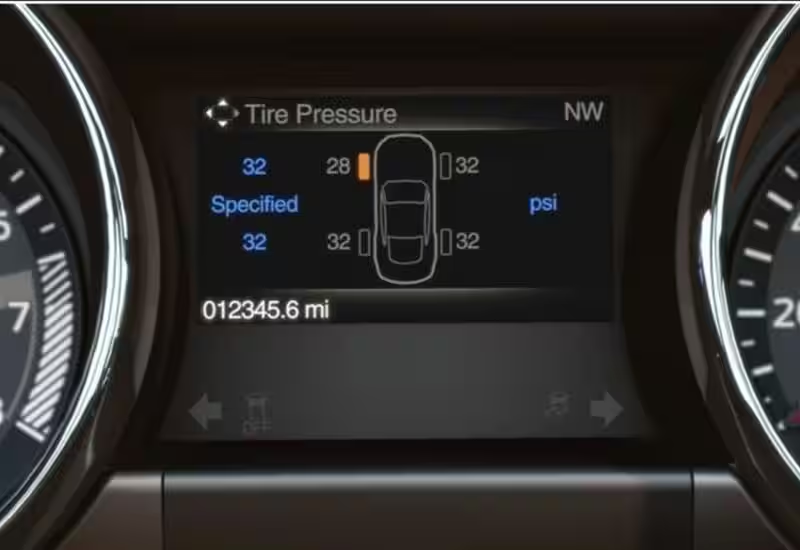
Wireless tire pressure monitoring systems (TPMS) built into many vehicles have an unexpected privacy downside: they can be exploited to track car movements with simple, low-cost devices. Researchers from European universities and security firm IMEDA Networks demonstrated that these sensors, which regularly broadcast pressure data to the car’s onboard computer, can be intercepted to glean real-time location patterns without sophisticated tools.
The technical setup involves TPMS units equipped with their own batteries and wireless transmitters, typically operating within a 50-meter range. Using an off-the-shelf device costing around $100, attackers can repeatedly collect a car’s movement data by decoding these signals from a fixed position. While this approach lacks scalability in traffic-heavy areas, it suffices for focused surveillance-tracking patterns such as when a car leaves or returns to a specific zone.
Beyond privacy concerns, this vulnerability carries security risks. Hackers can spoof TPMS messages to trigger false low-pressure warnings, potentially causing drivers to stop unnecessarily. That scenario raises the chance of physical attacks or delays-an unsettling prospect, especially in high-risk regions or for commercial vehicles. Additionally, regarding freight transport, these signals might indirectly hint at cargo weight based on tire pressure readings, opening up further intelligence-gathering avenues.
The obvious fix-encrypting TPMS signals-is complicated by the industry’s fragmentation. Multiple sensor and automaker brands produce incompatible systems, making a unified security standard tricky. Implementing encryption piecemeal risks incompatibility and malfunctions, undermining the system’s core safety function of alerting drivers to tire issues.
This revelation taps into a broader pattern where seemingly minor vehicle sensors become privacy vulnerabilities. Previous research has shown keyless entry systems and infotainment bugs exposing cars to attacks. As vehicles grow increasingly connected, manufacturers must rethink security not just around primary control systems but also peripheral data streams like tire sensors.
Meanwhile, vehicle owners have limited recourse. TPMS hardware and protocols are defined years ahead and tightly integrated. Until the industry locks down robust encryption or authentication mechanisms, these wireless transmissions remain easy pickings for anyone with modest technical skills and a desire to snoop.
With law enforcement and criminals both potentially exploiting this weakness, it raises pressing questions about automotive data security governance. Should governments mandate secure standards for all vehicle telemetry? Can manufacturers balance interoperability with protective measures? As cars shift from mechanical machines to software-driven devices, protecting privacy and safety will require fresh thinking far beyond traditional cyber defense.