

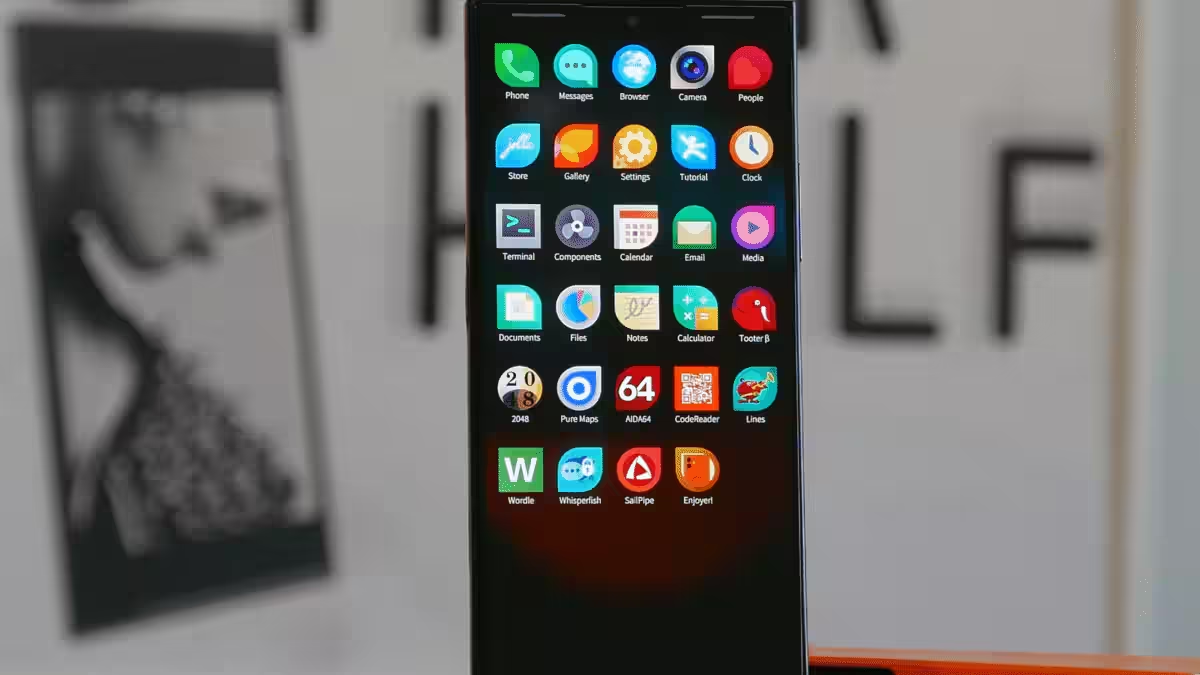
Jolla, the Finnish company quietly championing its Linux-based Sailfish OS for over a decade, has returned with a new smartphone marketed as the ”European phone.” Priced at €649 and assembled entirely in Finland, the device offers a privacy-minded alternative to the Android and iOS duopoly, appealing to growing European skepticism of US tech dominance.
Unveiled at Mobile World Congress 2026 and backed by over 10,000 preorders, the Jolla Phone revives the brand’s mission to provide a sovereign, Big Tech-free handset. This follows a turbulent history, including a near-bankruptcy and a pivot to software licensing. Now operating under a restructured company named Jollyboys, Jolla combines components sourced globally with software fully compiled and installed in Finland to maintain tighter control over privacy and security.
A Linux alternative built for privacy and customization
Unlike rival deGoogled efforts like GrapheneOS or e/OS that rely on stripped-down versions of Android, Sailfish OS is built directly on Linux. This independence from the Android Open Source Project means Jolla’s software avoids any embedded Google services by design, providing users with greater control without the need for ”deGoogle” hacks. The phone can run Android apps, though compatibility isn’t flawless. To ease adoption, Jolla offers integrations like MicroG-an open-source tool that mimics Google services for apps needing them-without forcing users to create accounts or surrender data.
Jolla’s commitment to openness extends to hardware: the device revives the ”The Other Half” concept from the original Jolla Phone-a set of swappable rear covers with pogo pins enabling community-developed accessories like a secondary display or keyboard. These modular components, which users can 3D print themselves, add a layer of longevity and personalization rarely seen in smartphones today. The phone’s battery is also user-replaceable, a feature long abandoned by major manufacturers.
Balancing performance, price, and niche appeal
With a MediaTek Dimensity 7100 5G chip, 8GB or 12GB of RAM, and 256GB of storage plus microSD expansion, the Jolla Phone offers respectable hardware for a midrange device. Its 6.36-inch AMOLED screen and 50-megapixel main camera make it competitive, though the lack of the latest Wi-Fi 7 and limited Bluetooth 5.4 connectivity highlight trade-offs typical for niche-market phones. The challenge remains in offering a convincing alternative when mainstream devices continue to improve rapidly-especially given the phone’s price, which sits close to flagship ranges from more widely available brands.
Jolla’s CEO Sami Pienimäki emphasizes the strategic importance of European technology sovereignty, claiming the current geopolitical climate and increasing distrust in US cloud services present a unique market opening. That said, the phone isn’t expected to disrupt the mass market overnight. As Jolla Group chair Antti Saarnio admits, the device is ”a stepping stone” rather than a mass-market challenger, with future growth tied to new form factors and AI-driven experiences.
Jolla’s forthcoming AI assistant, Mind2, promises a privacy-first alternative to cloud-heavy AI, running entirely on local devices and integrating smoothly with email and calendars. This aligns with Jolla’s vision for a smartphone ecosystem that respects user data-a contrast to the surveillance-driven models dominating the industry. While the new phone ships without AI features initially, software updates could bring this functionality later this year, potentially carving out a unique niche.
European alternatives to Big Tech phone ecosystems have multiplied, with companies like Murena in France and GrapheneOS in Canada also pushing privacy-friendly platforms. Governments have shown interest in reducing reliance on US technologies, exemplified by France’s shift away from Zoom to locally developed software. Jolla sits within this broader geopolitical push, though its fate will hinge on delivering a smooth user experience and convincing enough consumers to look beyond the Android-iOS hegemony.
Jolla’s choice to manufacture in Finland, playing on the nostalgic legacy of Nokia’s heyday, further signals its European authenticity. Yet, sourcing components from Taiwan, South Korea, and China reveals the complexity of pursuing sovereignty in a globalized supply chain. It will be interesting to see if Jolla’s approach inspires others to balance European identity with realistic production constraints, especially as consumers demand more transparency and control over their digital lives.
For now, the Jolla Phone challenges the idea that smartphones must be locked into Google or Apple’s ecosystems. Whether a Linux-based handset with modular hardware and a European pedigree can attract more than a niche audience remains to be seen. But as debates over privacy and digital sovereignty intensify worldwide, Jolla’s experiment represents an intriguing step beyond Big Tech’s shadow.