

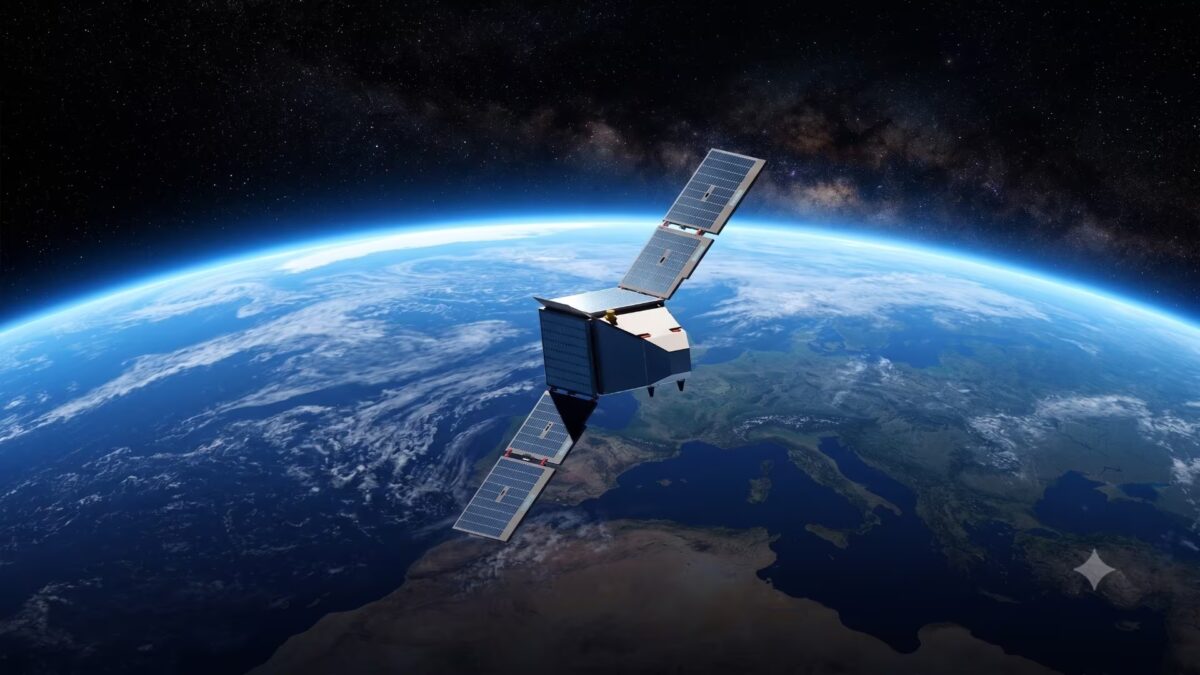
NGC Aerospace has completed a study for the European Space Agency revealing a novel approach to satellite navigation: using the atmosphere itself as a maneuvering tool. For satellites orbiting in very low Earth orbit (VLEO)-roughly below 450 kilometers altitude-the thin upper atmosphere is usually seen as a hindrance that quickly slows down spacecraft. But NGC Aerospace proposes turning this drag into an advantage by using aerodynamic surfaces to control satellite orientation, easing the burden on traditional reaction wheels and thrusters.
VLEO satellites benefit from being closer to Earth with faster data links and higher imaging resolution, but atmospheric drag drastically cuts their orbital lifetime. NGC’s solution, developed under ESA’s RAVELO program, is called Robust Attitude and Orbit Control System for Very Low Earth Orbit (RAOS-VLEO). It integrates external aerodynamic flaps that adjust orientation across all three axes by interacting with the sparse atmospheric flow, effectively letting the satellite ”surf” the drag instead of constantly fighting it.
This approach also reduces reliance on onboard momentum management systems. Normally, satellites use magnetic torquers or thrusters to unload accumulated angular momentum from reaction wheels. Here, the aerodynamic forces partially take over that role, lessening wear and lowering fuel consumption.
NGC Aerospace is also refining onboard software to support autonomous navigation. These new algorithms enable satellites to align with the airflow and the Sun, measure atmospheric density in real time, and adjust commands without constant ground control. Perhaps the most intriguing aspect is the combination with an electric thruster that ”breathes” atmospheric particles as propellant, promising extended mission durations.
Challenges of satellites in very low Earth orbit
Satellites in VLEO have long tempted operators eager for low-latency, high-resolution imaging, but the environment is punishing. The atmosphere’s drag rapidly depletes satellite velocity and demands frequent orbit-raising maneuvers to stay aloft.
Previous missions have pushed these limits. Europe’s GOCE satellite, launched in 2009, maintained a 255 km orbit using an ion engine to counteract drag. Japan’s SLATS (Tsubame) went even lower, around 167 km in 2018, setting records for VLEO operations but highlighting the challenge of precise attitude and orbit control in such conditions.
Meanwhile, the industry is exploring ”air-breathing” electric propulsion as a complementary approach. This technique uses atmospheric particles directly for thrust, reducing propellant mass. ESA, Italian company Sitael, and several startups are actively developing these systems for small satellites. Combining aerodynamic control with air-breathing thrusters in a unified system could shift VLEO missions from experimental to operational.
The commercial drive behind these efforts is clear: lower orbits mean shorter communication delays and sharper Earth observations, important for telecom constellations and Earth-monitoring satellites alike. Even a few tens of kilometers closer to Earth significantly enhance imaging detail, making atmospheric drag management a key focus for the next generation of satellite technology.
If NGC Aerospace’s integrated aerodynamic and propulsion control system proves viable, it could enable the routine use of VLEO for practical missions, turning atmospheric drag from a liability into a valuable ally.