

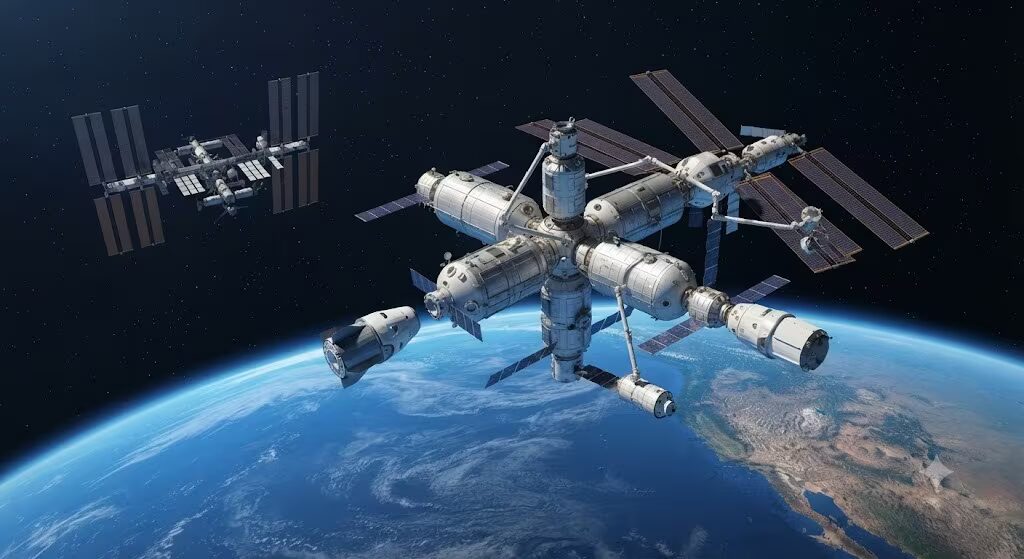
NASA is launching a competition to find commercial companies ready to build the next generation of orbital space stations that will replace the International Space Station (ISS). The goal is clear: after retiring the ISS, the US wants to maintain a continuous presence in low Earth orbit-not through a single government-run station, but via multiple private platforms where NASA acts as a customer.
NASA is preparing the second phase of its commercial space station program and plans to conduct an open procurement through a standard government contract process. Initially, NASA may select several contractors who will then compete in subsequent stages covering final design, testing, certification, and eventual orbital operation. Companies have until July 27 to submit feedback, with an industry briefing scheduled for July 9 at the Johnson Space Center in Houston to go through the requirements in detail.
NASA Administrator Jared Isaacman emphasized the agency’s hope that the private sector can build a sustainable market for orbital stations. Unlike past approaches relying on a single government asset, NASA does not intend to be the sole customer. This strategy echoes previous commercial cargo and crew contracts for visits to the ISS, where agencies like SpaceX and Northrop Grumman expanded their commercial foothold beyond NASA’s initial scope.
The contracting model follows a familiar pattern of fixed-price, long-term service agreements. This approach helps NASA contain budget uncertainties, while giving companies a clearer pipeline of government-backed orders to attract investors.
NASA commercial orbital station program history and key contenders
This isn’t NASA’s first attempt at commercial orbital stations. Since 2021, the agency has funded the Commercial LEO Destinations program to spur private stations in low Earth orbit. Back then, NASA awarded approximately $415.6 million among Blue Origin’s Orbital Reef, Nanoracks’ Starlab project, and Northrop Grumman, which later exited the competition in its original form. Meanwhile, Axiom Space charted a separate course, initially docking station modules to the ISS and later aiming to assemble an independent commercial outpost.
The field of favorites has shifted but remains stable. Voyager Space, Airbus, and partners now promote Starlab, Blue Origin continues with Orbital Reef, and Axiom remains the leading player transitioning from the ISS era to fully commercial infrastructure. This upcoming competition is more than a paperwork exercise: NASA will effectively test which contenders have survived the early commitments and matured enough to pursue certification and practical orbital operations.
Timing is tight. The ISS is scheduled for retirement around 2030, after which it will be deorbited. Should commercial platforms fail to be operational by then, the US risks losing its continuous foothold in low Earth orbit.
- This presence is vital for experiments in material science, biology, medicine, and preparations for deep space missions, including the Artemis lunar program.
- China’s Tiangong station is already operational and stands as the only fully national alternative to the ISS.
- Washington’s push aims to reshape orbital access so the government isn’t solely bearing the weight of such projects for decades.
Another open question is how many contenders will survive to the finish line. The commercial space sector often starts with many hopefuls, but only a few ever reach certified, functioning hardware. On the crewed spacecraft front, despite years of NASA support, only two major players currently operate, with SpaceX maintaining a clear lead in flight frequency.
The next key milestone is imminent: feedback on the NASA Request for Proposals closes at the end of July. Afterward, NASA must finalize the competition’s terms. If contracts are signed in fiscal 2027, winners will have less than four years to prepare for the most demanding phase before the ISS retires. For a space station, that’s an aggressive schedule-even before factoring in any unexpected challenges on Earth or in orbit.
This program marks a pivotal shift in how low Earth orbit will be managed in the coming decade. The success or failure of these commercial space stations will shape not only the future of scientific research and human spaceflight but also the viability of a commercial orbital economy that could redefine NASA’s role from operator to customer. Watch for which companies deliver tangible progress-and whether this model becomes the blueprint for space infrastructure worldwide.