

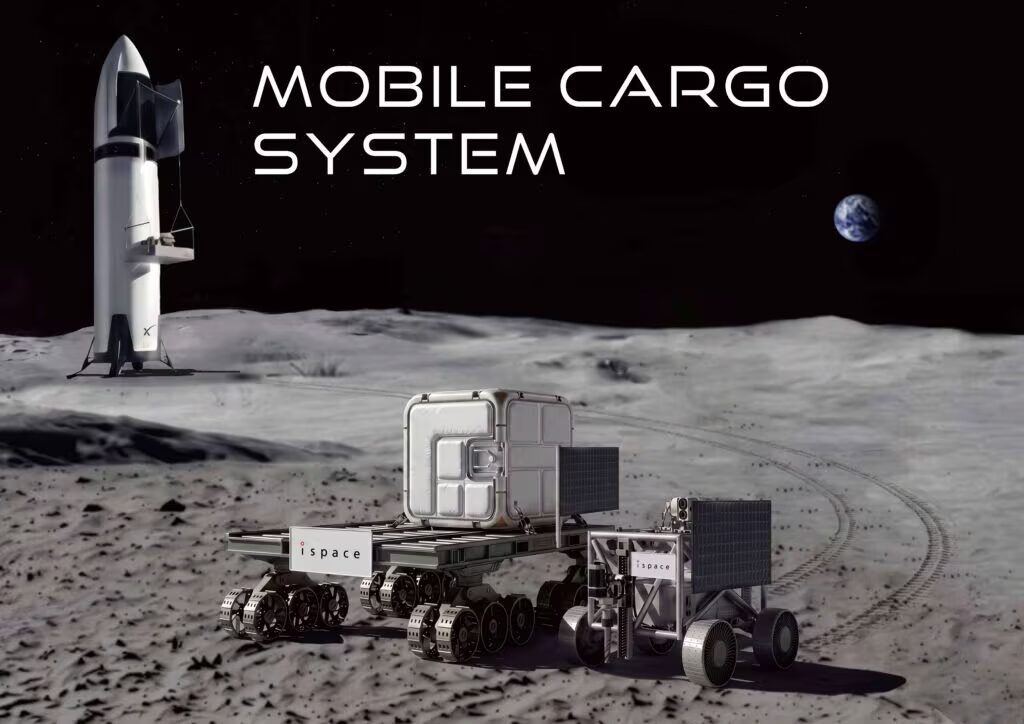
Japanese space company ispace is taking lunar logistics to the next level. Moving beyond just landing its own spacecraft, ispace has unveiled a full-service Moon cargo delivery operation called Lunar Asset Integrator. The company promises turnkey missions that cover everything from payload integration and launch coordination to offloading and servicing on the lunar surface. SpaceX’s Starship will handle the heavy lifting, with commercial operations planned to start by 2030.
The Lunar Asset Integrator service was announced at the SpaceTide 2026 conference. The process is straightforward: customers bring their payloads, and ispace manages almost every other aspect. This includes mission design, arranging the Starship launch, securing the payload onboard, transit to the Moon, unloading, and lunar surface operations. For the final stages, ispace will deploy its Mobile Cargo System, a proprietary platform that handles lunar surface tasks.
With a payload capacity of up to 500 kilograms, ispace’s offering stands out in a market where landers typically carry far less. Current commercial lunar landers-like Intuitive Machines and Firefly Aerospace operating under NASA’s CLPS program-generally handle payloads in the tens or low hundreds of kilograms. Astrobotic, recovering from its Peregrine lander failure, is still scaling back up to full missions. Against this backdrop, ispace’s partnership with SpaceX Starship is positioned as a leap into a higher tier of lunar cargo logistics.
While ispace continues to develop its own ULTRA lander, it is integrating this into a broader lunar logistics service. Instead of offering standalone lander missions, the company aims to become a logistics operator supporting government programs, scientific research, and commercial cargo clients who need more than just a ride to the Moon.
- Up to 500 kg payload delivery to the lunar surface
- Launches conducted on SpaceX’s Starship launch vehicle
- Mission planning and payload integration managed by ispace
- Lunar unloading and servicing executed via Mobile Cargo System
- Commercial cargo delivery service targeted to begin by 2030
ispace’s pivot in the lunar delivery landscape
ispace’s shift toward becoming a lunar infrastructure provider did not happen overnight. Earlier this year, the company overhauled its flight program, scrapping older lander models in favor of a unified ULTRA platform. It also changed engine suppliers-a move that reshapes schedules, certification requirements, and risk profiles.
This retooling pushed back the CP-12 mission-being developed alongside Draper for NASA’s CLPS program-from 2027 to 2030. That delay is significant as several companies race to capture a share of the growing commercial lunar delivery market. Firefly successfully soft-landed its Blue Ghost lander in 2025, and Intuitive Machines has followed up its historic IM-1 mission with successive launches. NASA’s CLPS program continues to generate a steady stream of contracts for private companies.
ispace’s track record includes two failed soft landing attempts with its HAKUTO-R landers. While valuable lessons came from those missions, the company’s reliability reputation suffered-a critical factor in transport services. The new Lunar Asset Integrator service aims to address two challenges: offering customers a clearer, more comprehensive service than just ”another lander,” and embedding ispace into SpaceX’s ecosystem. This partnership lends credibility and simplifies engagement with potential customers.
SpaceX’s role goes beyond launching payloads. Starship has been selected by NASA as the crewed lunar lander for the Artemis program, although it is not yet regularly operational. If and when Starship reaches consistent flight cadence, the per-kilogram cost of Moon delivery could drop significantly. ispace is betting on this scenario to offer more affordable bulk cargo shipments than current lunar transport options allow.
Before launching the new lunar cargo service, ispace has key milestones ahead: deploying a lunar orbit communications and navigation satellite in 2027, followed by lander missions in 2028 and 2029. If all goes to plan, by 2030, ispace will transition from proposing future lunar infrastructure concepts to operating actual functional components-from lunar orbit relays to landing and surface operations.
The lunar economy is no longer just theoretical. Analysts estimate NASA’s CLPS program alone has awarded billions in contracts to private contractors, while companies across the US, Japan, and Europe develop their own Moon services. ispace’s move targets becoming a long-term lunar logistics operator, not just another startup. Progress on the 2027 orbital infrastructure element will indicate how ambitious the company can become.