

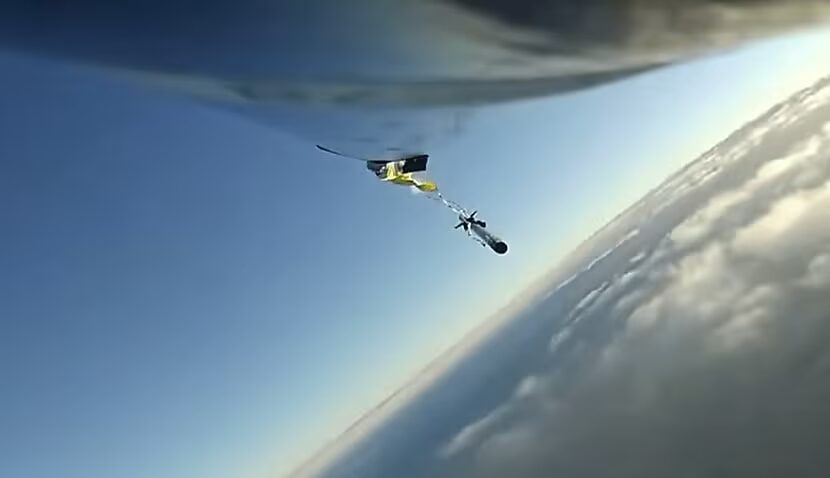
Australia took a major step into commercial rocketry with the successful launch of Mini Meggs, the country’s first liquid-fueled rocket completely designed and built locally. On July 6, the Australian startup Sunburnt Space launched the two-stage suborbital rocket from White Cliffs, New South Wales, marking the company’s first commercial flight and a rare achievement for the domestic space sector: an entirely homegrown liquid propulsion system flying a paying payload.
Mini Meggs uses a bipropellant engine running on ethanol and nitrous oxide. Sunburnt Space reported that the engine performed flawlessly, the mission went smoothly, and the commercial payload separated, returned to Earth, and was handed over to customers intact. In suborbital test flights, returning payloads with data is the ultimate benchmark-spectacular launches mean little if the cargo doesn’t come back with results.
The rocket carried equipment from two commercial clients. Orbit2Orbit sent its Parallax 0 container, a precursor for their upcoming Lab2Space platform aimed at preparing space experiments for suborbital flights. During the flight, Parallax 0 collected real-world data on g-forces, vibrations, and internal environmental conditions inside the container. Engineers need this hands-on info to validate their hardware beyond lab simulations.
Metakosmos provided the second payload: HELIOS, a ”Suit in a Box” system integrated with sensors for testing next-generation spacesuits. Their focus extended beyond altitude-key points included payload integration, power, communication, telemetry, structural durability, and the system’s condition post-landing. Suborbital tests remain essential because they recreate the accelerations, vibrations, and dynamic loads that can’t be fully replicated on Earth.
What makes Mini Meggs Australia’s first liquid-fueled commercial rocket?
This launch is symbolically significant for Australia’s space industry, which has long centered on ground support services, test ranges, and participation in foreign missions. Despite the Australian Space Agency starting only in 2018, domestic hardware development has been sparse. While Gilmour Space targets orbit with its hybrid-fueled Eris rocket, Sunburnt Space is the first to put a fully liquid-fueled, Australian-made launch vehicle on a successful commercial trajectory.
Sunburnt Space’s strategy for building reliable launch vehicles
Looking ahead, Sunburnt Space plans to adopt a ”launch, analyze, launch again” approach to prove their vehicle’s reliability. If Mini Meggs starts flying regularly, Australia could finally have its own dedicated suborbital testing platform-cutting out wait times at foreign launch providers and reducing reliance on external programs. This could be a foundation for a genuinely independent commercial launch capability.
Global context of liquid-fueled commercial rockets
Globally, liquid-fueled commercial rockets are dominated by players like SpaceX, Rocket Lab, and Blue Origin, with tightly integrated systems and repeatable rides for payloads. Australia’s Mini Meggs, while modest in scale, represents a key milestone in closing the technology gap and building a new domestic launch ecosystem-a footprint on the path to more ambitious orbital efforts from Australian startups.