

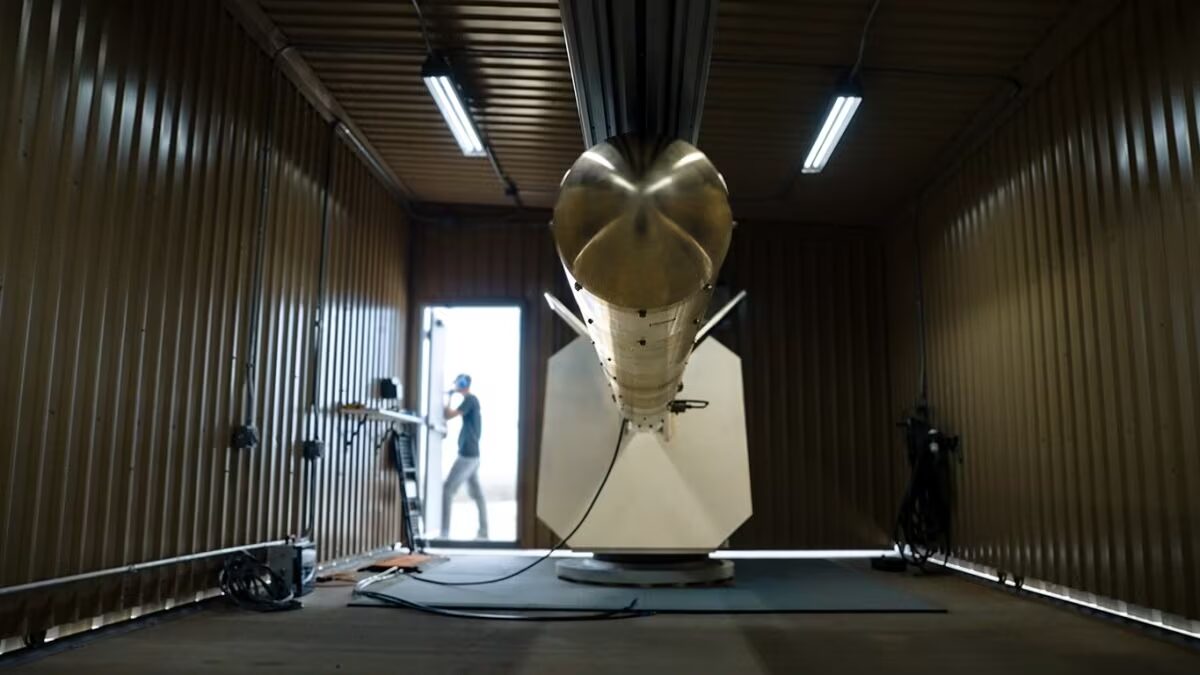
Venus Aerospace has secured $91 million in Series B funding to accelerate production of its rotating detonation rocket engines (RDRE)-a propulsion technology promising higher fuel efficiency for hypersonic and space vehicles. This fresh capital arrived just after the company completed the first-ever US flight test of an RDRE-powered craft in May, marking a major milestone in rocket engine development.
Leading the funding round was Mercury Fund, with participation from Lockheed Martin Ventures and other existing and new partners. Venus plans to invest the capital into engine design refinement, testing, and scaling up manufacturing capacity. The company envisions RDRE as a powerplant not only for hypersonic missiles but also for launch vehicles, orbital tugs, and lunar landers.
How rotating detonation rocket engine technology works
The core innovation in Venus’s engine is the use of a continuously rotating detonation wave inside the combustion chamber, rather than traditional steady-state burning. This method generates thrust more efficiently by producing higher specific impulse and lower fuel consumption in a more compact form factor. For hypersonic platforms, where weight savings directly translate to improved range, thermal management, and cost, these advantages are significant.
Venus is also betting on modern manufacturing techniques to speed up production. Their engines are built using components 3D-printed from industrial-grade materials, a strategy similar to approaches taken by companies like Relativity Space and Ursa Major. This additive manufacturing reduces development cycles from years to months by avoiding traditional tooling bottlenecks.
First successful rotating detonation rocket engine flight in the US
Venus’s recent flight tests took place at Spaceport America in New Mexico, firing an RDRE that produced about 2,000 pounds-force of thrust (approximately 8.9 kN). While RDREs have proven their capabilities on test stands for years, actual in-flight demonstrations remain rare worldwide, making Venus’s milestone a notable breakthrough.
The US aerospace sector has tracked detonation engine technology for over a decade, with NASA and the Air Force funding early research since the 2010s. Renewed hypersonic weapon programs and the push for lower-cost orbital launches have intensified this interest. Domestic startups like Ursa Major have built similar RDRE projects combining efficiency with scalable manufacturing, so Venus is entering a growing field rather than uncharted territory.
Moreover, the hypersonic arms race has matured beyond startups-defense giants like Lockheed Martin, Northrop Grumman, and Raytheon Technologies increasingly drive their own programs. According to Fortune Business Insights, the global hypersonic systems market is already worth several billion dollars and could multiply by the early 2030s. Against this backdrop, a fuel-saving, easily producible engine technology like RDRE is positioned to move from experimental gadget to critical supply chain component.
Government backing and industry support for rotating detonation engines
Venus Aerospace has attracted both private investors and government funding since 2020. Notably, the Texas Space Commission awarded the company $3.9 million to build a test facility in Houston. The appointment of Pamela Melroy, former NASA deputy administrator, to Venus’s board further signals deepening connections to federal agencies. This blend of infrastructure, political clout, and funding lays groundwork often absent in small aerospace startups attempting to scale prototype engines to flight-ready hardware.
Now the critical challenges for Venus are proving the engine’s durability, thrust control, and reproducibility in manufacturing. Many well-funded rocket programs have stumbled at this phase. If Venus manages a steady cadence of flight tests and reliable engine builds over the next 12 to 24 months, it could transition from research projects to major defense and space contracts, where budgets run into tens or hundreds of millions instead of single-digit millions.
Venus Aerospace’s journey highlights the growing momentum behind rotating detonation rocket engines as a potential new standard for propulsion in hypersonic and space applications. Success here could disrupt the current dominance of conventional rocket motors by offering lighter, more efficient, and scalable alternatives. The coming years will reveal whether RDRE can turn from a laboratory oddity into a commercial and military staple.