

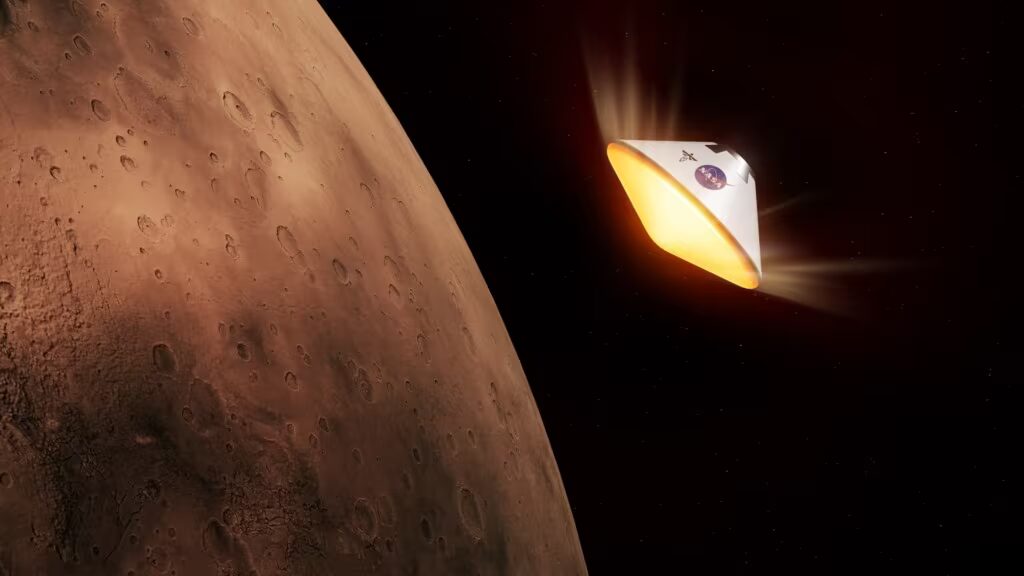
Firefly Aerospace has secured a $13 million subcontract from NASA’s Jet Propulsion Laboratory (JPL) to develop a specialized aerodynamic shell for the upcoming SkyFall mission, set to launch at the end of 2028. The mission aims to deploy three helicopters into the Martian atmosphere simultaneously-a significant scale-up from past rotorcraft demonstrations. Firefly’s job is to design, test, and deliver a heat and protective shield sturdy enough to survive launch from Earth, interplanetary travel, and the turbulent descent into Mars’ atmosphere.
This aerodynamic shell comprises two major components: a rear protective shield and a heat shield. Fabrication will take place in Firefly’s new Gloworks lab, with assembly and final tuning handled at their Rocket Ranch facility in Briggs, Texas. After production, Firefly will conduct durability and flight-readiness tests before handing over the shell to JPL for environmental validation and integration with the helicopter payloads.
Unlike typical Mars landers that touch down as a single unit, the SkyFall capsule is designed to release the three helicopters mid-descent. Each rotorcraft then touches down independently and begins the mission: conducting high-resolution aerial imaging and radar mapping to probe subsurface structures, including potential water ice deposits. This approach could change how scientists scout landing sites and resource deposits in future Mars exploration efforts.
Development of the Mars atmospheric entry shell for SkyFall
The concept of Mars helicopters has evolved dramatically since NASA’s Ingenuity rotorcraft first flew nearly three years ago. Originally planned for just five test flights alongside the Perseverance rover, Ingenuity exceeded expectations by completing 72 flights, proving its worth as a practical tool for Martian science and navigation rather than just a flashy demo.
SkyFall builds on that legacy but significantly amps up the ambition. Instead of a single helicopter proving the technology, NASA plans to field three helicopters simultaneously, each outfitted with ground-penetrating radar-adding a layer of subsurface exploration that aerial orbiters like Mars Reconnaissance Orbiter can’t match in detail. Airborne reconnaissance on Mars promises precise mapping of water ice deposits essential for sustained human presence.
Firefly Aerospace’s role in Mars helicopter deployment
Firefly isn’t new to advanced planetary missions. The company’s Blue Ghost lunar lander successfully touched down on the Moon in spring 2025 under NASA’s Commercial Lunar Payload Services (CLPS) program, landing it squarely among a select group of commercial operators that have mastered soft landings. This contrasts with peers like Astrobotic, whose Peregrine mission failed due to a fuel leak, and Intuitive Machines, which faced operational limits after the IM-1 lunar landing.
Leveraging its lunar experience, Firefly is ramping up production capacity in central Texas, expanding cleanrooms to deliver multiple landers and orbiters annually. The company is deeply embedded in NASA’s Artemis program via several lunar missions such as MoonFall, which will deliver four drones to the Moon’s south pole with its Elytra platform. This solid contract portfolio shows Firefly’s transition from a niche startup to a multi-mission supplier favored by NASA.
For NASA, awarding separate spacecraft components and delivery systems to private contractors like Firefly is part of a broader shift. Instead of building all mission elements within a single agency or prime contractor, NASA increasingly parcelizes complex missions into smaller packages for commercial providers-a practice well established on lunar missions under CLPS and now extending to Mars exploration.
If all goes to plan, the SkyFall mission will become the first attempt to deliver and deploy three rotorcraft on Mars simultaneously. The success hinges not just on the helicopters themselves but also on Firefly’s aerodynamic shell surviving the punishing phases of Earth launch, deep space cruise, atmospheric entry, and deployment. For Firefly, this $13 million contract cements its role in NASA’s evolving spacecraft delivery ecosystem. For the space agency, it tests a modular approach to Mars exploration that could scale future missions for aerial scouting and deeper planetary insight.