

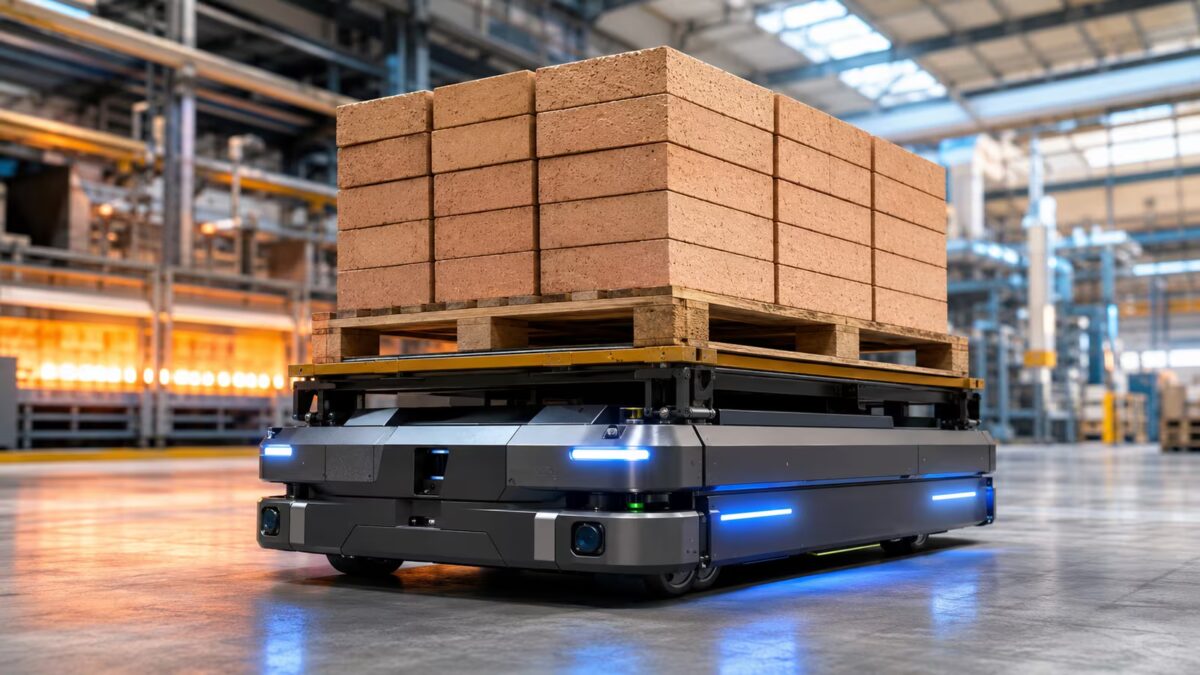
Researchers at South Ural State University have proposed swapping manual haulage for autonomous mobile robots (AMRs) at refractory industry factories. The plan is to use robots to transport heavy pallets of bricks and bulk materials in harsh environments-where dust, heat, and costly mistakes are constant challenges. A pilot system is already running at a test facility, with plans to scale it up through a digital twin of the Magnezit production complex.
Unlike traditional automated guided vehicles (AGVs) that follow fixed tracks, these AMRs navigate autonomously and can reroute themselves via updated digital maps-no factory floor redesign required. This flexibility is important for busy plants that can’t afford downtime just to switch up logistics.
South Ural State set strict specs for the robots to thrive in refractory plant conditions, where heavy loads meet dusty air and long shifts:
- Load capacity up to 1.5 tons
- Dust and moisture protection rated at least IP54
- Positioning accuracy within 10 mm
- At least eight hours of autonomous operation per shift
For the typical route between pressing shops and drying chambers, researchers estimate six robotic platforms will suffice. Payback for the base case is projected at nine years. However, trimming equipment downtime, reducing product damage, and redeploying workers from hauling to higher-value tasks could reduce this to six or seven years.
This effort fits into a broader industrial shift towards automation. According to the International Federation of Robotics, over four million industrial robots operate globally today. Warehouses and factories increasingly favor mobile robots for internal logistics over fixed automation systems. In Russia, this also helps address labor shortages, especially for dangerous or physically demanding roles.
The project’s next phase pairs robotics with a digital twin of the Magnezit facility. By building a 3D model of the factory, planners can simulate routes, bottlenecks, and load scenarios in a virtual environment before rolling out changes on the floor. This reduces startup risks, avoids costly midstream alterations, and ensures stable throughput-not just raw speed.