

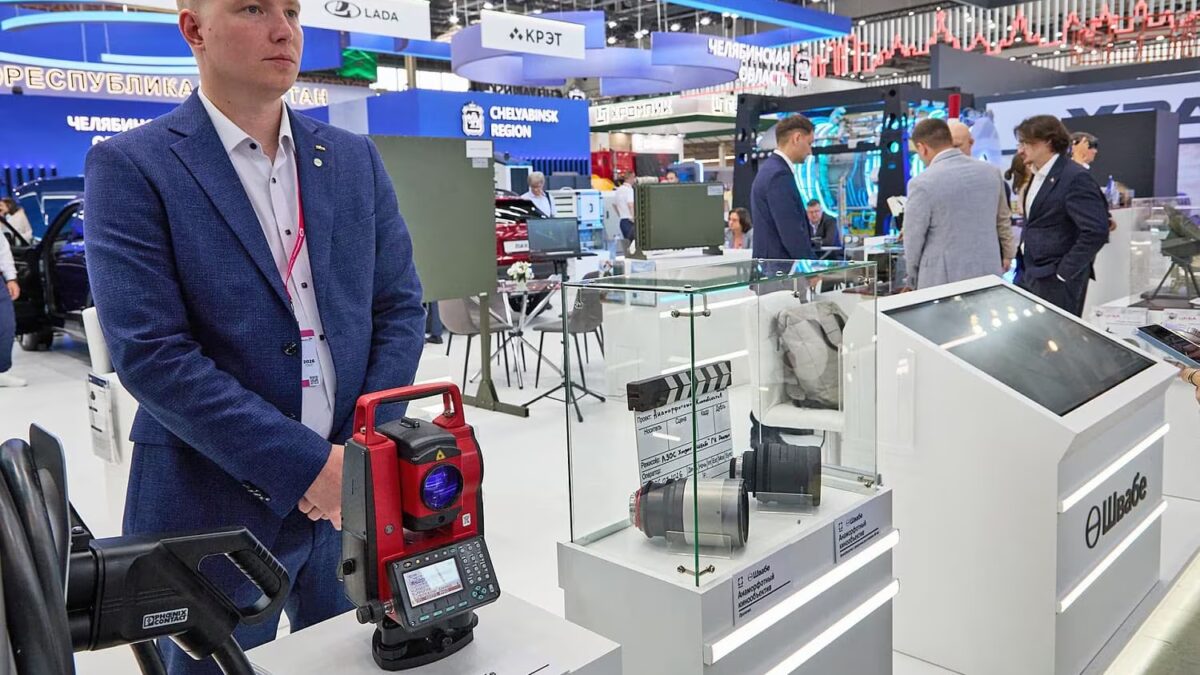
Russian optics giant Shvabe showcased three devices at the INNOPROM industrial expo in Yekaterinburg, aiming to replace imported measurement tools where precision directly impacts cost and timelines. The highlights included an astronomically accurate profilometer, a revamped stereoscopic microscope, and a theodolite offering angular measurements precise to one arcsecond.
Profilometer measures surface imperfections thinner than a human hair
The standout innovation is a profilometer developed by the Lytkarino Optical Glass Plant in collaboration with Bauman Moscow State Technical University. This device detects surface irregularities smaller than the thickness of a human hair, evaluating microscopic textures on telescope mirrors and space-grade lenses. Globally, only a handful of companies produce such equipment for optical components exceeding 0.25 meters in diameter. Quality at this level directly affects the resolution of Earth imagery from space and the precision of astronomical observations.
Upgraded stereoscopic microscope designed for labs and restoration experts
The second product aims at a broader audience: an updated stereoscopic microscope from LZOS that offers sharp contrast images without noticeable color or geometric distortion. Marketed to laboratories, restoration experts, and jewelers, mass production has already started with plans to produce several dozen units by the end of 2025.
Shvabe’s theodolite offers first Russian domestic option with one-arcsecond precision
The third device is the 6Ta1 theodolite from the Ural Optical and Mechanical Plant, capable of measuring angles with an error margin of just one arcsecond (1/3600 of a degree). This marks a first for the Russian market, as previously this class of highly accurate theodolites was dominated by Leica Geosystems, Topcon, and Trimble. Since 2023, 345 units of the 6Ta series have been deployed across Central Russia, the Urals, and the Far East, signaling growing trust in a domestic alternative for construction and geodesy.
Within Russia’s defense and industrial sectors, the demand for homegrown optics and measurement solutions is rising sharply as Western suppliers retreat amid geopolitical shifts. Shvabe’s presentation at INNOPROM isn’t a one-off showcase but part of a strategic push under Rostec’s umbrella to deepen local manufacturing. As the Russian market for surveying and industrial tools evolves, 2025 will be a key year to see if these devices move beyond pilot phases and gain mass production.
For comparison, while Western firms like Leica and Trimble have set high benchmarks in surveying precision, Russia’s push for indigenous equipment reflects broader attempts to reduce import dependency and sustain critical infrastructure projects amid sanctions. How quickly Shvabe’s instruments can match or exceed their international counterparts will influence their adoption beyond military and state sectors into civilian markets.
Looking ahead, the micro-profile measurement capabilities of the profilometer could impact space optics development, while the one-arcsecond theodolite may shift surveying practices across Russia’s vast and challenging terrain. The full rollout of these tools might reveal whether Russian high-precision instrument manufacturing can reclaim lost ground in global standards.