

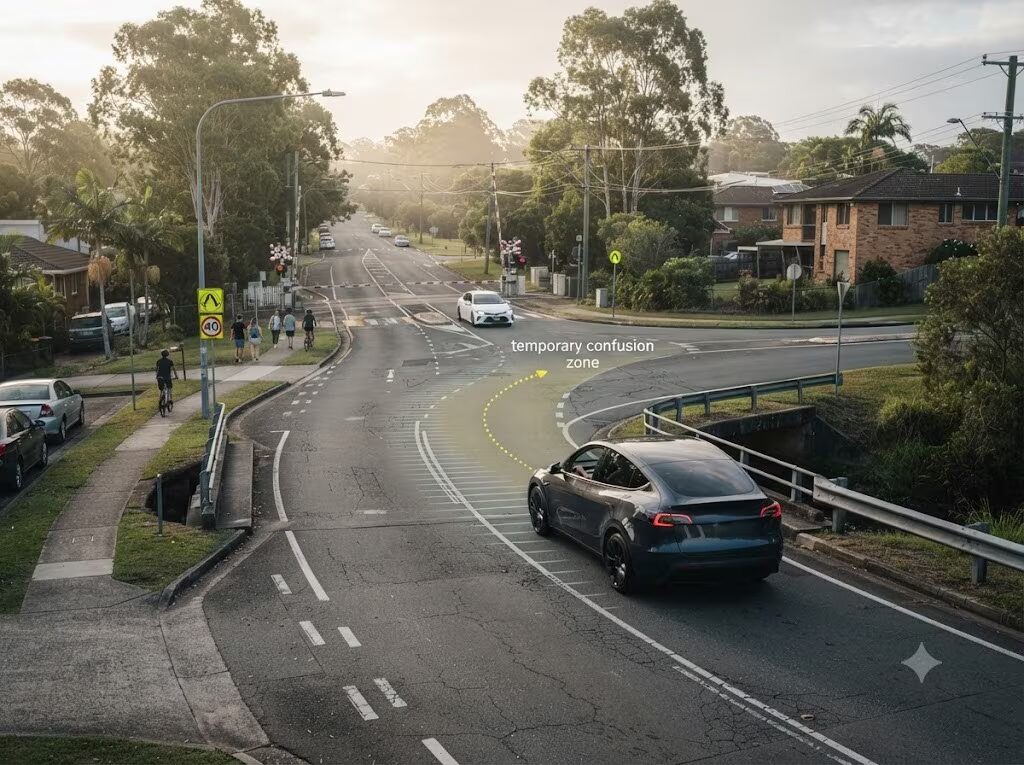
Tesla’s Full Self-Driving (FSD) system logged over 500 critical intervention-worthy errors in just 100 days of real-world testing across Queensland’s ordinary streets. Not a single trip went fully hands-free, exposing a major hurdle for driver-assist technology: even advanced autopilots struggle with everyday driving scenarios, not just rare edge cases.
The tests used a Tesla Model Y equipped with FSD, operated under normal traffic conditions and documented in the public White Box Autonomy archive. Despite high-profile promises of an imminent ”ChatGPT moment” for autonomous vehicles, Tesla’s system often wavered, hesitating in common situations that human drivers handle instinctively.
Tesla Full Self-Driving struggles with routine road conditions
One glaring example was navigating a small residential bridge, where the car drifted within its lane and made uncertain steering adjustments. For a human driver, this is a mundane task, but for Tesla FSD, the environment remains ambiguous, even without complicating factors like rain or fog.
The biggest failures weren’t rare edge cases-often cited by the industry as excuses-but everyday patterns. For instance, Tesla’s FSD frequently got confused around school zones with temporary speed limits, requiring intervention in over 90% of these scenarios. The system sometimes maintained ”school mode” well after hours or misread the road segment entirely.
Railroad crossings were another challenge. In one instance, the Tesla stopped too close behind a leading car, risking a halt directly on the tracks. The human driver had to immediately take control. Similar difficulties occurred during zipper merges, where informal driver behaviors and unwritten rules play a major role-factors hard for AI to decode solely from signs and markings.
Tesla’s weaker points also included roundabouts, narrow streets packed with parked cars, poor road markings, and identifying road users. The system occasionally labeled electric scooters as pedestrians. Bad weather further degraded performance as cameras and algorithms struggled to detect lane borders and road paint. Australia’s mix of highways, suburban streets, and varying pavement quality creates a tough proving ground.
Why Australian roads challenge autonomous driving systems
The key takeaway from this research is that the bottleneck for autonomous driving isn’t just immature AI-it’s the fact that roads are built for human senses and judgment. People effortlessly read contextual cues, interpret gestures, and anticipate local driving habits. For a machine, this requires near-perfect conditions or vast data and computing power.
Back in the late 2010s, many companies hyped up the rapid arrival of full self-driving. Since then, timelines have slipped considerably. Cruise scaled back ambitions following accidents and regulatory clashes, pivoting to a limited robotaxi service. Waymo has taken a cautious, zone-restricted deployment approach. Tesla’s gambit-using cameras and machine learning broadly on public roads-is both bold and controversial.
Australia has emerged as a testing hotspot for autonomous technology. Tesla is already running FSD on real roads there, while Waymo is exploring robotaxi launches. Yet the local environment-including numerous roundabouts, temporary speed limits, complex suburban routes, and driving customs-doesn’t lend itself to impressive demos.
Improving software and infrastructure to enhance autonomous driving
The study’s authors urge a pragmatic approach that doesn’t rely solely on software breakthroughs. They advocate gradual steps, pairing smarter algorithms with infrastructure tweaks like clearer road markings, duplicated signage, better-organized intersections, and improved pavement conditions. These adjustments offer predictability without major street overhauls and benefit human and machine drivers alike.
This strategy also makes economic sense. Consultancy McKinsey projects the autonomous mobility and advanced driver-assistance systems (ADAS) market could reach hundreds of billions of dollars by the next decade. But widespread adoption depends as much on delivering safe miles requiring zero human intervention as it does on polished software. Australia’s test results underline this challenge starkly: zero fully hands-off trips in over three months.
Interestingly, these vehicles can still be valuable without true autonomy. They double as mobile sensors, collecting real-time data on road surface quality, faded markings, and traffic bottlenecks. However, before Teslas-and other self-driving cars-can smoothly navigate school zones, roundabouts, and railroad crossings solo, the industry faces the daunting task of gathering much more comprehensive on-road experience and moving beyond optimistic promises.