

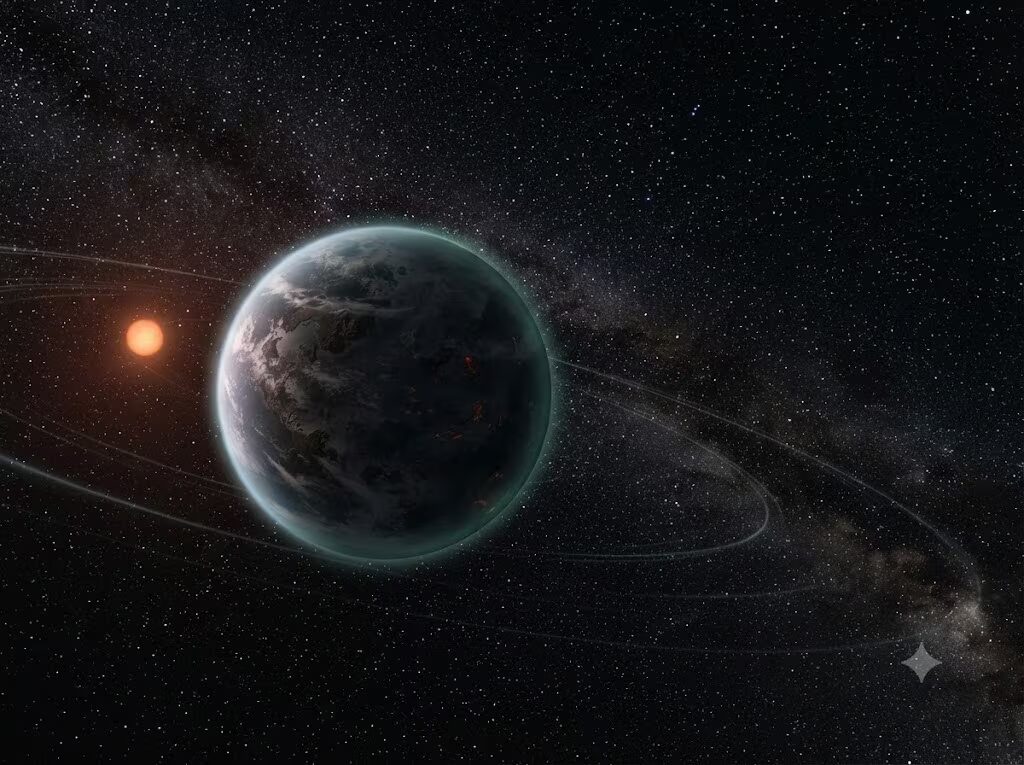
Astronomers have revised the mass and orbit of the exoplanet GJ 3378b, located about 25 light-years from Earth, revealing it to be much smaller and closer to Earth than previous estimates suggested. Instead of nearly five Earth masses, the new calculations peg it at roughly 2.3 Earth masses. Its orbital period has also been shortened from 25 days to around 21 days. These updates raise the chances that GJ 3378b is a rocky world rather than a mini-Neptune shrouded in a thick gas envelope, making it a more intriguing candidate in the search for potentially habitable planets.
GJ 3378b orbits a red dwarf star in the constellation Camelopardalis. Red dwarfs are the most common stars in the Milky Way, accounting for up to 70% of its stellar population, which is why exoplanet surveys focus heavily on these systems. However, red dwarfs are prone to stellar flares that can strip atmospheres from nearby planets, complicating their habitability prospects.
The updated data came from observations with the Hobby-Eberly Telescope in Texas, employing the Habitable-zone Planet Finder spectrograph. This infrared instrument excels at detecting subtle stellar ”wobbles” caused by orbiting planets around faint, cool stars-usually difficult targets for visible-light telescopes. By measuring these tiny shifts in the star’s velocity, astronomers calculate precise planetary masses and orbital characteristics using the radial velocity method.
The corrected orbital period has important implications for understanding GJ 3378b’s position within its star’s habitable zone. A 21-day year places the planet slightly closer to its star, refining estimates of surface conditions. Still, calling GJ 3378b a ”second Earth” is premature. Beyond orbit and mass, habitability depends heavily on atmospheric composition, radiation levels, and surface temperature.
To cross-validate their findings, astronomers combined data from NASA’s TESS and ESA’s Gaia missions with ground-based observations. This layered approach is now standard in exoplanet studies-similar methods have sharpened parameters for notable systems like TRAPPIST-1 and Proxima Centauri. With over 6,000 confirmed exoplanets cataloged by 2026, the field is shifting focus from just finding new planets to honing in on the most promising ones for detailed atmospheric analysis.
Thanks to these refinements, GJ 3378b now stands out as a particularly compelling target for next-generation telescopes. If future observations confirm its rocky nature and stable stellar environment, the system could join the shortlist of exoplanets prioritized for deep dives-not only to detect water vapor or carbon dioxide but also to hunt for biosignatures that could indicate life.