

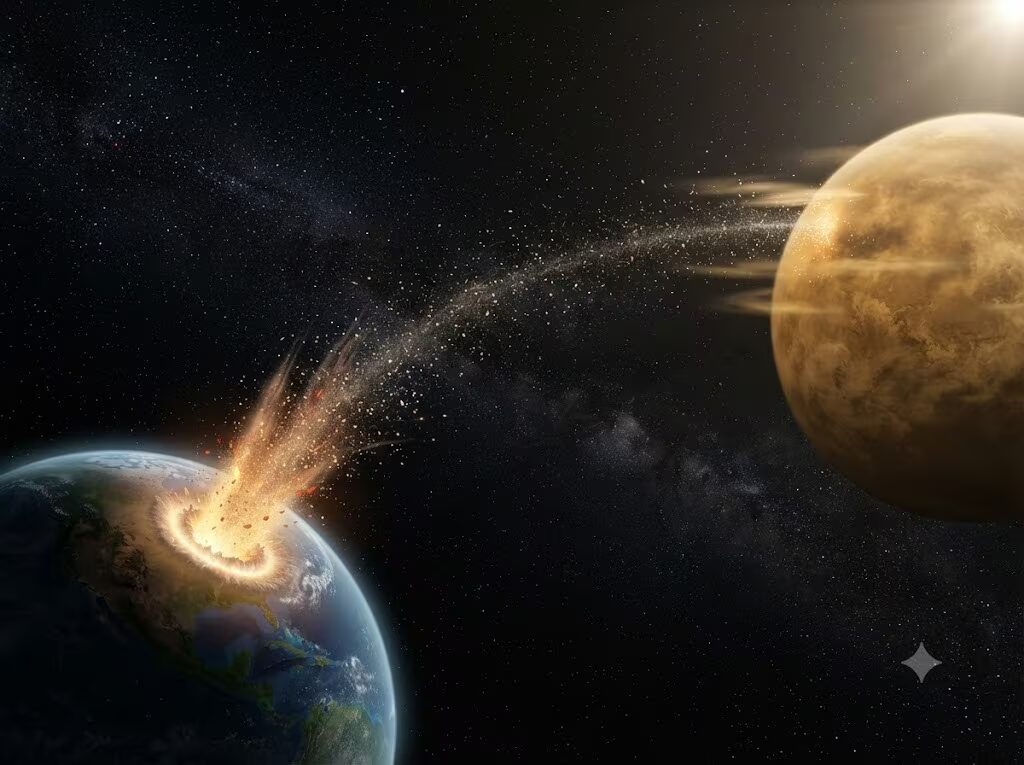
Scientists have modeled a bizarre cosmic route: tiny fragments blasted off Earth by large asteroid impacts might travel through space and lodge in Venus’s clouds. This isn’t evidence of life, but a possible transfer of material stretching back billions of years.
This research was unveiled at the 2026 Lunar and Planetary Science Conference by teams from Arizona State University, Johns Hopkins Applied Physics Laboratory, and Sandia National Laboratories. They investigate this scenario through the lens of panspermia-the hypothesis that life or its chemical building blocks can hitch a ride between planets aboard impact-ejected debris. While such studies typically focus on Earth and Mars (especially since meteorites from Mars have been found on Earth), Venus is increasingly drawing scientific attention.
To estimate the odds of Earth material making it to Venus, the researchers built on the ”Venus Life Equation” proposed by planetary scientist Noam Izenberg in 2021. This framework weighs three factors: whether life could have emerged, whether it could survive Venus’s harsh conditions, and how long habitable environments might have persisted there. The team also tackled the critical question of whether Earth ejecta can survive both the violent asteroid impact launch and entry through Venus’s dense atmosphere.
For atmospheric entry, they applied the ”pancake model,” which describes how meteoroids flatten, break apart, and spread into clouds of small debris when hitting a thick atmosphere. Their calculations suggest that some fragments can be tiny enough to never reach the surface, instead getting trapped in Venus’s upper clouds. These cloud layers have recently become a hotspot for astrobiologists searching for microbial-friendly environments-though so far without concrete evidence.
The final tally is striking: over the shared history of Earth and Venus, between 2 and 4 billion ”cellular-sized material fragments” could have accumulated in Venus’s clouds. That breaks down to roughly 100 particles per year, or about 20 billion in the last billion years alone. Even if most of this material perished en route, the surviving fraction remains significant by astrobiology standards.
Interest in Venus’s potential habitability is heating up alongside a fresh wave of missions. NASA’s DAVINCI probe and the European Space Agency’s EnVision orbiter are both slated to explore Venus’s atmosphere and surface in the coming years. The debate over possible life in Venus’s clouds reignited after a 2020 study claimed detection of phosphine-a potential biosignature gas-in Venus’s atmosphere. Although those findings faced heavy skepticism, the question of life on Venus is far from settled.
If upcoming missions do uncover biological markers, scientists will face the challenge of distinguishing native life from Earth-origin fragments potentially delivered by asteroid ejecta. This new study opens a Pandora’s box for astrobiologists: any signs of life or organic material discovered on Venus may partly originate from Earth. The prospect challenges our understanding of planetary boundaries and cross-planet contamination. Tracking the complex exchange of material between neighboring worlds could reshape how we interpret biosignatures and guide future exploration strategies.