


Google’s Nano Banana-also known as Gemini 2.5 Flash Image-has emerged over the past year as a leading AI model for image generation and editing. It excels at rewriting backgrounds from text prompts, rendering readable text on posters, and maintaining consistent character appearances across multiple frames. But for users in Russia, the main hurdle isn’t the model’s capabilities-it’s how to get around regional locks that block direct access to Gemini and Google AI Studio. Using VPNs can help, but also risks account bans triggered by Google’s strict security checks.
Google is juggling two challenges. First, it’s chasing OpenAI, which integrates image generation through ChatGPT and APIs, and Adobe, which bundles Firefly inside Photoshop and Express. Second, it needs to enforce strict payment and geographic controls. For Russian users, this means that even subtle mismatches between IP address, account region, and billing card can spark security lockdowns.
Capabilities of Nano Banana AI image model
”Nano Banana” is the unofficial name for a family of image models from Google that debuted in test environments before launching as Gemini 2.5 Flash Image. The line has since expanded: the basic version handles quick edits and simple scenes, the Pro model improves on rendering embedded text and following complex instructions, while Nano Banana 2 powers core Google tools like Gemini, Lens, and Flow.
What sets Nano Banana apart is its natural language editing. Instead of isolating sections or masking areas by hand, users just describe the desired change-whether swapping a background, changing a subject’s outfit, removing unwanted objects, or creating multiple stylistically consistent versions. The model retains dialogue context, allowing step-by-step refinements.
Its standout strength is how it handles text within images. Nano Banana Pro produces clear, readable text on posters, packaging, and infographics better than most competitors. This matters for marketing, where historically models like Midjourney struggled with lettering, and OpenAI only recently improved with GPT-4o iterations that cut errors in short phrases and titles.
Another highlight, particularly for Nano Banana 2, is consistent character retention across scenes. It can keep a subject’s face recognizable in office, street, and café shots-something early generators often failed at, forcing manual fixes frame by frame. This makes it a practical choice for comics, storyboards, and product narratives.

- Basic version is suited for quick edits and simple scenarios.
- Pro excels at complex instructions and rendering text inside images.
- Nano Banana 2 preserves appearances of up to five characters.
- Pro supports image resolutions up to 4K.
- All versions can edit photos using text prompts.
Limitations are typical of generative AI graphics: complicated lighting, photo stitching, and dense scenes with many objects can yield unnatural results. Infographics with numbers might look convincing despite factual errors. These issues aren’t unique to Google; Adobe’s Firefly and OpenAI’s models exhibit similar weaknesses.
For practical use, Nano Banana is a solid tool for marketing, e-commerce, and design prototypes. Sellers can create product images without photo shoots; marketing teams can localize posters into several languages without redesigning layouts. Old photos can be restored and colorized in one go, while rough covers or banners can be presented to clients before hiring a designer. Google adds SynthID, an invisible watermark, to mark AI-generated content for extra control.
According to Google’s prompt guidelines, quality depends heavily on defining six components: object, composition, action, environment, style, and technical parameters. The more precise these are, the less chance the AI will misinterpret the request.
Access restrictions and account risks for Russian users
Direct access to Nano Banana AI image model is blocked in Russia at the regional level-covering Gemini, Google AI Studio, and associated APIs. The obvious workaround is a VPN, but it significantly raises the risk of account suspension. Google’s security systems analyze the relationship between IP address, account location, login history, and billing card. Any suspicious mismatch triggers additional verification.
Three scenarios cause the most trouble:
- Paying for subscriptions or API credits while connected to a VPN.
- Switching geographic locations frequently within an active session.
- A sudden surge of requests from an unfamiliar IP linked to the account.
Outcomes can range from a repeat security check to temporary freezes or complete bans. Users risk losing paid credits if flagged.
Payment cards complicate things further. Google expects foreign billing that matches the user’s access region. Russian virtual cards and unconventional payment schemes often get flagged or rejected by risk systems. If IP, profile country, and payment method don’t align, the chance of manual or automated account reviews spikes.
- Don’t switch VPN countries on the day you make payments.
- Avoid logging in from many IPs within a short time frame.
- Keep personal Google accounts separate from test accounts involving risky payments.
- Don’t top up your balance through unknown intermediaries without track records.
Because of these risks, aggregator platforms that handle both access and billing are safer for Russian users. Instead of setting up a Google account, linking a foreign card, and using VPNs, customers can use a single interface that limits account blocks on Google’s end.
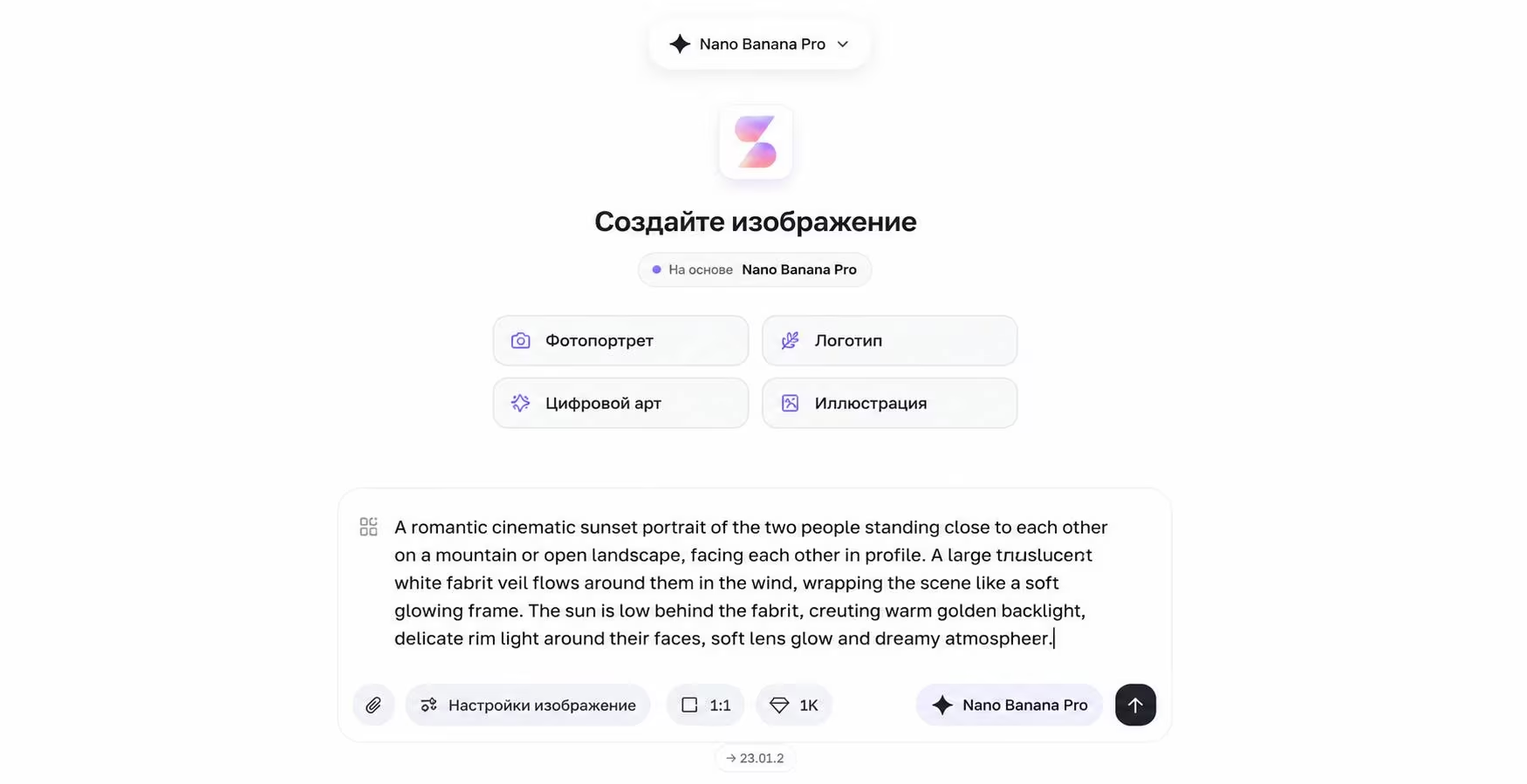
One example is SpeShu.AI, a Russian-language web portal offering Nano Banana access without VPN or foreign cards. Payments are in rubles, and users can switch easily among AI image generators like Seedream, FLUX, and Grok. SpeShu.AI also provides promo code HABRTSNIS15, adding 15% to top-up amounts.
Choosing between Nano Banana versions depends on the task. Basic Nano Banana and Nano Banana 2 cover most everyday and commercial edits, while Pro suits intricate prompts, embedded text-heavy images, and 4K resolution needs. No programming skills are needed when working through a web interface rather than direct API integration.
The legal side is murkier. Although Google embeds SynthID watermarks on AI-generated images, this doesn’t automatically solve copyright issues. Usage rules vary by country, hosting platform, and service terms. Advertisers and brands should verify both the image and licensing before publishing AI-generated content.
If Google keeps Gemini and AI Studio locked out of Russia, demand for third-party intermediaries providing Nano Banana access will only grow. This mirrors trends with other foreign AI services where users prioritize stable access, straightforward payments, and account security over the latest model versions.