

Stargate was sold as the kind of AI infrastructure project that would make smaller ambitions look quaint. Eighteen months after its splashy White House debut, the Stargate project is facing a harder question: can a $500 billion plan survive the realities of power, money, and decision-making long enough to become real?
The headline numbers are still enormous: up to 10 GW of new compute capacity and hundreds of billions of dollars for AI data centers, power systems, and supporting infrastructure in the US. But the bigger story is that Stargate is drifting from a single bold announcement into a scattered, higher-risk network of sites, partnerships, and local fights – exactly the sort of complexity that tends to slow mega-projects down.
From Texas flagship to wider rollout
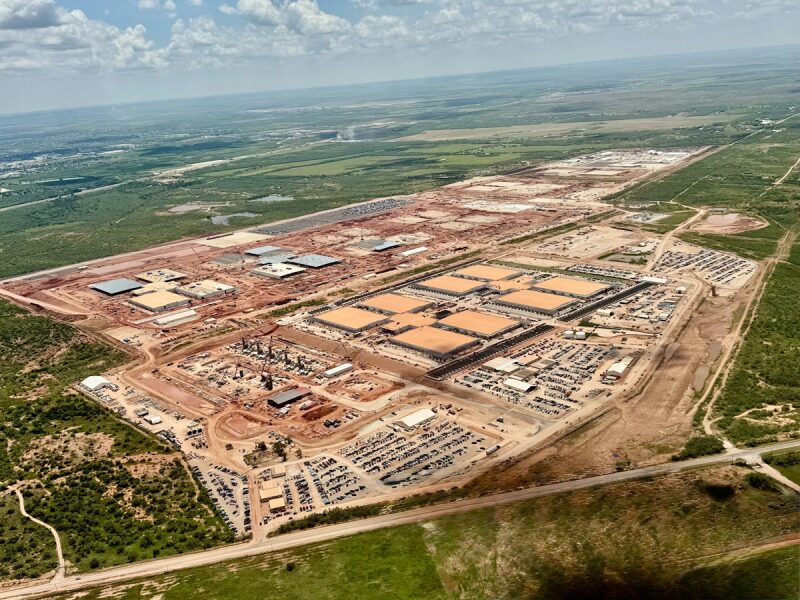
The project began in Texas, where the flagship campus in Abilene spans 445 ha and has moved faster than comparable hyperscale builds. Since then, new campuses have been announced in Wisconsin, Ohio, New Mexico, and elsewhere, while international plans have also appeared in the UAE and South Korea. The UK and Norway, however, have not gone as planned – a useful reminder that global expansion sounds easier in a press release than it does in zoning meetings.
That spread matters because Stargate is no longer just a construction story. It is becoming a test case for whether AI training campuses need their own energy strategy, including so-called ”behind-the-meter” generation, rather than just another box on a hyperscale site plan. In practice, that pushes the industry toward vertically integrated AI parks, which is a lot more complicated – and a lot less flexible – than renting space in a conventional data center.
The hard parts are the boring parts
The risks are exactly the ones that sink grand infrastructure dreams: power delivery, financing, governance disputes, delays, and public pushback. Stargate also has a problem that cloud operators did not face to the same degree: AI factories need confidence that demand will actually arrive at the scale promised, and forecasts for training and inference keep moving around.
- Planned capacity: up to 10 GW
- Flagship site: 445 ha in Abilene, Texas
- Named partners include OpenAI, SoftBank, Oracle, and MGX
- Supporting companies include NVIDIA, Microsoft, and Arm
That long partner list looks reassuring on paper because it spreads risk and helps with equipment supply, but it also creates more room for disagreement over ownership and control. The fact that expansion by OpenAI and Oracle has already been trimmed, while Microsoft’s involvement through Crusoe points to a broader use of the site, suggests the project is being quietly re-engineered as it goes.
Texas is helping, and complicating, the plan
Texas remains the project’s center of gravity, but it is also where political pressure is building fastest. Water use, grid strain, and permitting are drawing more scrutiny, with proposals to revisit tax breaks and approval rules. That means Stargate’s pace in the state may end up depending as much on regulators as on builders.
There is a reason investors like giant campuses: if the power and financing work, the scale can be efficient. But scaling fast without durable demand, stable governance, and reliable electricity is how you turn a moonshot into a very expensive cautionary tale. Stargate may still define the next phase of AI buildout – or it may become the example everyone cites when trillion-dollar enthusiasm runs into utility bills.