

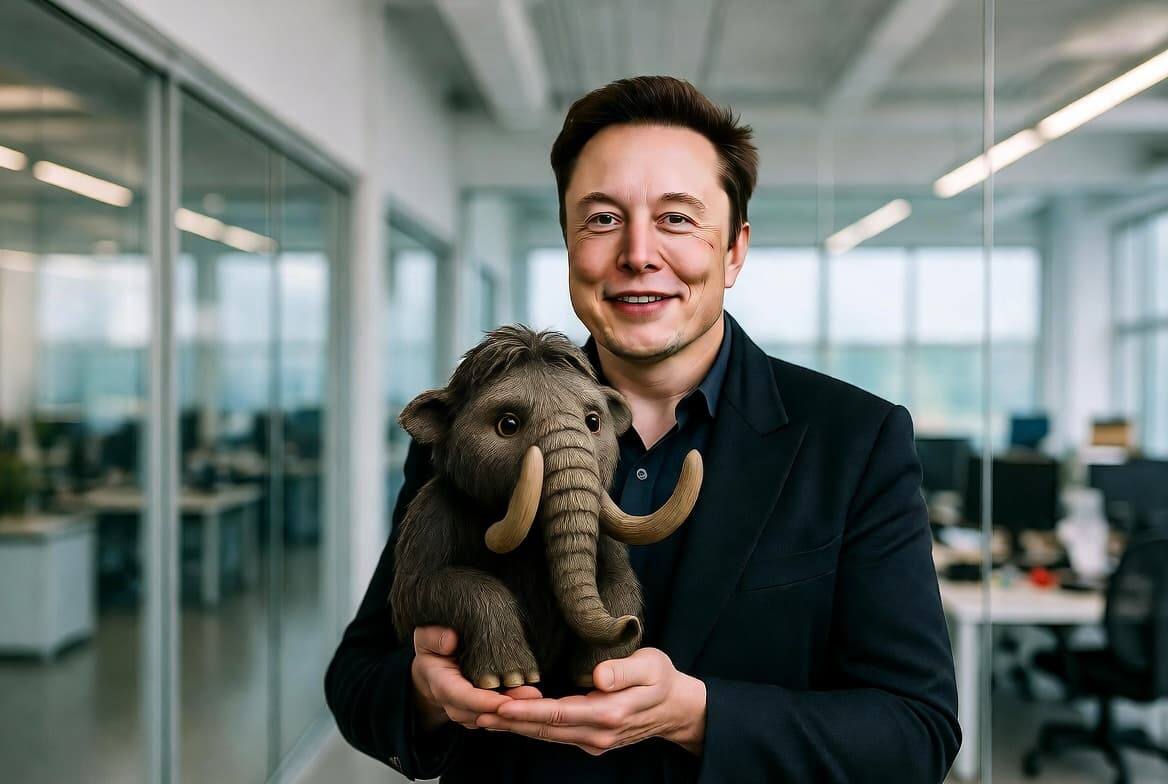
Elon Musk says he would happily keep a ”miniature woolly mammoth” as a pet, and the joke lands a little harder because Colossal Biosciences is already trying to build one. The company is editing Asian elephant DNA to give it mammoth-like traits, with the broader aim of producing hybrid calves by 2028.
The idea surfaced during a talk at the Abundance360 summit, where Peter Diamandis brought up Musk’s interest in the creature and said he would follow up with Colossal’s chief executive. Musk’s answer was pure Musk: enthusiastic, oddly specific, and exactly the sort of thing that makes biotech investors, ethicists, and zookeepers reach for different glasses of water.
What Colossal Biosciences is trying to build
Colossal is a private U.S. biotech and genetic engineering company built around ”de-extinction” – the idea of bringing back traits from extinct species and, in some cases, the species themselves. It was founded in 2021 by entrepreneur Ben Lamm and geneticist George Church, and is based in Dallas, Texas.
By the beginning of 2025, the startup’s valuation had reached 10.2 billion dollars, a figure that says as much about investor appetite as it does about the science. That kind of money buys a lot of lab time, and in this case it is being spent on a very old animal with a very modern gene-editing toolkit.
How the woolly mammoth project works
The company is modifying Asian elephant DNA to add mammoth traits such as thick fur and curved tusks. Its goal is to edit more than 20 genes and then begin an IVF program, with hybrid offspring expected by 2028.
- Base animal: Asian elephant
- Target traits: dense woolly coat, curved tusks
- Planned scope: more than 20 genes
- Next step: IVF program
- Goal: hybrid calves by 2028
A pet project with a very expensive shadow
There is a serious scientific wager hiding inside the meme-friendly pitch. If Colossal can reliably rewrite elephant biology, the company could move from headline-grabbing stunts to a platform that affects conservation work far beyond mammoths, which is probably the real prize here.
The open question is whether the miniature version is just Musk being Musk, or a preview of how quickly extreme bioengineering ideas get normalized once enough capital, celebrity, and lab equipment line up in the same room.