

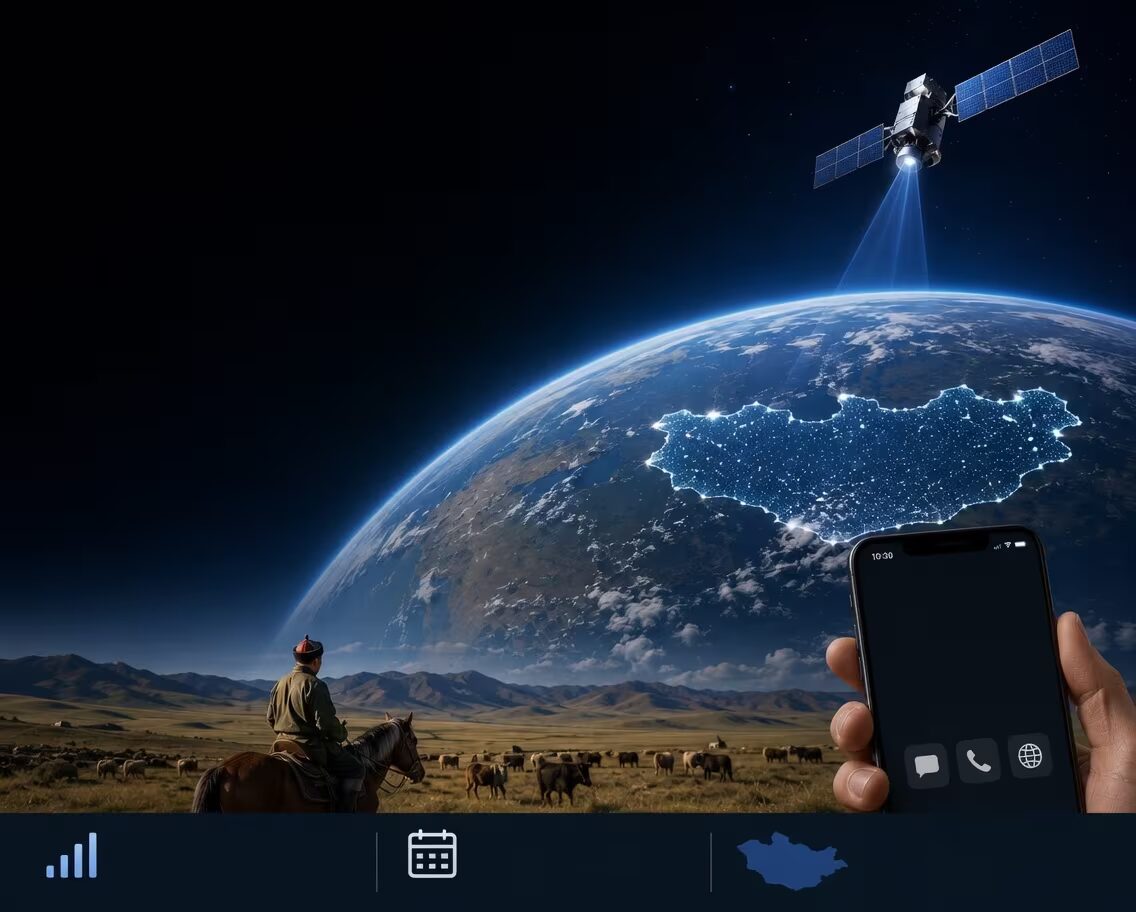
Starlink is rolling out its direct-to-smartphone satellite service in Mongolia through a partnership with local operator GMobile. The new offering aims to deliver mobile connectivity directly to standard smartphones in remote areas without cellular towers or reliable ground networks. For Mongolia-one of the world’s least densely populated countries-this could bring coverage to vast steppes and mountainous regions without the need to build costly infrastructure.
The technology works with regular smartphones and doesn’t require external antennas or specialized terminals. It’s designed not to replace existing cellular networks, but to provide basic mobile connectivity in ”dead zones.” Starlink targets rural residents, mining industry workers, herders, and field professionals operating in Mongolia’s most isolated spots.

Initial capabilities will focus on access to messaging apps and essential smartphone functions. Typically, satellite-to-phone services start with low-bandwidth messaging and gradually expand toward voice calls and more stable mobile internet. Starlink has yet to announce exact commercial launch dates or pricing for Mongolia.
Mongolia is a logical market for Starlink’s direct-to-smartphone service. According to World Bank data, its population stands at around 3.5 million, but the country’s vast territory is sparsely settled and extending terrestrial networks beyond major cities is expensive. In such scenarios, satellite connectivity succeeds less on speed and more on availability-offering signal where no other options exist.
Direct-to-smartphone satellite services have moved beyond pilot phases. In the US, Starlink partners with T-Mobile to deliver such coverage, Apple offers emergency satellite connectivity on iPhone via Globalstar, and AST SpaceMobile is testing direct-to-phone links with Vodafone and AT&T. The competition here isn’t just for subscribers but also for partnerships with mobile operators who control spectrum licenses, billing systems, and retail.
If Starlink’s launch in Mongolia proceeds without device restrictions or service issues, it will provide a valuable proof point for satellite-to-phone connectivity outside the US. This development is important for vast, underserved regions in Central Asia, Africa, and Australia, where building a single cellular base station often costs more than the revenue generated from local traffic.