

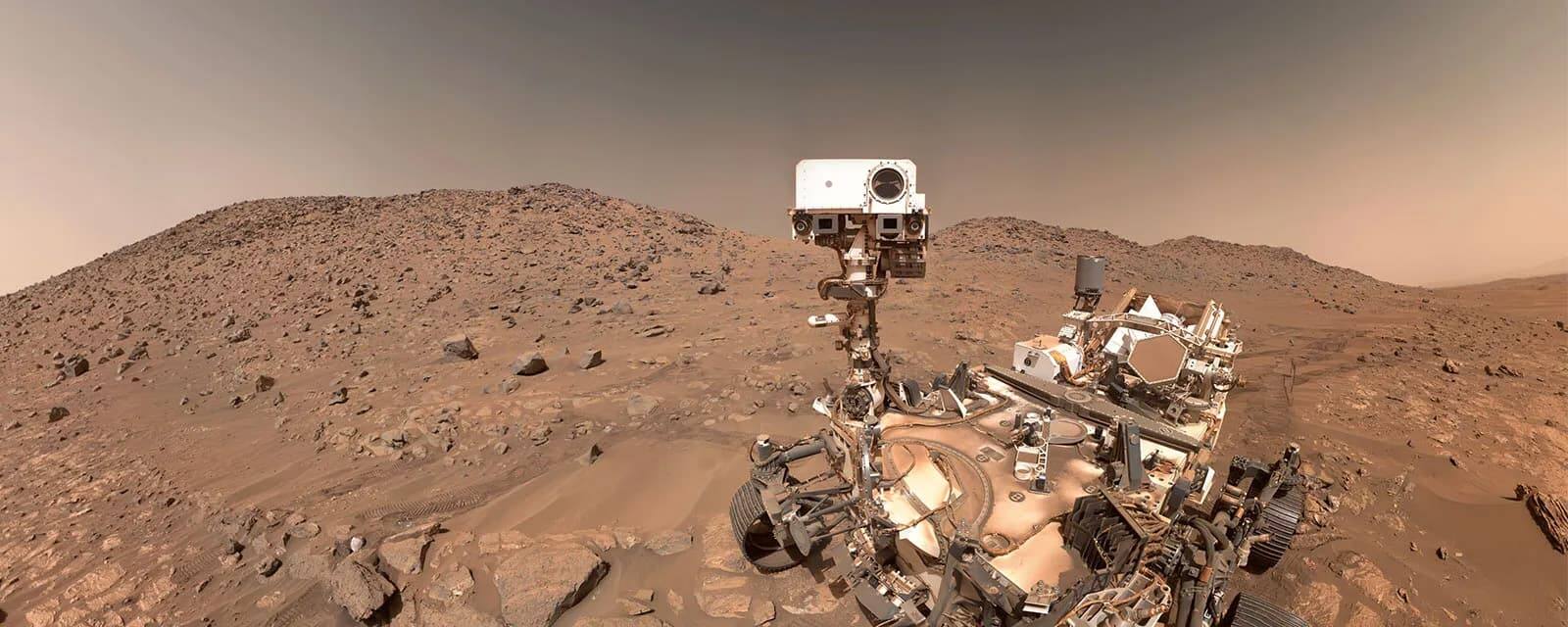
NASA’s Perseverance rover has found complex organic molecules in two patches of ancient shale in Jezero crater, adding another piece to the long-running question of whether Mars once had the chemistry needed for life. The new study, published in Science Advances, suggests that organic compounds can survive on the planet’s surface for very long periods, even in rock that has spent ages out in the open.
The find comes from the western side of Jezero, in the Neretva region, where an ancient lake and river delta existed billions of years ago. Perseverance is not just wandering around for the scenery; it has been repeatedly sampling one of the most promising habitats ever examined on Mars, and every new detection raises the value of that crater floor as a target for future return missions.
What SHERLOC found in the shale
Using the SHERLOC spectrometer, scientists examined hundreds of points across the rock surface and reported complex organic compounds, large carbon macromolecules, and organic material preserved both in well-kept layers and in rock that had been exposed to the environment for a long time. The important part is not just that organics were present, but that they showed up across multiple samples rather than in a single lucky spot.
The team says it still cannot tell whether the material came from non-biological chemistry or from ancient life. That uncertainty is the whole story, of course: organic chemistry is not proof of biology, but on Mars it is exactly the kind of breadcrumb scientists have been hunting for.
Why Jezero crater keeps paying off
Jezero keeps looking better because it was once a lake-fed environment, and watery sediments are among the best places to trap and preserve chemical traces. NASA picked the crater for that reason, and the rover’s latest result reinforces the idea that some Martian rocks can protect complex molecules far longer than researchers once assumed.
There is also a useful bit of corroboration here. Curiosity found organics in another part of Mars more than 3,000 kilometres away from Jezero, hinting that this may be a planet-wide story rather than a local oddity.
What the next sample hunt could answer
The big unanswered question is still origin, not presence. If the organics turn out to be widespread across different terrains, the case strengthens for Mars having once supported a chemistry that could have been favourable to life, even if the actual biological proof remains out of reach for now.
That is why Perseverance’s cache of samples matters so much. The rover is building a dossier, not just taking snapshots, and the next major leap will come only when those rocks are studied back on Earth, where scientists can squeeze a lot more out of them than a rover ever could.