

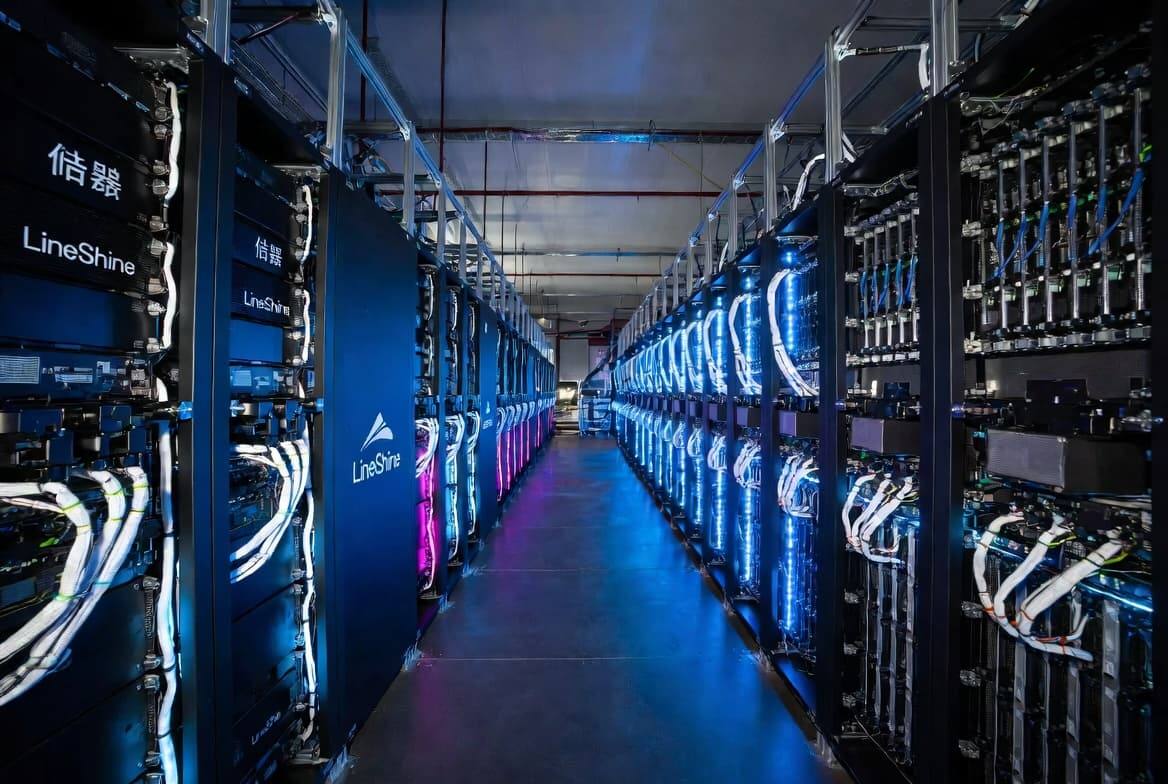
China is back at the top of the supercomputing pile. At the ISC 2026 conference in Hamburg, Germany, the latest TOP500 list named Lingsheng the world’s fastest supercomputer, with a measured performance of 2.19 exaflops. That ends a nine-year stretch without a Chinese system holding first place, and it lands at a moment when raw compute has become a geopolitical sport as much as a technical one.
The headline number is impressive enough, but the engineering behind it is the real flex. Lingsheng is a new-generation supercomputer built by the National Supercomputing Center in Shenzhen, and it reportedly uses about 47,000 Chinese multicore processors. It also runs with liquid cooling, which is exactly what you need when a machine is burning through 42.22 MW and nobody wants the server room to double as a sauna.
Lingsheng’s hardware profile
For readers who want the snapshot version, here it is:
- Performance: 2.19 exaflops
- Processors: about 47,000 Chinese multicore chips
- Power consumption: 42.22 MW
- Cooling: liquid cooling
- Storage: 428 nodes
- Total storage capacity: 650 PB
- Storage bandwidth: 10 TB/s
Those storage figures matter because top-end supercomputing is no longer just about flops. The systems that dominate now have to feed enormous datasets fast enough to keep the compute units busy, which is why the race increasingly looks like a contest between memory, networking, cooling, and power delivery as much as chips themselves.
A return to the top after nine years
China’s return to first place is also a reminder that the TOP500 list is more than a scoreboard. It tracks a field where national investment, domestic chip design, and infrastructure know-how all collide, and where leadership tends to swing whenever a country decides to pour enough money and industrial muscle into the problem. For the rest of the pack, that usually means more pressure to chase efficiency, not just bragging rights.
The timing is awkward for rivals that have spent years pushing exascale systems of their own. The United States still has formidable entries on the list, and Japan and Europe have kept building serious machines, but Lingsheng shows that China is again willing to play at the very top end rather than merely filling out the rankings. The next question is whether this is a one-off leap or the start of a new run of Chinese systems near the top of TOP500.