

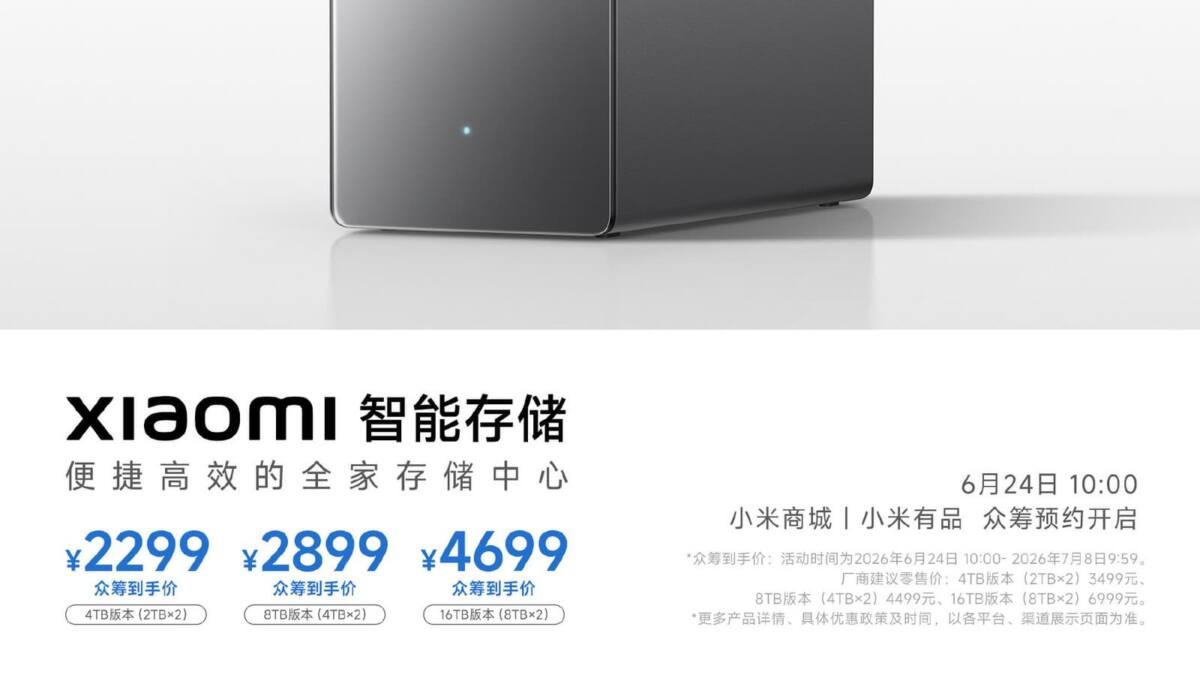
Xiaomi has finally stepped into the NAS market with Xiaomi Smart Storage, a home storage box meant to sit at the center of its device ecosystem rather than just swallow files in a corner of the network. The company has opened preorders through Xiaomi Mall and Xiaomi Youpin, and the pitch is straightforward: make shared storage feel less like a hobby project and more like part of the Xiaomi stack.
The pricing starts at 340 dollars, with higher-capacity versions available for 425 dollars and 690 dollars. That puts Xiaomi in familiar territory: not cheap enough to be impulse-buy hardware, but not so expensive that it instantly plays in the enterprise sandbox.
NAS devices have long been dominated by Synology, QNAP, and Western Digital, while consumer brands mostly stayed on the sidelines or treated network storage as an afterthought. Xiaomi is betting there’s room for a simpler, ecosystem-driven alternative, especially for households already using its phones, TVs, and smart home gear.
Xiaomi Smart Storage prices
The pricing is split into three configurations:
- 4 TB: 340 dollars
- 8 TB: 425 dollars
- 16 TB: 690 dollars
That puts Xiaomi in familiar territory: not cheap enough to be impulse-buy hardware, but not so expensive that it instantly plays in the enterprise sandbox. The real test will be whether the software feels polished enough to justify buying into yet another closed ecosystem.
What Xiaomi Smart Storage is for
Xiaomi describes Smart Storage as a centralized home data store designed to make file access easier across its own ecosystem. In practical terms, that means the product is being framed less as a traditional NAS for tinkering power users and more as a shared vault for households that already live inside Xiaomi’s world.
That approach is smart, because the average buyer does not dream about RAID levels or backup rules. They want photos, videos, and documents to show up everywhere without a scavenger hunt. If Xiaomi can make that friction disappear, it has a real shot at turning a niche category into a mainstream appliance.
The challenge for Xiaomi Smart Storage
The hard part is not announcing a NAS. It is convincing people to trust Xiaomi with their data while also delivering enough app support, privacy controls, and speed to stand up against brands that have been refining this category for years. With storage hardware, the box is only half the product; the software experience decides whether the thing gets used or quietly becomes an expensive shelf ornament.
Still, Xiaomi’s move makes sense. As smart homes get denser and cloud storage keeps getting pricier, home NAS devices are due for another push, and Xiaomi is trying to make that push from inside its own ecosystem rather than as a pure storage vendor.