

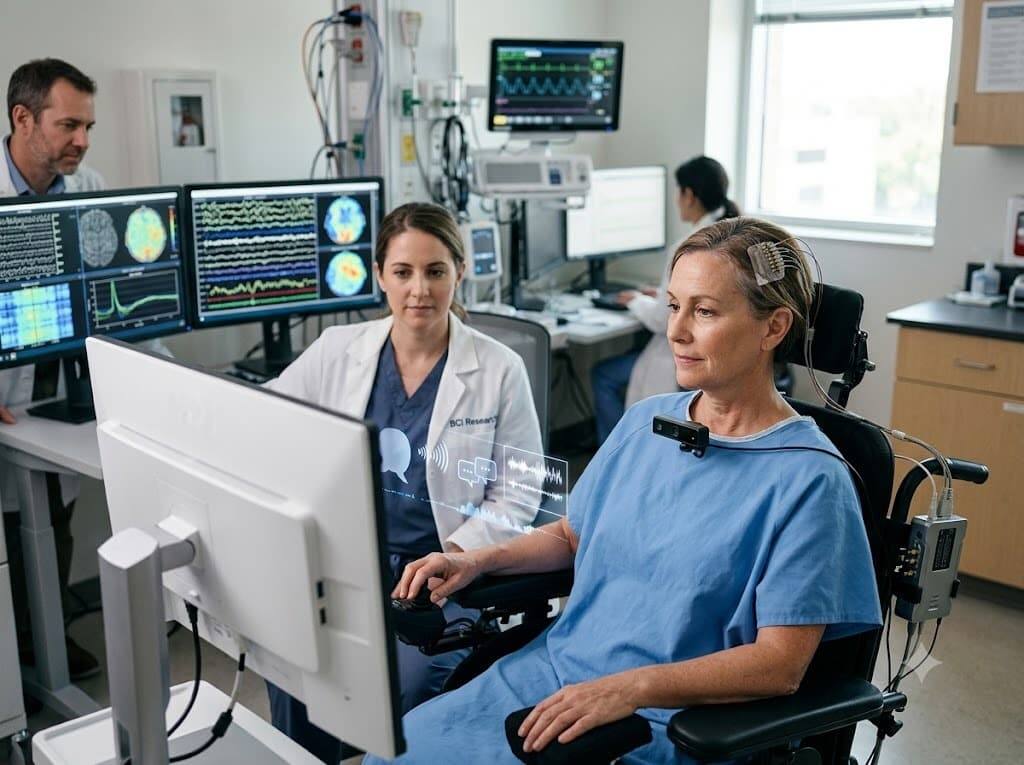
Brain-computer interfaces are no longer just a sci-fi flex for conference stages and lab videos. In the US and China, the number of people with implanted brain electrodes has more than doubled over the past two years, reaching roughly 150 by researchers’ estimates, as BCI systems move from isolated experiments toward limited but real medical use.
The clearest sign of that shift is simple: these devices are starting to be used every day, not just tested once. For patients who have lost speech or movement, that means the difference between a proof of concept and a tool that can help them talk, work, and deal with digital services again.
Casey Harrell and the new BCI use case
One of the best-known examples is Casey Harrell, who has amyotrophic lateral sclerosis. He became one of the first active users of an implant developed in research at the University of California, and the system lets him ”speak” despite paralysis and the loss of his natural voice.
The setup is fairly elegant, if unsettling in the way all good medical tech is: electrodes in the brain capture signals linked to attempted speech, software converts them into phonemes, and a synthesized voice comes out the other end. Eye-tracking is used alongside it to sharpen and correct messages, while the system also includes privacy modes, speech filters, and protection against accidental profanity.
Neuralink, Synchron and China’s first approval
The field is getting crowded. Neuralink, Synchron, Precision Neuroscience and China’s Neuracle are all pushing ahead, and clinical programs expanded in 2024-2025. China has already granted the first approval for medical use of these kinds of systems, a sign that regulators are no longer treating BCI as a pure research curiosity.
That matters because the race is not just about who can read the cleanest signal. It is also about who can make an implant safe enough, durable enough, and simple enough for actual patients, which is where a lot of flashy neurotech goes to die.
How invasive brain-computer interfaces differ
- Fully implanted systems place electrodes inside the brain and can capture the most precise signals.
- Less invasive systems sit on the surface of the cortex and trade some accuracy for lower medical risk.
- External sensors avoid surgery altogether, but they are generally less capable.
That trade-off is the whole story. The closer the hardware gets to neurons, the better the signal, but the higher the surgical and long-term risk. The core use today is still communication recovery for people with paralysis, especially after spinal cord injury or neurodegenerative disease.
The problems no demo can hide
Even with the progress, the big unanswered questions are stubborn ones: how long these implants keep working, why some stop functioning over time, and what happens when a device that looks brilliant in trials has to survive years inside a human brain. That is the real filter between a medical breakthrough and another expensive prototype.
The next phase is likely to be less glamorous and more important. Expect more patients, tighter regulation, and a slow grind toward reliability, because the first real winners in BCI will be the systems that keep working after the headlines fade.