

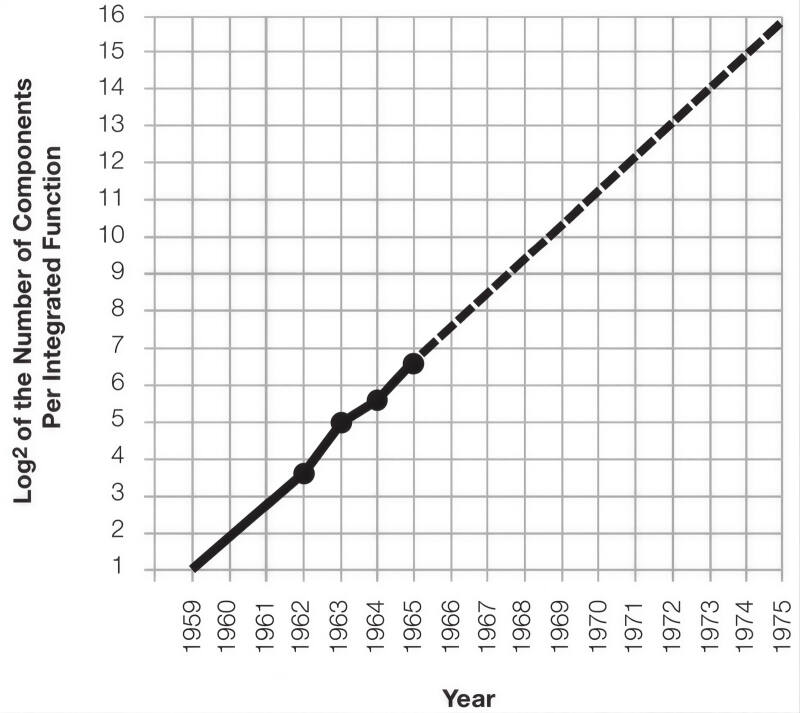
Moore’s law has been declared dead so many times it ought to have a tombstone and a reboot button. Yet the semiconductor industry keeps dragging it back to life with three increasingly elaborate successors: More Moore, More than Moore, and Beyond Moore. The reason is simple enough: even if the original transistor-doubling rule has long stopped being a clean forecast, the business model it created is still too useful to abandon.
That model once gave chipmakers, software vendors, and buyers of computers the same comforting promise: faster hardware would arrive on a predictable schedule, and everyone could plan around it. That predictability helped turn an engineering observation into an industrial metronome. It also helped create the habit of expecting software to get bigger, heavier, and less disciplined every time the silicon underneath it improved.
Why the industry still wants Moore’s law
The appeal of Moore’s law was never just technical. It was economic. If a chip with more transistors cost roughly the same to make as its predecessor, buyers got more performance for their money and sellers got a dependable upgrade cycle. That is a lovely arrangement if you are Intel, TSMC, AMD, or basically anyone trying to keep capital expenditure from looking like a fever dream.
Then reality arrived, as it usually does. Manufacturing got harder, cleaner, and vastly more expensive. Physics stopped being polite. At a certain point, shrinking transistors stopped looking like an elegant trend and started looking like a very costly game of inches.
More Moore: shrinking further without changing religion
More Moore is the conservative option: keep the CMOS playbook, but squeeze more transistors into the same area and push them harder. Intel’s RibbonFET, PowerVia, and PowerDirect, along with High-NA EUV for 14A, are all part of that effort. The point is not to invent a different industry; it is to buy a little more time from the one that already exists.
That strategy still has serious momentum because it can lean on decades of process knowledge and factory infrastructure. In practice, that makes it far more realistic than a clean-sheet leap into exotic materials. The world loves disruption until someone hands over the invoice.
More than Moore: chiplets and heterogeneous systems
More than Moore is the more interesting bet. Instead of forcing every function onto one giant die, designers are breaking systems into chiplets and stitching them together with high-speed interconnects such as Intel Foveros or TSMC CoWoS. AMD and Intel are already leaning hard into that direction, and for good reason: not every component needs bleeding-edge process nodes to do useful work.
This is also where economics gets clever. Standardized chiplet links could let older fabs do part of the work, raising output and lowering cost. That matters because the future is not just about faster CPUs; it is about heterogeneous systems that mix logic, memory, sensors, and specialized accelerators without pretending they all belong on one immaculate slab of silicon.
For edge AI, smart cars, industrial IoT, and other embedded systems, that flexibility is more than convenient. It is the difference between scaling sensibly and paying a premium just to overengineer a toaster with a neural network.
Beyond Moore: photonics, spintronics, and quantum systems
Beyond Moore goes further and asks a much ruder question: why stop at semiconductors at all? Photonics, spintronics, neuromorphic computing, and quantum systems all promise some version of the next jump in compute, even if most of them are still closer to research programs than to mass production. There is also a deeper shift hiding in that list: the possibility that future systems will move away from the classic von Neumann architecture that has dominated computing for decades.
The catch is obvious. The more radical the technology, the harder it is to build an investment case around it. That is why the industry keeps circling back to Moore’s law, even when everyone in the room knows the original version has already done its historical job.
The next few years will probably be a hybrid era rather than a clean handoff. More Moore will keep delivering incremental gains, More than Moore will reshape how chips are assembled, and Beyond Moore will keep attracting labs, grant money, and optimistic slide decks. The unanswered question is not whether Moore’s law survives in its old form. It is which of its heirs gets to become the new default before the old myth finally stops being useful.