

The Pentagon is warning that solid rocket motors could become a bottleneck as US missile production climbs, but Northrop Grumman says the real problem is not factory capacity. The company says it could almost double output if Washington stops treating demand like a one-year event and starts signing longer contracts.
That is a familiar Washington fight: industry wants certainty, while budget cycles keep everyone guessing. In this case, the stakes are unusually high because only two US suppliers dominate the market for large- and medium-solid-fuel rocket motors, which means any delay, defect, or supply squeeze ripples straight into defense and space programs.
Northrop Grumman’s output target is 25,000 motors a year
Northrop Grumman says it produced about 13,000 rocket motors in 2024 and wants that figure to reach 25,000 annually by 2029. The company also says it is already making about 13.6 million kg of solid propellant a year, with capacity for up to 22.7 million kg.
James Calberer, vice president of propulsion systems at Northrop Grumman, argues the company can grow faster if customers commit for the long haul. He says annual budgeting and short-term contracts make it harder to fund new lines, hire and train workers, and build out suppliers – a complaint defense manufacturers have been making for years, usually after the government has already decided it needs more gear.
- 2024 output: about 13,000 rocket motors
- Target for 2029: 25,000 a year
- Current solid propellant production: about 13.6 million kg a year
- Stated maximum capacity: 22.7 million kg
The Pentagon sees a solid rocket motor supply-chain choke point
The concern did not come out of nowhere. A recent CSIS report described solid rocket motors as one of the main constraints on scaling production, which fits the broader scramble across the US defense sector to rebuild stockpiles and expand missile manufacturing. Northrop says it has already invested more than $2 billion in weapons programs and solid motor production in recent years, with more than $1 billion of that going directly into this area.
That spending matters because this is not a normal competitive market. Northrop Grumman and L3Harris Technologies, through the former Aerojet Rocketdyne business, effectively define the top end of the US solid-motor market, so each production hiccup has outsized consequences. For the Pentagon, that means procurement policy is now part of the supply chain.
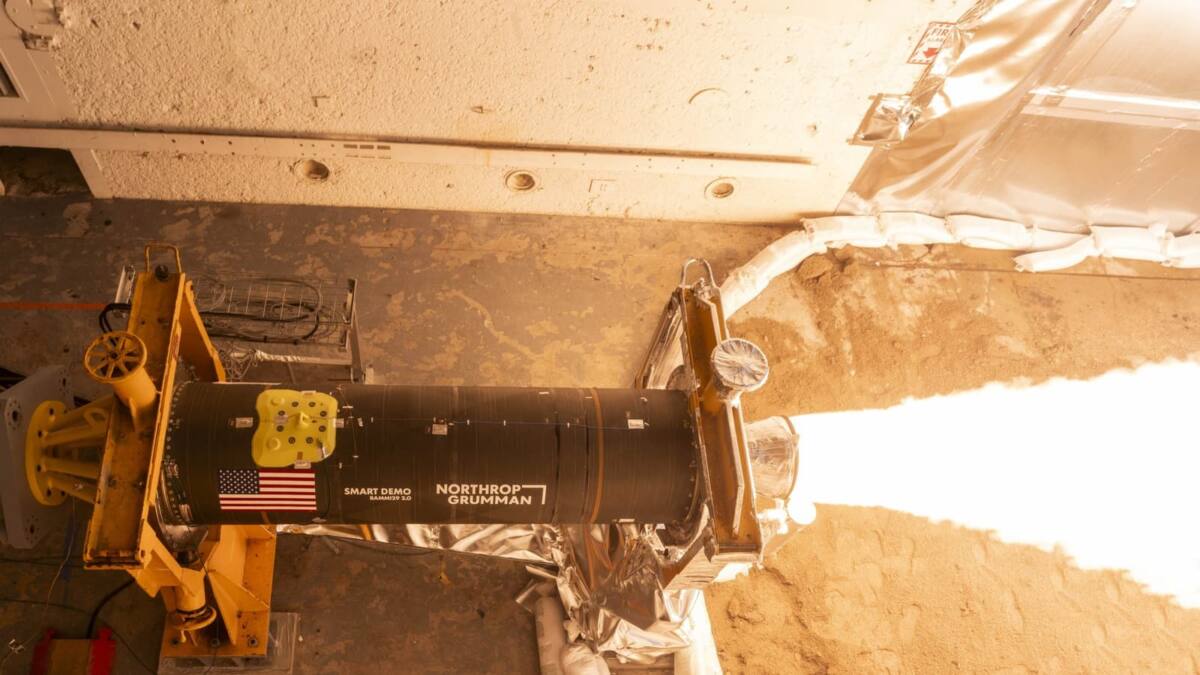
SMART Demo is cutting development time
To speed up new materials, technologies, and suppliers, Northrop is using its SMART Demo program, short for Solid Motor Annual Rocket Technology Demonstrator. The company says it has cut the time from design to qualification testing from three years to 12 to 18 months, which is the sort of number that tends to make procurement officers smile and program managers mutter about paperwork.
Northrop’s motors are also tied to high-profile launch systems beyond the missile business. The company supplies the two solid boosters for NASA’s Space Launch System, the heavy-lift rocket built for the Artemis lunar program.
A Vulcan setback still hangs over the business
The company’s pitch for expansion comes with a reminder that manufacturing scale does not erase quality risk. Earlier this year, US Space Force paused launches of United Launch Alliance’s Vulcan rocket after a second solid-booster incident in two years involving a Northrop motor. The investigation is still ongoing, and Northrop says it is working with United Launch Alliance to get the rocket flying again.
That leaves Washington with an awkward choice: accept tighter supplier dependence, or write longer contracts and hope that more certainty translates into more capacity without more mistakes. The next test is whether the Pentagon is willing to buy the stability industry says it needs, rather than keep pretending annual budgets can solve a multi-year production problem.