

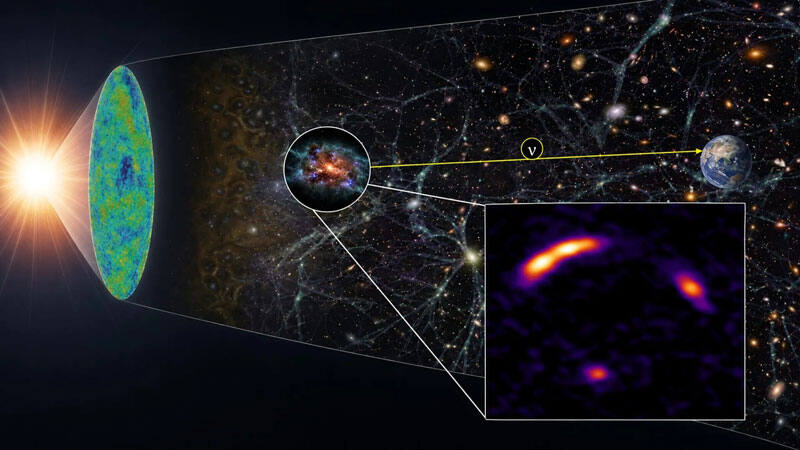
A high-energy neutrino that IceCube caught in Antarctic ice on 22 September 2021 may not have come from the usual suspect. Instead of an active supermassive black hole, astronomers now think the particle may trace back to a dust-shrouded galaxy nicknamed Shadow Blaster, where stars are being forged at a breakneck pace and the conditions are ripe for cosmic-ray collisions.
That is a useful reminder that neutrino astronomy is still a field of surprises. Because these particles barely interact with matter and are hard to localize precisely, every clean source identification is hard won – and the most convincing ones often rewrite expectations about where extreme particle acceleration really happens.
Shadow Blaster beats the black-hole bet
The source candidate is JCMT0402−0424, a galaxy about 11 billion light years away, obscured by thick dust and seen in more detail with ALMA. A foreground elliptical galaxy happens to lens it, splitting the distant object into four distorted but magnified images, which gave astronomers a much better look than they would otherwise have gotten.
That mattered because the usual signatures of an actively feeding black hole were missing. X-ray and gamma-ray observations, along with CO and neutral carbon measurements, pointed instead to a compact central starburst about 1,500 light years across, converting hundreds of solar masses of gas into new stars every year.
How a dusty starburst galaxy makes neutrinos
In that kind of dense, violent environment, cosmic rays keep slamming into gas, producing short-lived particles whose decays generate gamma rays and neutrinos. It is a neat bit of astrophysical recycling, and also a good reason not to assume every high-energy neutrino must come from a black-hole engine just because black holes have better PR.
- Event: IC 210922A
- Detection date: 22 September 2021
- Candidate source distance: about 11 billion light years
- Star-forming region size: 1,500 light years
A possible new class of neutrino sources
The team is careful not to call this a nailed-down identification, but the match is strong enough to put Shadow Blaster at the top of the list, with the chance of a random coincidence estimated at about 1% or lower. More interestingly, if dust-obscured compact starbursts like this are common, they could contribute around 15% of the high-energy neutrino background, and in some models as much as 20%.
If that estimate holds up, the field may need to widen its usual search image. The next question is whether astronomers can find a handful more of these buried star factories before black holes reclaim the spotlight.