

Amazon, QuEra, and Quantinuum are all talking up useful quantum computers by 2028, but the real battle is no longer just about building bigger devices – it is about whether classical algorithms keep erasing the advantage before the hardware arrives.
Amazon and QuEra say their Libra system could reach ”mega-quop” scale by 2028, with around a million quantum operations and hundreds of logical qubits. That is the sort of target investors love and engineers sweat over, because logical qubits only matter if the underlying hardware can absorb a brutal amount of error correction without falling apart.
Amazon and QuEra’s Libra target
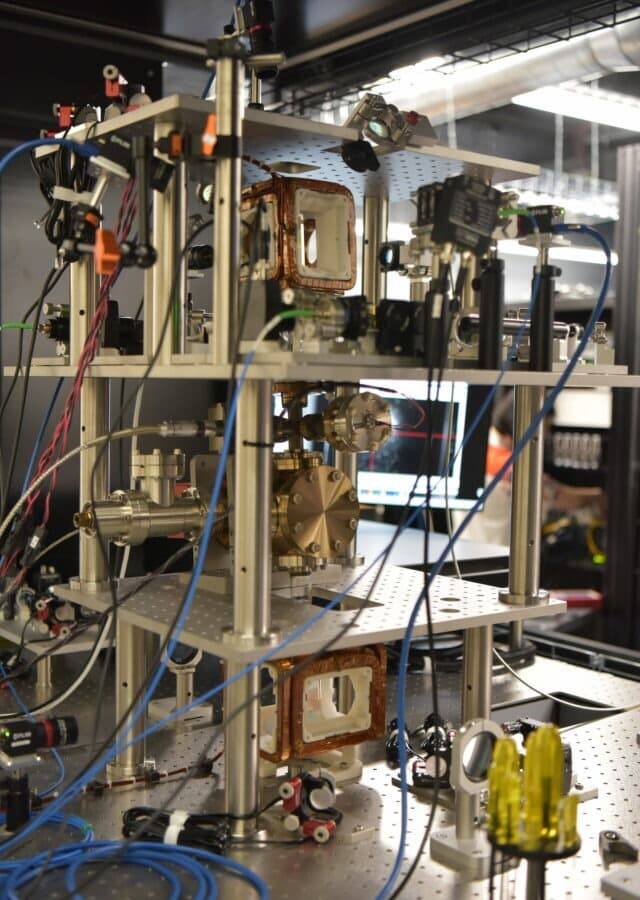
QuEra’s neutral-atom approach is attractive for scale: atoms are trapped in laser grids and manipulated with light fields, and the company has already shown arrays of about 3,000 atoms in the lab. The catch is that atoms heat up, can be lost during operations, and the gate speed is still relatively slow – not a great cocktail if you are trying to build fault-tolerant systems for chemistry, high-energy physics, or materials science.
That tension has become familiar across the sector. Google, IBM, and others have spent years proving that the hard part is not merely adding qubits, but keeping them accurate enough to matter; the industry has now moved from ”how many qubits?” to ”how many survive the corrections?”
Quantinuum’s Helios bets on lower errors
Quantinuum is taking a different route with trapped ions and its Helios system. Ions move through a ring structure and are processed in dedicated work zones, while the company is leaning hard on extremely low error rates: 0.00003 for single-qubit operations and 0.0008 for two-qubit operations.
Just as important, Helios is built around ”virtual qubits”, a software layer that hides the physical plumbing from users and handles distribution and error correction in real time. That makes the system feel closer to cloud computing than to the old image of a fragile science experiment sitting in a lab.
- Amazon and QuEra: Libra, targeted for 2028
- Scale goal: around a million quantum operations
- Logical-qubit goal: hundreds, not just a handful
- Quantinuum Helios: trapped-ion design with dedicated work zones
- Helios error rates: 0.00003 for single-qubit operations and 0.0008 for two-qubit operations
Classical algorithms keep taking bites out of quantum advantage
But the other side of the race is moving too. A result once presented as a 3,000x quantum speedup on IBM hardware was later cut to 36x after a better classical algorithm, and in some cases the classical method even came out ahead. That is why ”quantum advantage” has become a moving target rather than a trophy on a shelf.
The pattern is becoming almost routine: a quantum claim lands, classical researchers sharpen their tools, and the gap narrows. IBM has even turned that uncertainty into a running tracker, which is a pretty honest admission that this field now advances in revisions as much as in breakthroughs.
The next few years should tell us whether the winners are the teams that scale fastest or the teams that make error correction cheap enough to survive contact with reality. My bet: the first truly useful quantum computers will not win by brute force alone, but by being narrow, well-bounded, and just expensive enough to make classical alternatives look annoyingly good.