

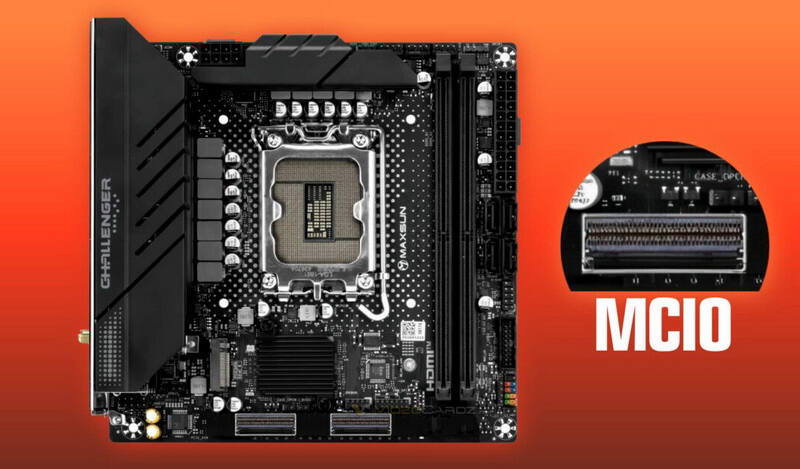
MaxSun has turned two tiny Mini-ITX motherboards into a very non-gaming statement: the new MS-Challenger MCIO ITX and MS-PC Farm B860I replace the familiar PCIe x16 slot with MCIO connectors, a move aimed squarely at dense systems, external GPUs, and cabling flexibility rather than a tidy desktop under a desk.
Both boards are built on Intel 800-series platforms, and both treat PCIe as something to be routed, split, and rearranged instead of simply dropped into a big slot. That makes them more interesting than the usual ”mini board, fewer features” formula. It also hints at where motherboard makers are looking for growth: not in one more RGB-laced gaming slab, but in compact systems that behave more like infrastructure.
What MCIO brings to Mini-ITX
MCIO stands for Mini Cool Edge I/O, a high-speed connector designed for server, telecom, and compute hardware. It carries PCIe signals in a smaller package and supports Gen4, Gen5, and potentially Gen6, which is exactly why it shows up here: the connector is built for flexibility, not for looking like every consumer board since the dawn of time.
On the MS-Challenger MCIO ITX, MaxSun kept the same PCB layout used on the earlier MS-Challenger H810ITX WIFI, then removed the standard PCIe x16 slot and replaced it with two MCIO connectors. The board will ship in Q870, Z890, H810, and B860 versions. The Q870 and Z890 models can split PCIe lanes into x8+x8 or x8+(x4+x4), while the H810 and B860 versions use a combined x16 mode across the two MCIO interfaces.
MS-PC Farm B860I is built for clusters, not LAN parties
The MS-PC Farm B860I takes the idea further. MaxSun showed it last year and has kept surfacing it ever since, which usually means the company sees a real niche rather than a marketing stunt. It has four DDR5 UDIMM slots, a rotated CPU socket and memory layout for denser builds, two MCIO connectors, and one extra PCIe expansion slot.
It also adds the sort of admin-friendly features that make sense in racks and awkward remote deployments: IPMI management, forced BIOS flashing, and smart fault diagnostics. That is not the recipe for a cheerful gaming tower. It is, however, exactly the kind of board you want if the goal is a compact cluster or a system that needs more cable-routing options than a standard x16 slot can offer.
Why board makers are poking at PCIe layouts
Gaming graphics cards still expect a conventional PCIe x16 connector, so these designs are not here to replace the mainstream desktop overnight. The better comparison is with server boards and specialist compact systems, where MCIO can simplify external GPU links, mounted cabling, and lane sharing without forcing everything through one giant slot.
That leaves MaxSun with a clear bet: the company is chasing users who care more about signal routing and density than about the comfort of a full-size slot. If more motherboard vendors follow, MCIO could move from an oddity in server gear to a more visible option in compact PC designs. If they do not, these boards will stay in the very specific corner of the market they were clearly built for.