

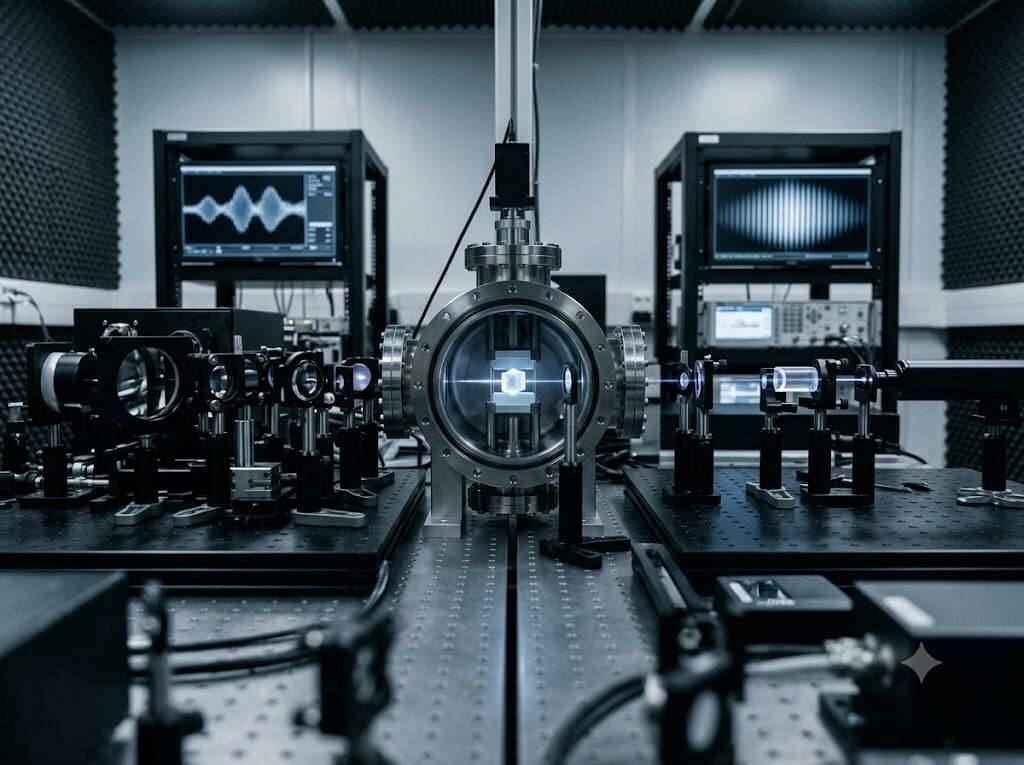
Two teams in China and Europe have built working nuclear clocks for the first time, turning a long-running physics goal into an experiment rather than a promise. Both setups use thorium-229, a rare isotope whose nucleus can be driven by laser light, and both point to a new class of timekeepers that could outclass today’s best atomic clocks in stability and in what they can be used to test.
The appeal is simple: atomic clocks read time from electrons, while nuclear clocks read it from the nucleus itself. That makes them far less sensitive to stray electric and magnetic fields, which is exactly why physicists have been chasing them for years. The catch has always been the laser problem – thorium-229 needs vacuum-ultraviolet light around 148 nanometers, a nasty regime for stable laser control.
How the thorium-229 breakthrough works
Both groups got around the wavelength headache by embedding thorium-229 nuclei in calcium fluoride crystals and probing them with a narrow continuous laser in the vacuum-ultraviolet range. The Chinese team used a stronger laser source, while the European team leaned on a crystal with a higher thorium concentration. Different routes, same point: the nucleus can now be used as a real clock reference.
- Reference: thorium-229 nucleus, not electron transitions
- Platform: calcium fluoride crystals
- Laser range: about 148 nanometers
- Claimed stability: about one part in 10 trillion over a day
What each team demonstrated
The Chinese group showed they could stabilize a vacuum-ultraviolet laser locked to the nuclear transition. The reported stability – roughly one part in 10 trillion per day – puts it in the same ballpark as the best atomic clocks now in service, which is a pretty awkward moment for anyone who assumed nuclei would stay a whiteboard fantasy forever.
The European team took a different route and used its system to look for signals of ultralight dark matter, the hypothetical particles that could account for a large share of the universe’s mass. They did not find a signal, but the sensitivity they reached was said to match or exceed top atomic-clock performance, which is useful even without a cosmic jackpot.
What nuclear clocks could be used for next
The immediate prize is not just better timekeeping. Nuclear clocks could become a cleaner way to probe fundamental constants, hunt for tiny shifts in physics that atom-based devices might miss, and test ideas beyond the Standard Model. If the technology can be miniaturized, the practical list gets longer: navigation, gravitational sensing, and compact instruments for precision experiments.
That is also where the competition will sharpen. Atomic clocks are already absurdly good, but they are mature tech with a ceiling that researchers keep bumping into; nuclear clocks are the new kid with stranger hardware and, possibly, more room to grow. The next question is whether labs can make these systems smaller, more robust, and less dependent on delicate vacuum-ultraviolet setups – because until that happens, the clocks may be brilliant, but still mostly confined to the lab bench.