

Silicon Motion is looking past Intel and AMD and toward Nvidia to decide when PCIe 6.0 SSDs should arrive in client PCs. That is a pretty clean sign of where the next storage demand is expected to come from: not traditional desktop CPUs, but Nvidia’s expanding footprint in client and workstation systems.
The controller maker says its first client platform with PCIe Gen6 SSD support is scheduled for the end of next year. That is early by consumer standards and late by data center standards, which is exactly the awkward middle ground PCIe 6.0 occupies right now. PCIe 5.0 SSDs have already been around for about three and a half years, yet the only PCIe 6.0 drive currently on the market, Micron’s 9650, is not aimed at consumer machines.
Nvidia is setting the pace for PCIe 6.0 SSDs
In an interview with Tom’s Hardware, Silicon Motion vice president Nelson Duann said the company’s client PCIe 6.0 roadmap is being shaped mainly around Nvidia rather than Intel or AMD. That tracks with Nvidia’s recent push beyond the server rack and into client hardware, including the company’s Computex 2026 messaging and its RTX Spark family.
For storage vendors, that matters because faster SSDs only become meaningful when the rest of the platform can actually feed them. Nvidia’s processors are expected to need high-bandwidth data movement, while Intel and AMD are moving more cautiously on the client side because the surrounding infrastructure is expensive and the payoff is still fuzzy.
Server hardware gets PCIe 6.0 first
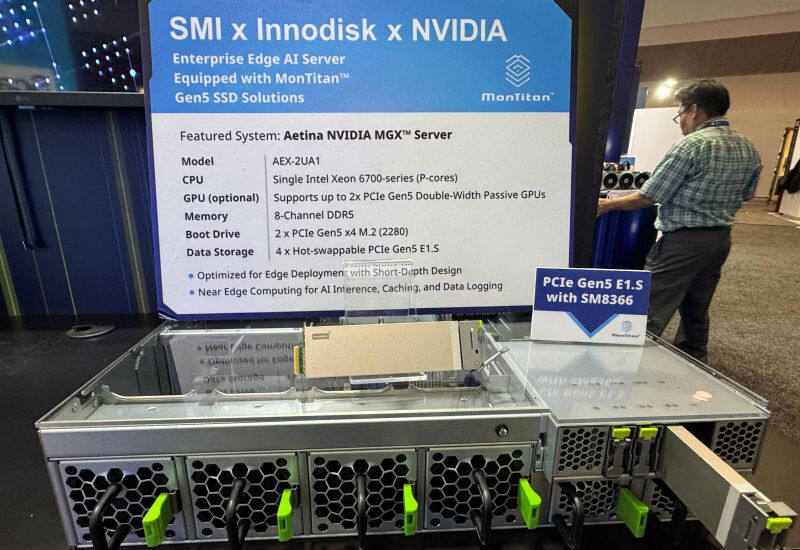
Silicon Motion is not ignoring the data center. The company plans to show its 16-channel SM8466 controller with PCIe 6.0 support this year, which puts it in position for server systems built around upcoming AMD EPYC Venice and Nvidia Vera Rubin processors. Switch vendors such as Astera Labs are also lining up to support the new interface, though adoption this year still looks limited.
- Silicon Motion client PCIe Gen6 SSD platform: end of next year
- SM8466 server controller: 16 channels, PCIe 6.0 support, shown this year
- Current consumer PCIe 6.0 SSD on the market: Micron 9650
PCIe 6.0 still needs a real consumer trigger
The bigger story is that interface standards no longer move only when Intel or AMD blink. Nvidia now has enough momentum to influence what SSD controllers get built and when, especially if its future client systems create demand for bandwidth-hungry storage. If that happens, PCIe 6.0 could reach enthusiasts first as a halo feature, then slowly trickle into mainstream PCs after the parts, prices, and platform support finally catch up.