

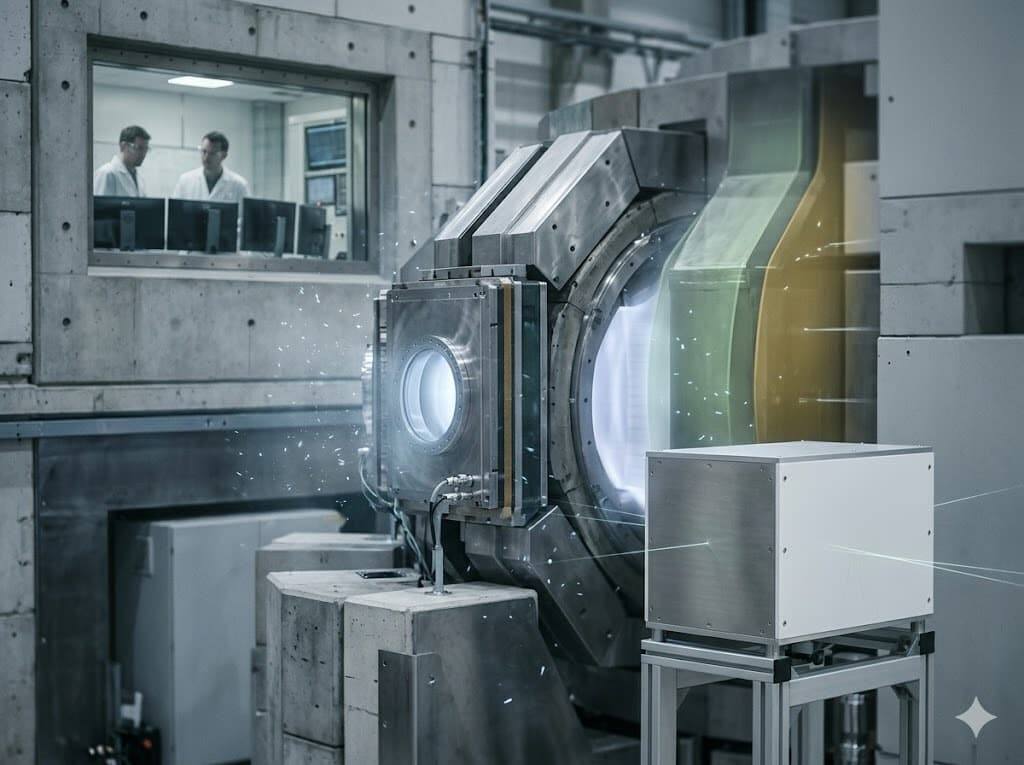
A compact antineutrino detector may be enough to catch hidden plutonium-239 production in a fusion reactor. Researchers from Virginia Tech say a one-ton system could spot several kilograms of the material in 30 days, even if the detector sits outside the reactor building.
That is a pretty awkward fact for anyone hoping fusion power will be a proliferation-free paradise. Fusion plants do not need weapons-grade fuel to run, but the neutron flood they produce can still turn added uranium-238 into plutonium-239, which is exactly the sort of side hustle the nonproliferation crowd worries about.
How antineutrino detectors spot hidden plutonium
The method relies on antineutrinos, tiny neutral particles produced in nuclear reactions and effectively impossible to shield. The team modeled how their signal would change if a reactor blanket were quietly used to breed fissile material, then compared that with the normal output of the reactor and the natural antineutrino background.
They focused on a torus-shaped fusion reactor with a large radius of 6.2 m, a small radius of 2.0 m, and thermal power of about 1,500 MW. Using Monte Carlo simulations and modern nuclear cross-section data, they found that the antineutrino signature from even a modest concealed buildup remains detectable.
Why blanket design changes the signal
The study looked at two blanket concepts in particular: FLiBe, a molten-salt mix of lithium and beryllium with Li-6 enrichment to around 20%, and a double-coolant lithium-lead design, or DCLL, where lithium enrichment can reach 90%. Those choices matter because they change the secondary reactions, the background noise, and the way structural materials activate under neutron bombardment.
Some activation products barely show up in inverse beta decay detectors at all, which helps the method discriminate between harmless reactor behavior and suspicious material production. Others create a background that is messy, but still statistically separable with enough observation time.
Remote monitoring without opening the reactor
The practical attraction is obvious: no need to open the plant, no need to install instruments inside the core, and no need to trust a paper declaration that everything is ”peaceful.” If the physics checks out in real deployments, inspectors could verify operation through tens of meters of steel and concrete.
That puts fusion in an unusual position. The technology is being sold as the clean successor to fission, yet the same neutron physics that makes it useful for energy also gives it a potential weapons-related blind spot. The race now is not just toward commercial reactors, but toward monitoring systems that are built into their architecture from day one.
The next test for fusion safeguards
If regulators take this seriously, antineutrino monitoring could become part of the standard design conversation for future DT reactors, alongside tritium handling and blanket materials. The bigger question is whether operators will accept external verification as a feature rather than a nuisance – because the neutrons are not going away, and neither is the possibility that someone will try to use them creatively.