

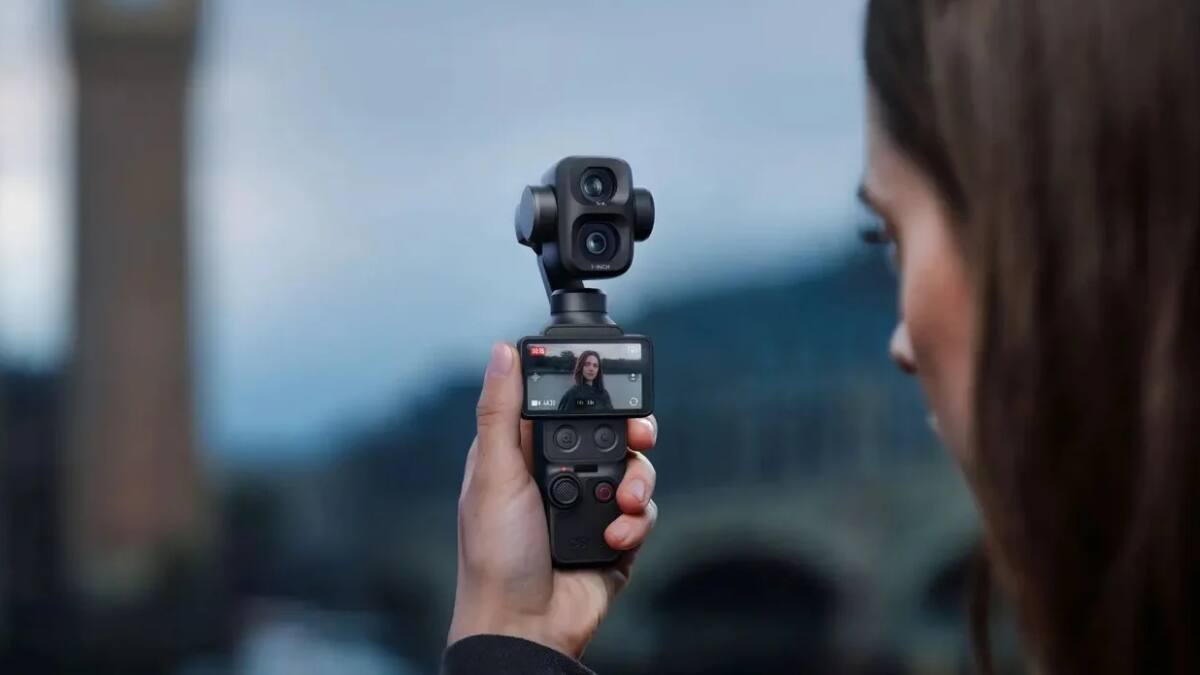
DJI has pushed the Osmo Pocket line into new territory with the Pocket 4P, a dual-camera gimbal compact that adds a second lens, raises dynamic range to 17 stops on the main sensor, and lands with 4K recording at up to 240fps. It’s also aimed squarely at Insta360, whose Luna Ultra just made its own move into gimbal-camera turf, turning a product category into a very public grudge match.
The headline feature is the new optics package: a 1-inch wide-angle main camera paired with a dedicated 60mm telephoto lens. That gives DJI something the Pocket line has never had before, and it makes the 4P more than a mild refresh. At 230 grams, it stays small enough to feel like a travel tool rather than a rig, even if the specs are now edging into serious creator kit territory.
Dual cameras and 17 stops of dynamic range
DJI says the main sensor delivers 10-bit D-Log2 color, while the 1-inch wide camera is the one that gets the full 17 stops of dynamic range claim. That’s the kind of number you usually hear attached to much larger cameras, so DJI is clearly trying to sell this as a pocketable image-making device rather than a gadget with a fancy hinge.
- 1-inch wide-angle main camera
- Dedicated 60mm telephoto lens
- 10-bit D-Log2 color
- 4K at up to 240fps
- 230-gram weight
- 103GB built-in storage
Pocket 4P price in China and the US sales problem
In China, the Pocket 4P starts at 3,799 yuan, which works out to roughly $525. US buyers, however, can’t order one yet, and DJI does not have a public timeline for when that changes. The company has been on the FCC Covered List since December 2025, which blocks new hardware from being sold in the US, a reminder that even good hardware can get stuck in regulatory mud.
DJI and Insta360 are fighting on two fronts
The product launch lands in the middle of an increasingly ugly legal fight. DJI filed two patent infringement lawsuits against Insta360 in the Eastern District of Texas on the same day the Luna Ultra went on sale in the US, saying the rival camera copies the Osmo Pocket’s physical design and borrows from its gimbal control and subject-tracking patents. Insta360 responded two days later with five patents of its own, and DJI had already sued the company in China earlier in 2026 over drone flight control and image processing patents.
That kind of back-and-forth usually means the real competition is already settled in the market, and the lawyers are just taking over from the product teams. DJI’s answer here is simple: build a Pocket that looks harder to ignore. The open question is whether that second lens and those headline-grabbing specs are enough to keep creators loyal if the US market stays off-limits for the foreseeable future.