

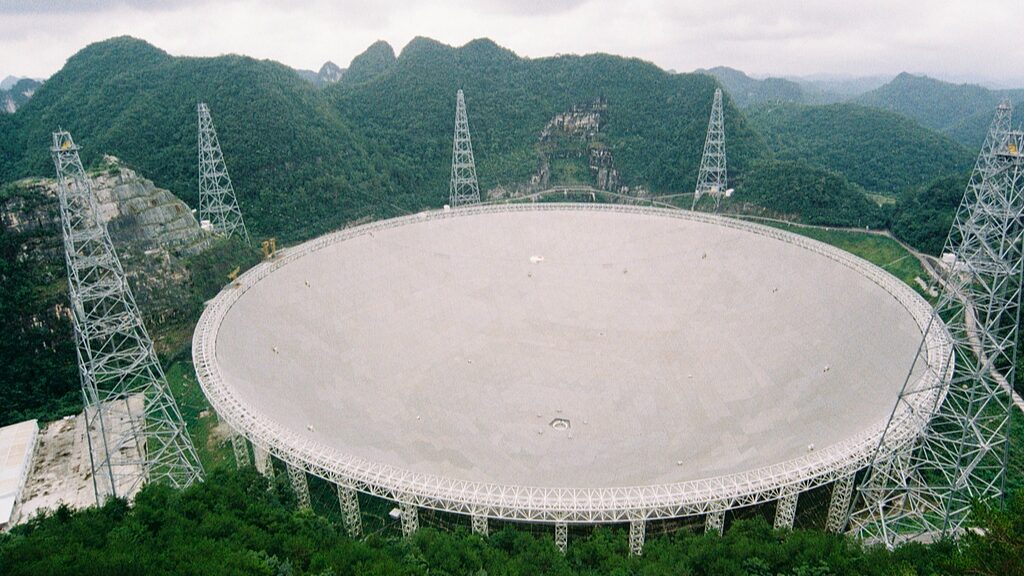
China’s FAST radio telescope has swapped imported hardware for homegrown muscle: six steel cables, each weighing more than 6 tons, now drive the system that keeps the 500-meter dish pointed with extreme precision. The upgrade is less flashy than a new receiver or a record-breaking detection, but it is exactly the kind of industrial detail that decides whether a giant instrument stays reliable for years or turns into an expensive headache.
The cables are part of the mechanism that moves a 30-ton feed unit across a 206-meter-wide working area, 140 meters above the dish. In practice, that means hundreds of bending and pulse loads every day, with the system expected to keep going for five years of intensive use without breaking. For a telescope of this scale, that sort of durability is the real headline.
FAST’s 6 steel cables carry the load
The full set of cables stretches to almost 4,000 meters in total length, according to the report. FAST began using imported steel cables when it started operations in 2016, so the change also marks a quiet shift toward domestic supply for one of China’s best-known scientific megaprojects.
That matters because big science projects do not live on prestige alone. They survive on spare parts, maintenance cycles, and suppliers who can deliver the same thing again and again without drama.
Why the telescope needs cables that do not quit
FAST, officially the Five-hundred-meter Aperture Spherical Telescope, is the world’s largest filled-aperture radio telescope. Its 500-meter diameter has made it a major instrument for studying galaxy formation and evolution, dark matter, and objects from the reionization era.
- Diameter: 500 meters
- Feed mechanism weight: 30 tons
- Working range: 206 meters in diameter
- Height above the dish: 140 meters
- Total cable length: almost 4,000 meters
- Weight of each cable: more than 6 tons
There is a tidy lesson here: in huge scientific machines, the supporting cast often matters more than the spotlighted instrument. A telescope can only be as good as the mechanics that move it, and FAST’s new cables suggest China wants that dependence to sit closer to home.
FAST’s supplier shift points to a larger trend
FAST cost more than $185 million to build, and it is hardly alone in facing the unglamorous challenge of long-term component supply. Across astronomy and space hardware, operators increasingly want local sourcing for critical parts, both to reduce risk and to avoid being trapped by legacy imports that become harder to replace over time.
For now, the open question is how quickly these Chinese-made cables prove themselves under nonstop load. If they hold up as specified, the replacement is not just a maintenance update; it is a quiet argument that the country can now supply the mechanical backbone of its flagship radio telescope as confidently as it supplies the science goals.