

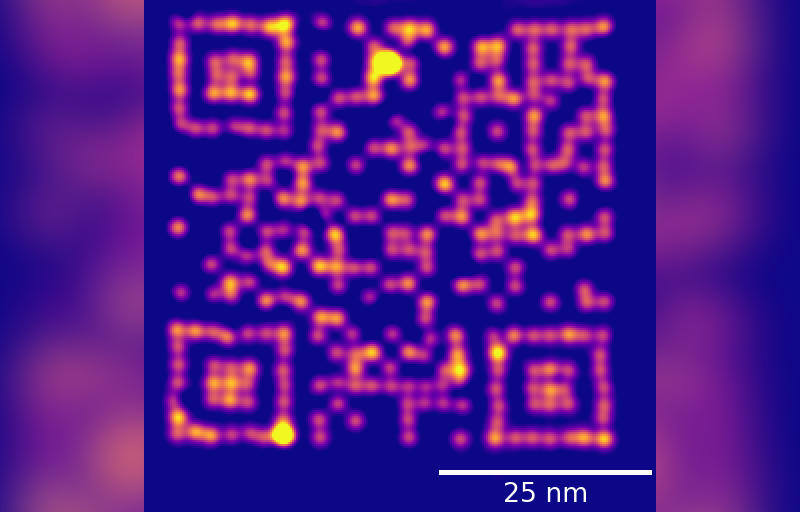
Researchers in Australia and the Czech Republic have built what may be the smallest QR code ever made: a fully scannable pattern assembled from individual silver atoms. The atomic QR code is about 800 times smaller than the previous record holder, and it is so small that the whole thing is only slightly larger than one pixel from that earlier design.
The result is a neat flex for nanotechnology, but also a reminder that records in this field tend to be a race between how small something can be made and how practical it is to keep it there. The new code was produced under ultra-high vacuum and cryogenic temperatures, which is not exactly the setup you’d want for a sticker on your coffee mug.
How the atomic QR code was built
The team, from Monash University’s School of Physics and Astronomy and the Czech Academy of Sciences, placed the atoms using an ultra-fine scanning tunnelling microscope. Each ”pixel” in the QR code is a single silver atom, positioned with the help of quantum tunnelling and then adjusted through automated control so the pattern could actually be scanned by a smartphone.
The full code measures 50 × 50 nm. That is roughly the size of a COVID-19 virus and about 1,000 times thinner than a human hair. The previous Guinness-record QR code, set in February by TU Wien and Cerabyte, used 49 nm pixels and occupied 1.98 μm², which suddenly sounds positively roomy.
A record, but not yet an official one
The researchers have applied for Guinness World Records recognition, but the claim has not been confirmed yet. If it sticks, the bigger bragging rights may not come from sheer size alone: Cerabyte says its earlier record also stood out for stability and durability, without needing the energy-hungry vacuum and extreme cooling required for the new experiment.
- New QR code size: 50 × 50 nm
- Previous record pixel size: 49 nm
- Previous record area: 1.98 μm²
- Building method: scanning tunnelling microscope and quantum tunnelling
Why this tiny QR code matters
This is less about QR codes as consumer products and more about proving control at the atomic scale. The next question is whether that precision can be made useful outside a lab, because the real winner will be the team that turns a parlor trick into something that survives the world without a vacuum chamber attached.