

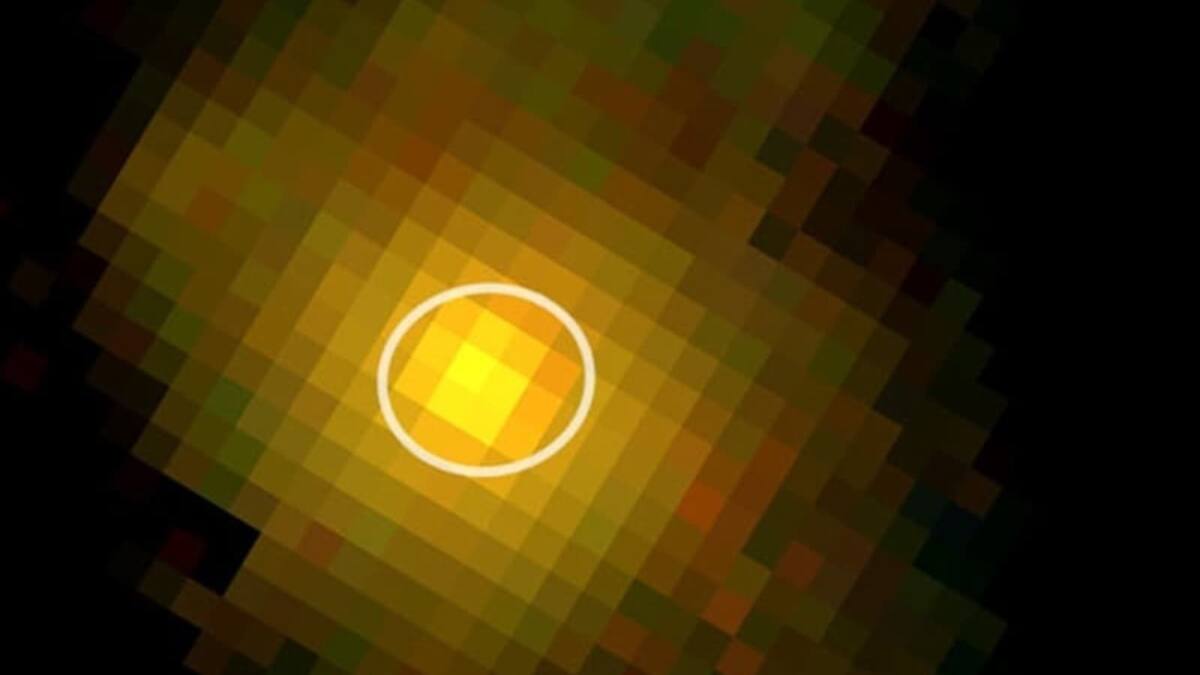
The James Webb Space Telescope has turned up a weird one in the early Universe: XMM-VID1-2075, a massive galaxy that should be spinning but apparently isn’t. Instead of a tidy rotation pattern, its stars move in a jumble, as if the system never settled on an axis in the first place.
That is awkward for the standard picture of galaxy formation, where gas clouds collapse under gravity and end up rotating. It is also a reminder that the early Universe was not a neat laboratory, no matter how much simulation code would like it to be.
XMM-VID1-2075 looks too young to be this chaotic
The galaxy was observed when the Universe was less than 2 billion years old, which makes its odd motion hard to explain with the usual merger-heavy story. In older galaxies, chaotic speed patterns are common because repeated collisions can scramble the motion of stars. Here, that level of messiness appears far too early.
Webb’s spectroscopic measurements were detailed enough to reconstruct stellar motion inside the system. Of the three ancient galaxies studied, one showed normal rotation, one had mixed dynamics, and XMM-VID1-2075 showed no sign of a shared spin axis at all.
- Object: XMM-VID1-2075
- Epoch: less than 2 billion years after the Big Bang
- Key finding: no clear rotation, with stars moving in multiple directions
A likely galaxy collision, but not a neat one
The leading explanation is a collision between two galaxies rotating in opposite directions, which would cancel out much of the angular momentum and leave the remnant without ordered spin. That would fit the data, especially alongside the asymmetry in brightness that hints at an ongoing disturbance or even the swallowing of a smaller companion.
Researchers have seen this kind of thing in theory before, and some formation models allow for it, but only as a rare outcome. The more interesting question is whether Webb is now catching a population of these objects that older telescopes simply missed. If so, the early Universe may have been building galaxies through a wider range of messy routes than current simulations comfortably allow.
What this means for galaxy formation models
This finding does not overthrow cosmology, but it does put pressure on the tidy version of galaxy growth many people grew up with. The real test will be statistics: if more young non-rotating galaxies turn up, theorists will need to explain why early growth could so often end in a dead stop instead of a graceful spin.
For now, XMM-VID1-2075 is the sort of object that makes astronomers recheck the assumptions in their models and then go looking for more trouble. Which is exactly what good data should do.