

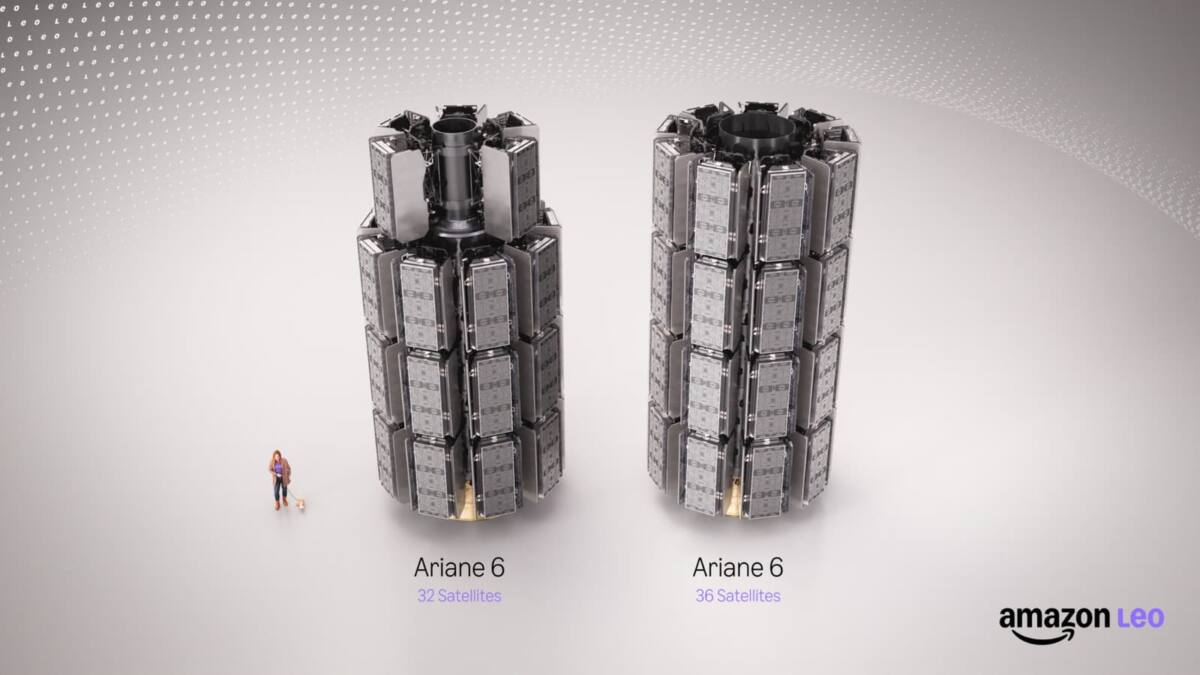
Amazon is about to push its satellite internet project a little harder against Starlink. On June 17, the company plans to launch 36 Amazon Leo satellites on an Ariane 6 from Kourou in French Guiana, setting a new single-mission record for the program and showing how quickly launch vehicles are being modified to keep up with broadband megaconstellations.
The number matters because these launches are not just about putting hardware in orbit. They are about cadence, payload mass, and who can build out a network fastest before competitors lock up more customers. Amazon’s Leo system is still catching up to SpaceX’s far larger Starlink fleet, so every increase in launch capacity helps narrow the gap.
Ariane 6 gets new P160C boosters
This mission, called LE-03, will be the first Ariane 6 flight to use the new P160C solid-fuel boosters. Amazon says the upgrade adds two tonnes of payload capacity, which is what makes the 36-satellite loadout possible. Before this, Ariane 6 had topped out at 32 Leo satellites per launch for Amazon.
That kind of stretch is exactly what launch providers are chasing right now. The race is no longer just ”can you get there?” but ”how many can you take with you?”
Amazon Leo is still trying to catch Starlink
Amazon has already used Falcon 9 and Atlas V for its satellite deployments, with batches ranging from 24 to 29 spacecraft. So 36 is a meaningful jump, even if it is still a long way from the scale SpaceX has built with repeated Starlink deployments.
The company is banking on bigger rockets to speed things up further. Amazon expects Blue Origin’s New Glenn to eventually carry up to 48 satellites for the project in a single launch, though that may have to wait until the end of 2026 after a recent accident delayed the schedule.
- Mission: LE-03
- Launch date: June 17
- Rocket: Ariane 6
- Satellites: 36 Amazon Leo units
- New hardware: P160C solid-fuel boosters
The next record may not last long
For now, Amazon gets a clean headline: its biggest Leo launch yet. But if New Glenn comes back on schedule and performs as Amazon hopes, this 36-satellite record could look like a brief waypoint rather than a milestone. In a market built on scale, even records have a short shelf life.