

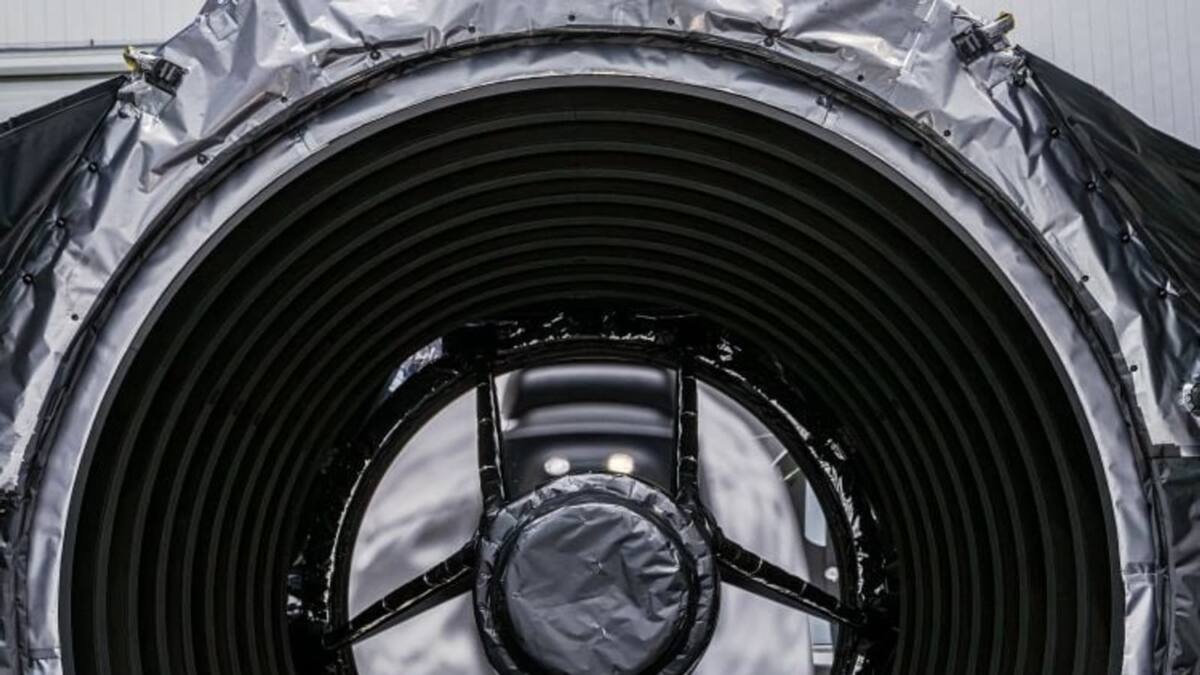
NASA has cleared the final inspection of the main mirror for the Nancy Grace Roman Space Telescope, pushing the long-running mission into its last stretch before it heads to the launch site. The 2.4-meter mirror, coated with a layer of silver only hundreds of nanometers thick, is the hardware that will let Roman hunt in near-infrared light for faint galaxies, dark matter clues, dark energy signals, and exoplanets.
The timing matters because Roman has spent years living in the shadow of JWST, a far more famous sibling with a very different job. Roman is designed for a wider view of the sky, which is exactly what makes it useful: not deeper than James Webb in every sense, but broader, faster, and better suited to surveys that need to map large swaths of the universe rather than stare at one tiny patch for hours.
What NASA just finished checking
The mirror inspection was the last major look at the telescope’s primary optical element before transport to Kennedy Space Center. NASA says the telescope should now move into final launch preparation, with liftoff planned for September 2026.
That silver coating is the practical detail that gets lost in the shiny headline photos. It is thin enough to sound absurd, but it is exactly what Roman needs to work efficiently in the infrared, where many distant and dim targets are easier to spot.
- Mirror diameter: 2.4 meters
- Coating: silver, hundreds of nanometers thick
- Destination after launch: the Earth-Sun L2 region
- Distance from Earth: about 1.5 million kilometers
Roman telescope survey mission and JWST comparison
Roman was previously known as WFIRST, and NASA has been developing it since 2014. Its science case is broad: study dark matter and dark energy, find exoplanets through direct imaging and gravitational microlensing, and probe how galaxies and star populations formed and changed over time.
That broad mission is also why Roman keeps getting compared with JWST. Webb will remain the heavyweight for ultra-deep observations, but Roman is the wide-field machine that can turn up the targets, the maps, and the statistics that big cosmology surveys run on.
Why L2 is the parking spot of choice
After launch, Roman will travel to the L2 point in the Earth-Sun system, a gravitationally stable region used by JWST as well. The appeal is simple: less fuel spent fighting orbital chaos, more time for observations and small course corrections.
NASA says the mission has cost almost $4 billion to develop, more than half of JWST’s price. That is a hefty bill, but it also reflects how difficult it is to build precision infrared observatories that can survive years of delays, integration work, and budget pressure without losing the plot.
What Roman could change first
If Roman launches on schedule in September 2026, the first wins are likely to come from scale rather than spectacle. It should be able to sweep up exoplanet candidates and large cosmic structures far faster than a narrow-field telescope, which is exactly the kind of data astronomers need when they are trying to test theories, not just admire pretty pictures.
The open question is how quickly NASA can turn this long-delayed project into a productive survey telescope once it reaches L2. The hardware has made it through the toughest inspection; now the real test is whether Roman can deliver the kind of high-volume infrared science that justifies the wait.