

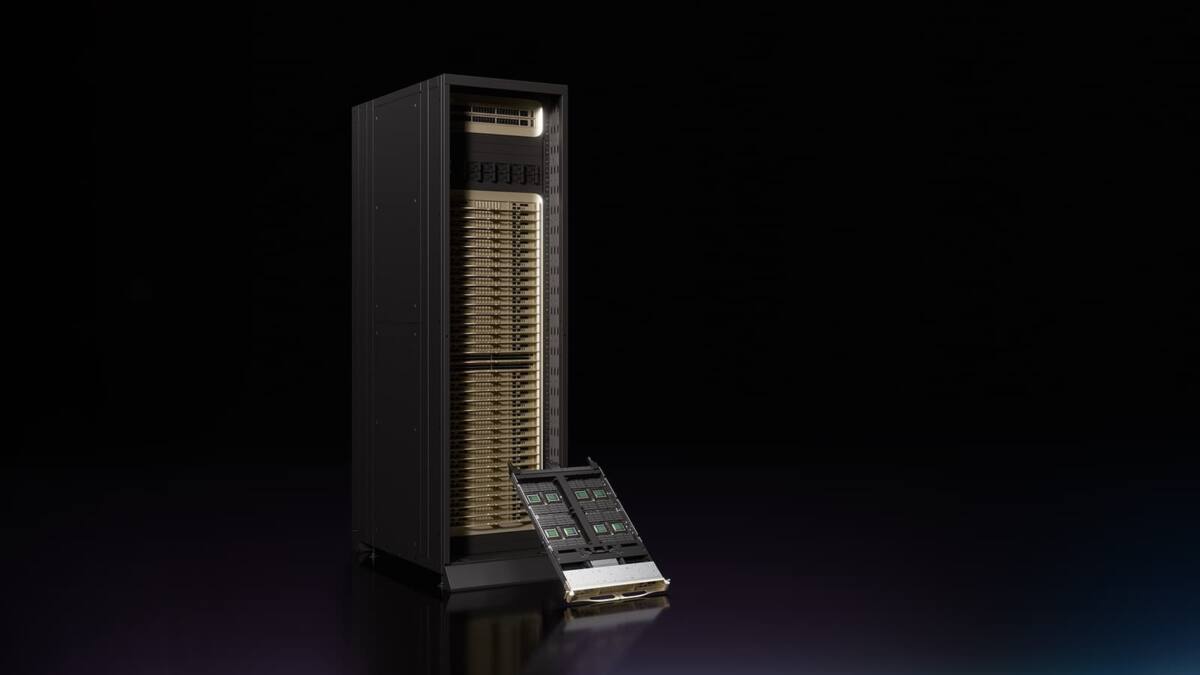
Nvidia has officially pulled the wrapper off Vera, its first processor built for a new class of AI agents rather than old-fashioned chatbot duty. The chip is already in full production, and Nvidia says it can deliver up to 1.8 times the performance of traditional x86 platforms on AI workloads – the kind of claim that makes server vendors pay attention and rivals reach for another benchmark deck.
Vera is aimed at systems that do more than generate text. It is designed for agents that write and compile code, call tools, inspect results, and make decisions on their own. That is the direction the industry is racing toward: less ”answer my question,” more ”go do the job.” Nvidia clearly wants the silicon underneath that shift before anyone else locks it down.
Nvidia Vera specs: 88 Olympus cores and LPDDR5X bandwidth
On paper, Vera is a serious piece of hardware. The architecture uses 88 Olympus cores, Spatial Multithreading, and LPDDR5X memory with bandwidth of up to 1.2 TB/s. Nvidia is pairing the chip with its Vera Rubin platform, where it will work alongside a GPU over second-generation NVLink-C2C with bandwidth of up to 1.8 TB/s.
Those numbers matter because agentic AI systems are hungry in different ways than classic inference servers. They bounce between CPU-heavy orchestration, memory traffic, and GPU acceleration, so Nvidia is not just selling a faster processor here; it is trying to own the whole rack-level conversation.
Benchmark results and early buyers
According to Phoronix, which tests performance with open-source benchmarking tools, Vera turned in the strongest overall results across agent-related workloads, including code compilation, Python, Java, and database processing. That lines up with what the AI infrastructure market has been drifting toward for months: more complex workloads, more server coordination, and less patience for generic CPU claims.
- Architecture: 88 Olympus cores
- Memory: LPDDR5X with up to 1.2 TB/s bandwidth
- GPU interconnect: second-generation NVLink-C2C with up to 1.8 TB/s bandwidth
- Claimed performance gain: up to 1.8 times versus traditional x86 platforms in AI tasks
Nvidia says interest is already coming from OpenAI, Anthropic, Oracle Cloud Infrastructure, NYSE, ByteDance, CoreWeave, Lambda, Nebius, and Nscale. Server systems from Dell, HPE, Lenovo, and Supermicro are expected in the fall of 2026, which gives rivals a narrow window to counter with their own AI-focused CPU and platform pitches. The next question is whether customers want another Nvidia stack – or whether they will start demanding more choice at the CPU layer too.