

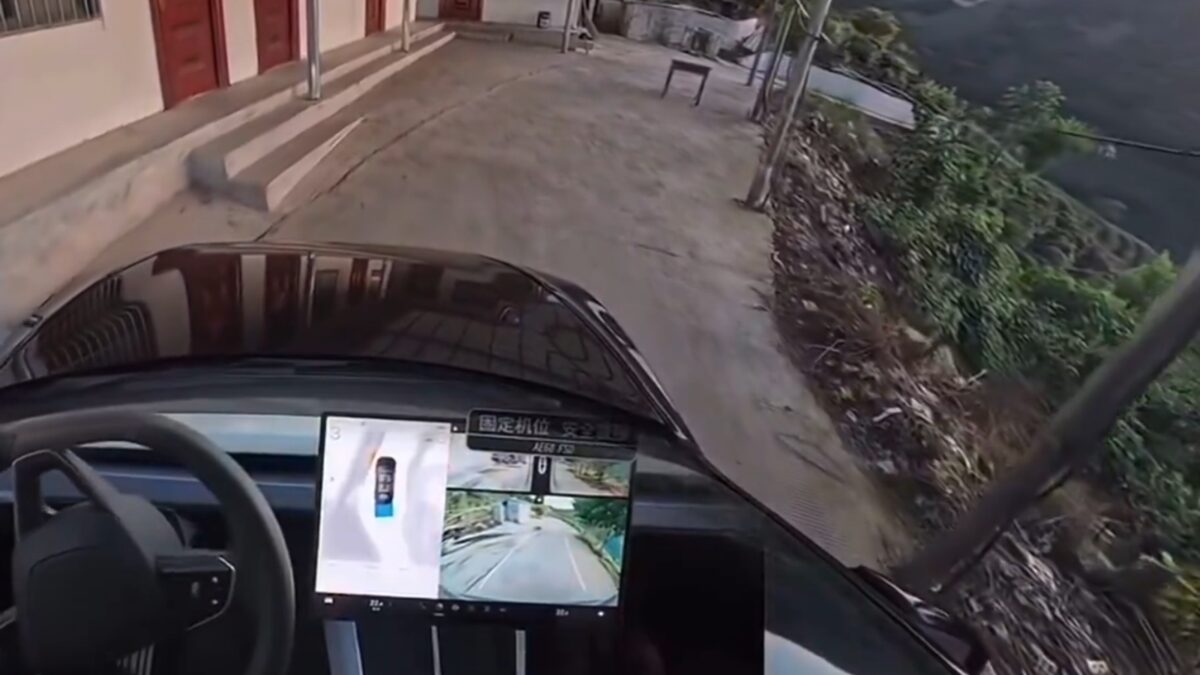
Tesla’s Full Self-Driving has turned up in another viral clip, this time in China, where a car was shown reversing for nearly seven minutes along a narrow mountain road with a drop inches away from its wheels. The footage is the kind that makes autonomous-driving hype look both impressive and slightly unhinged: the system keeps the car moving smoothly, while the human inside just watches.
That mix of spectacle and restraint is exactly where Tesla’s driver-assistance story now lives. FSD can handle steering, braking, acceleration, lane changes, and city navigation, but by SAE standards it is still Level 2, which means the driver is responsible for supervision at all times. In other words, the car can look uncannily confident without actually being in charge.
What the China clip shows
The video, filmed from inside the cabin, shows the Tesla edging backward along a winding road where the boundary between asphalt and open air appears uncomfortably thin. The car keeps its line with a calmness most humans would struggle to match, especially in reverse on a mountain pass. That’s the party trick: not full autonomy, but machine precision in a situation that feels far too nasty for improvisation.
China has become a useful stress test for driver-assist systems because local roads can be chaotic, tight, and unforgiving. Tesla is far from alone in using dramatic clips to sell capability – rivals such as Mercedes-Benz and BMW have been pushing increasingly capable lane-keeping and parking systems too – but FSD still gets the loudest headlines because it behaves like a headline machine itself.
What Level 2 FSD actually means
- The car can accelerate, brake, steer, and change lanes on its own.
- The driver must keep watching the road and be ready to intervene instantly.
- Despite the name, it is not the car taking full responsibility.
That distinction matters because viral clips often do the marketing work for Tesla. A seven-minute crawl along a cliff edge looks like science fiction, but the system is still operating inside a framework that assumes a human safety net. The real achievement here is not ”self-driving” in the robotaxi sense; it is a driver-assistance stack that can stay composed in a scenario that would have most motorists sweating through the seat.
The bigger question for Tesla
For Tesla, clips like this are useful because they reinforce the idea that FSD is getting better at handling odd, low-speed edge cases, where polished demo routes matter less than judgment and control. The catch is that every impressive video also invites the same old question: if the system is this capable, why is the human still legally and practically essential? That tension is now the product.
Expect more of these clips, and more arguments about whether they prove genuine progress or just excellent cherry-picking. Tesla’s software keeps collecting public proof points, but the gap between ”looks autonomous” and ”is autonomous” is still where the story lives.