

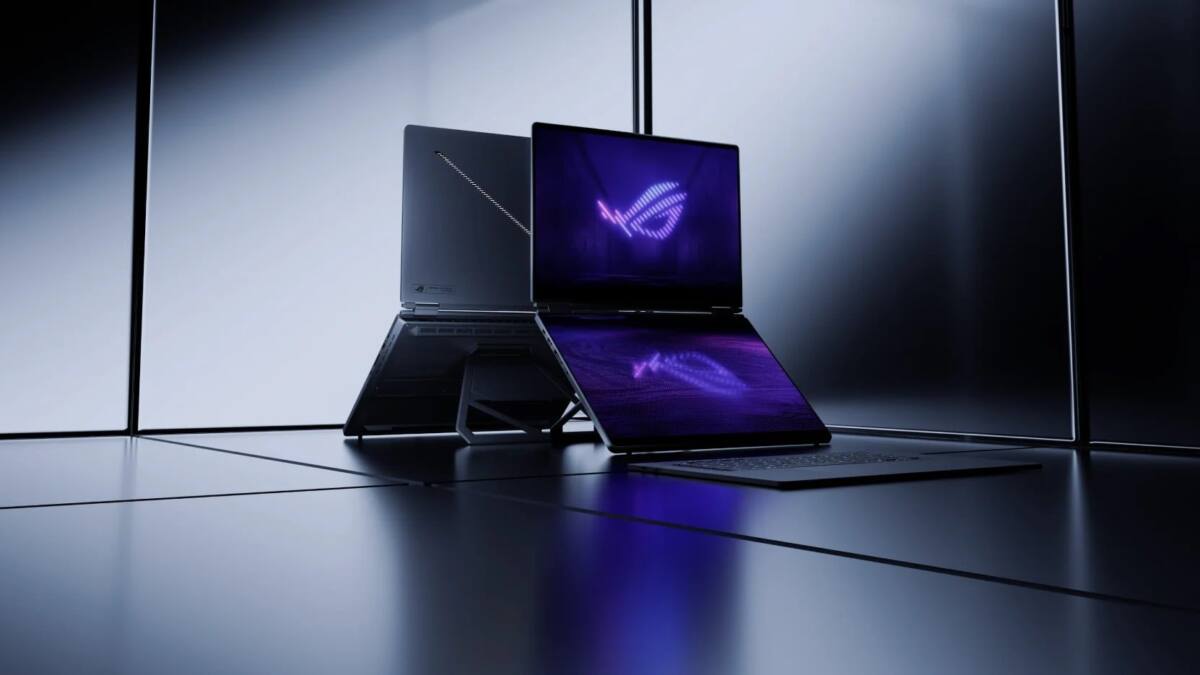
ASUS may be about to bring one of its most over-the-top gaming laptops to India next month. The ASUS ROG Zephyrus Duo (2026) GX651 is tipped to arrive with two 16-inch 3K OLED touch displays, an Intel Core Ultra 9 386H chip, and NVIDIA’s GeForce RTX 5090 Laptop GPU, making it less a mainstream laptop and more a portable demo of how much hardware ASUS can cram into a chassis.
According to tipster Yogesh Brar, the laptop should be announced soon, with sales expected to begin by the end of June 2026. If that timeline holds, ASUS would be betting that India’s high-end gaming and creator crowd is ready for a machine that costs more than many people spend on an entire desktop setup, monitor included.
Dual 16-inch 3K OLED touch displays
The Zephyrus Duo’s party trick is obvious: a primary 16-inch 3K OLED touch panel paired with a second 16-inch 3K OLED touch display, both running at 120Hz. ASUS says the main screen is for gaming and creative work, while the secondary panel can carry Discord, streaming controls, editing timelines, system monitoring, or whatever else you do not want buried behind a full-screen app.
That is a much more practical pitch than the company’s earlier dual-screen experiments, which often felt like futuristic hardware in search of an everyday use case. Here, the setup makes more sense for streamers and editors, especially at a time when multi-display workflows have become standard on desktops and even some gaming laptops from rivals such as Acer and MSI are leaning harder into creator-friendly features.
RTX 5090 laptop specs and battery
- Intel Core Ultra 9 386H processor
- NVIDIA GeForce RTX 5090 Laptop GPU
- Up to 24GB of GDDR7 memory
- 150W TGP
- 32GB LPDDR5X RAM
- 1TB PCIe 5.0 SSD
- 90Wh battery
Those parts are aimed squarely at the top end of the market: maxed-out AAA games, ray tracing, DLSS 4, 4K editing, and 3D rendering. The 150W RTX 5090 configuration is already priced at around $5,500 in the US, so an Indian sticker price near ₹5.2 lakh would not be shocking once duties and taxes are added. That is not a typo, and it is not for casual buyers either.
Who wins here? Enthusiasts, streamers, and professionals who can actually use the dual-screen setup. Who does not? Anyone hoping for a rational price tag. ASUS seems happy to keep the Zephyrus Duo in rarefied territory, where novelty, bragging rights, and brute-force specs all matter more than value. The only real question is whether India gets enough units to matter, or whether this becomes another halo product that turns heads and disappears into the background almost immediately.