

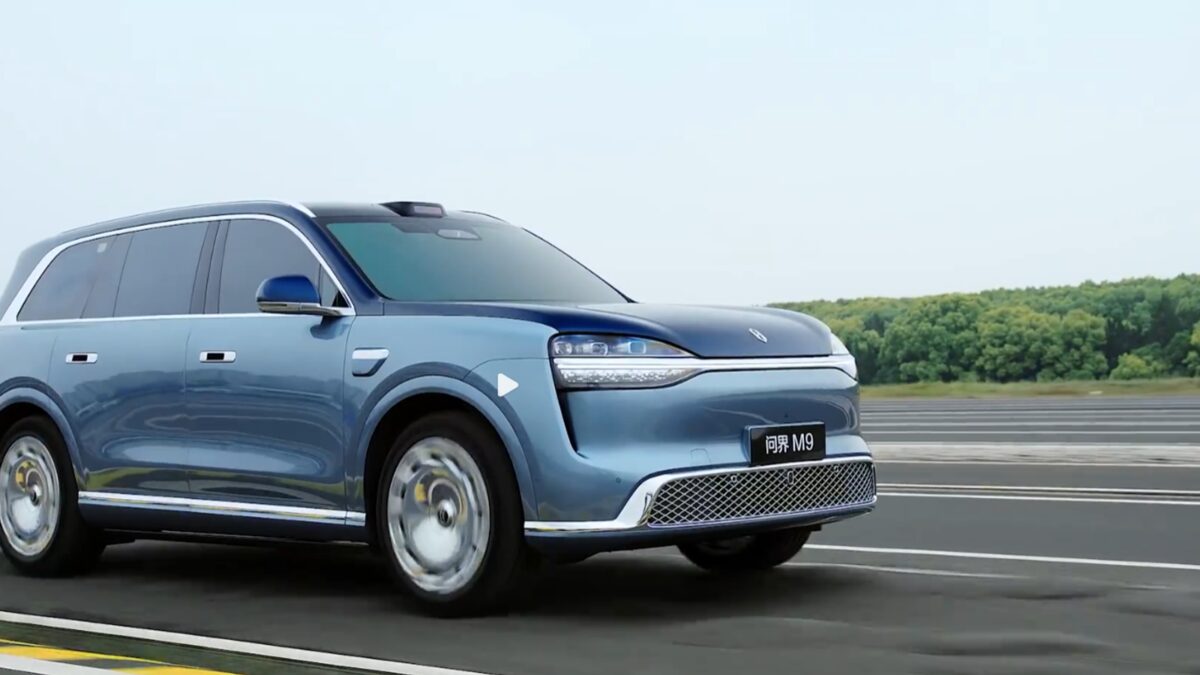
The Aito M9’s active suspension has pulled off a neat little trick: a suspension video looked so unreal that some viewers assumed it was AI-generated. Huawei’s response was to publish a plain, no-frills clip showing the SUV doing the same thing for real, which is a strong sign the suspension is the headline, not the marketing department’s imagination.
The scene is simple enough. The Aito M9 travels at 60 km/h over a rough road while the wheels and suspension soak up the bumps, and the body barely moves. In a world where car brands love to pad every demo with smoke and mirrors, that kind of restraint is almost suspicious. Here, though, the engineering appears to be the flex.
Huawei Tuling chassis under the M9
According to Huawei, the new-generation Aito M9 uses the fully active intelligent Huawei Tuling chassis. That would make it the first mass-produced HarmonyOS model to get a fully active suspension system, a claim that puts it in rare company even before you get into the details.
The hardware list is the sort of thing automakers use to make enthusiasts nod approvingly and everyone else reach for a search engine. The car gets:
- a front independent suspension with four ball joints and double wishbones
- a rear five-link setup
- an all-aluminum chassis
- closed-type intelligent air springs with two chambers and two valves
- CDC dampers with continuously variable damping
Why people thought the clip was fake
The skepticism makes sense. Smooth-body suspension demos are now so overproduced that viewers have learned to distrust anything that looks too polished, and AI suspicion is the modern version of ”that can’t be real.” The irony is that the more advanced the suspension gets, the more it starts to look like a visual effect rather than a mechanical one.
That puts Aito and Huawei in a useful position. If the car really can keep its cabin that flat over broken pavement, the clip does more than advertise comfort – it signals a push into the premium tech race, where Chinese brands are increasingly using chassis hardware as a differentiator instead of just battery size and screens.
What the Aito M9 is trying to prove
The Aito M9’s pitch is not subtle: this is meant to be a showcase for software-managed hardware, not just another large electric SUV with a fancy badge. Competitors have been leaning hard on adaptive air suspension and electronic damping for years, but a fully active system is a more aggressive statement because it promises to control body motion rather than merely soften it.
If the production car matches the demo, expect rivals to answer with their own ”our suspension is better” theater very quickly. If it doesn’t, well, the internet already knows how to react to that kind of disappointment.