

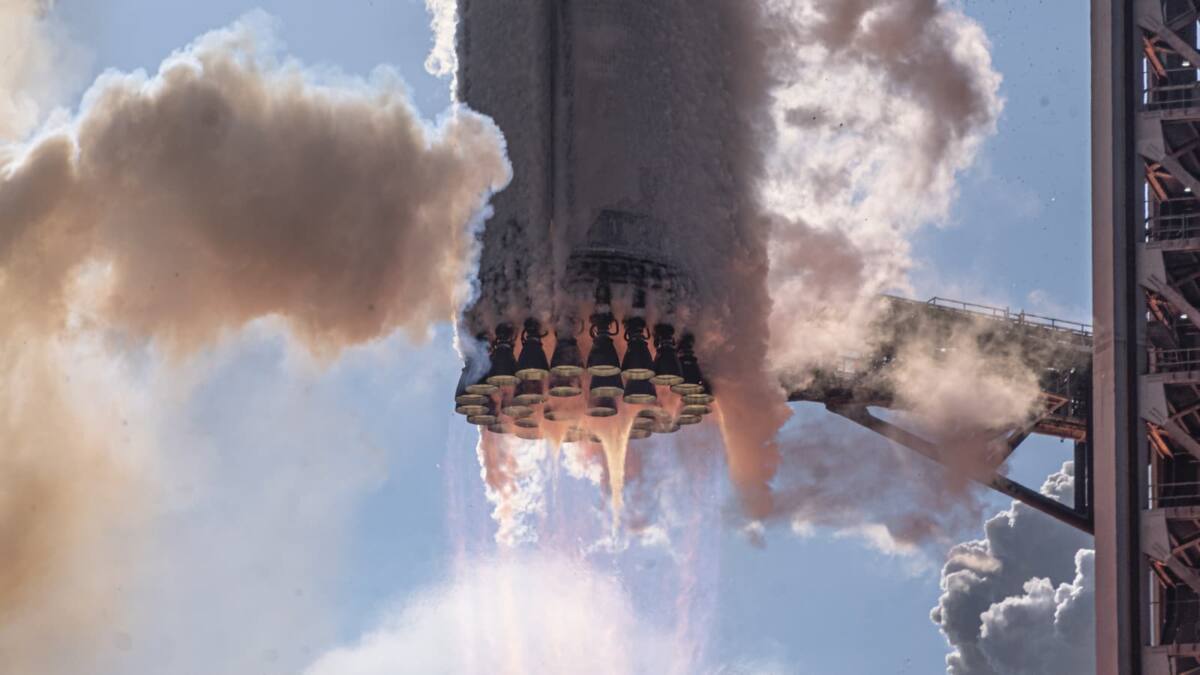
SpaceX’s first Starship V3 flight delivered a split verdict: the upgraded ship mostly did its job, while the Super Heavy booster ended with a hard splashdown in the Gulf of Mexico after problems with its relight. The company said the mission still hit key test goals, including a new launch pad, new Raptor 3 engines, and a long list of in-flight checks that will matter far more than the bruised booster.
The launch was the 12th test for the Starship program, and the first time both the ship and booster flew in V3 form from Pad 2 at Starbase in Texas. That alone makes the mission a useful data point: SpaceX is moving from ”can it fly?” to ”can it repeat the performance under pressure?”, which is where these giant rockets usually get humbled.
Starship V3 test flight and Super Heavy relight problems
On ascent, Super Heavy lit all 33 engines at liftoff, but one shut down during the climb. The ship then separated cleanly and continued toward space on six engines. Later, the booster’s return attempt went sideways when some engines failed to relight for the landing burn, ending with a splashdown in the Gulf rather than a controlled touchdown.
The upper stage had its own drama. One vacuum Raptor 3 dropped out during the climb, yet Starship still held its planned flight profile. That is the kind of result SpaceX likes to celebrate because it shows margin, even if the rocket is clearly not yet boring enough for regular service.
Starship carried Starlink simulators and camera satellites
The mission’s payload was built for testing, not selling. Starship released 20 Starlink simulators and two modified satellites that filmed the vehicle in flight, giving SpaceX more eyes on the system than a normal mission could provide.
During reentry, the company collected data on heat shield performance and structural strength. The final phase also included aggressive maneuvers meant to push the flaps hard and mimic future return paths to Starbase, a reminder that the polished orbital era SpaceX keeps hinting at still depends on making the ugly parts work first.
What the Gulf splashdown tells SpaceX about Starship V3
A failed booster recovery is not ideal, but it is also not the headline SpaceX probably fears most. The bigger win is that the ship survived a complex test profile with engine loss, payload deployment, and atmospheric reentry intact. That is the sort of resilience rocket builders spend years chasing, and it is exactly why the company keeps flying these increasingly expensive experiments.
The next question is whether SpaceX can turn this kind of uneven success into routine performance. If Raptor 3 is going to anchor the next phase of Starship, the engine has to stop making every launch feel like a live stress test.