

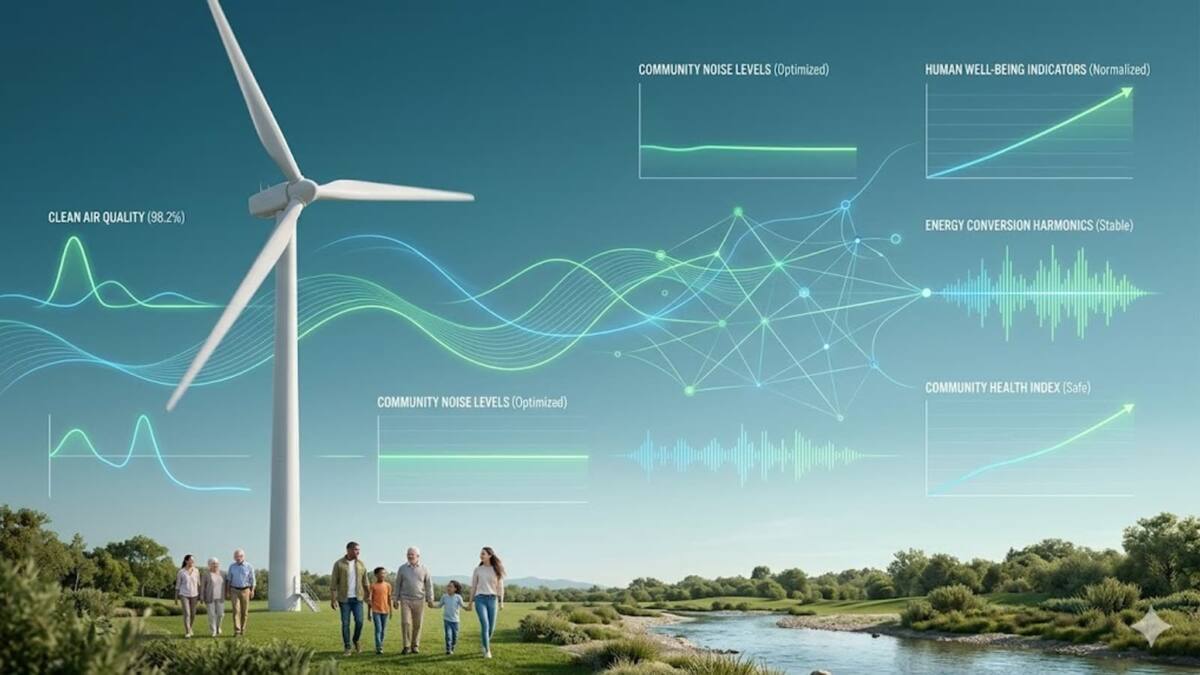
A large new study on wind turbines says the ”wind turbine syndrome” story does not hold up: researchers who tracked more than 120,000 households across the United States found no meaningful link between living near wind farms and migraines, depression, anxiety, sleep problems, or higher use of painkillers and sleeping pills. For a debate that has fed headlines for years, that is a fairly brutal result.
The study pulls together location data for turbines, long-running household surveys from 2011 to 2021, and records of medical-product purchases. In other words, this was not a quick opinion poll with a dramatic graph slapped on top; it was a broad attempt to see whether health complaints actually move when turbines move into the neighborhood.
What the wind turbines study compared
The work brought together scientists from the University of Pittsburgh, Columbia University, and Augsburg University. Led by Osea Giuntella, the team compared families’ health indicators before and after wind turbines were installed near their homes, then looked for patterns that would suggest a real medical effect rather than a loud assumption.
- More than 120,000 households surveyed
- Data covered 2011 to 2021
- Health outcomes included migraines, clinical depression, and anxiety
- Researchers also tracked purchases of painkillers and sleeping pills
Why the findings cut against the noise
The headline result is simple: at the usual distances people live from these projects, the turbines did not produce moderate or strong damage to physical or mental health. The team did say it cannot rule out tiny effects, such as subjective irritation from background noise, but that is a long way from the dire claims that sometimes trail renewable-energy projects.
That matters because the anti-wind argument has often been presented as a public-health warning, not just an aesthetic complaint. Yet the study points in the opposite direction: whatever risk people fear from turbines, it looks tiny compared with the well-documented harm from burning coal, oil, and gas, which still power far more of the grid than wind turbines do.
What the policy debate still has to answer
This will not end every local fight over wind farms. People still dislike the look, the noise, and the politics of sitting next to industrial hardware, and those objections are not the same thing as disease. But if the next round of opposition leans on health scares, this study gives regulators and developers a firmer answer than the usual hand-waving.
The remaining open question is whether the public debate can catch up with the evidence. Wind power already has to fight grid bottlenecks, permitting delays, and price pressure; it does not need medical folklore piled on top.