

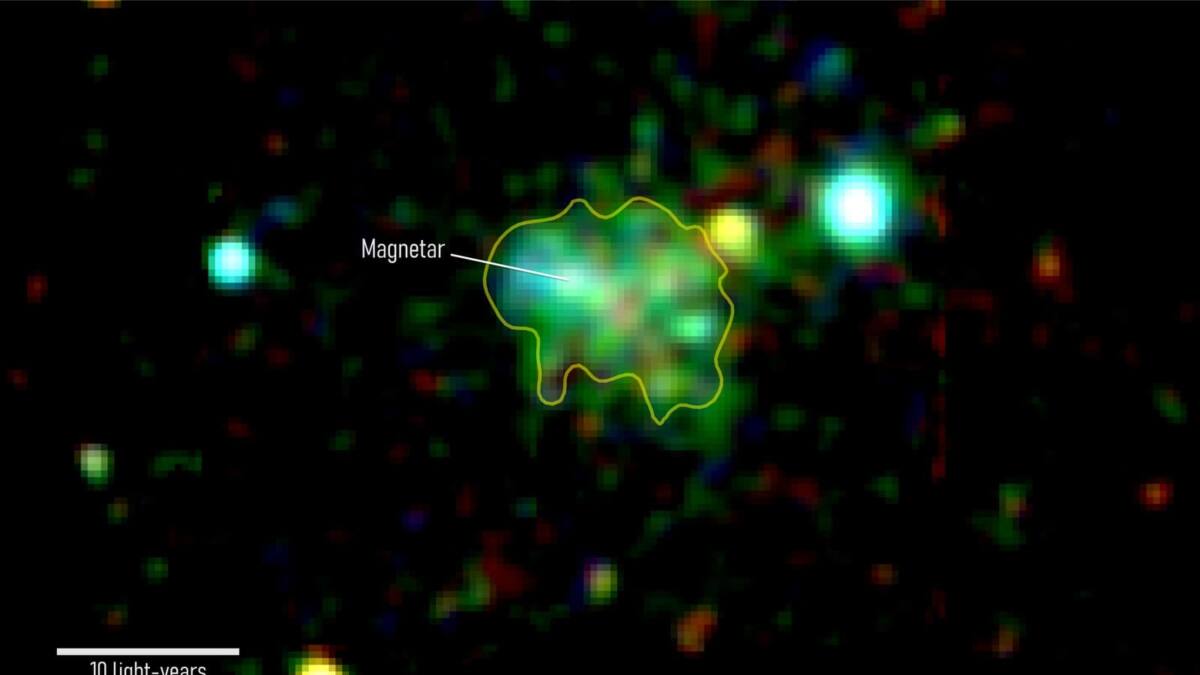
NASA’s Fermi gamma-ray telescope has finally caught something theorists have chased for nearly two decades: gamma rays from the birth of a magnetar inside a superluminous supernova. The target, SN 2017egm, is one of the nearest events of its kind, and the new analysis gives the strongest evidence yet that these ultra-bright explosions can be powered by a rapidly spinning neutron star with an absurdly strong magnetic field.
That is a big deal for a very simple reason: superluminous supernovae have been dazzling astronomers for years, but their energy source was still a fight between competing models. Fermi has now tipped the scales toward the magnetar camp, at least for this object, and it does so using archival data rather than a lucky new blast in the sky.
SN 2017egm gave astronomers a rare test case
SN 2017egm erupted in the galaxy NGC 3191, about 440 million light years from Earth in Ursa Major. That is distant by any normal standard, but in the tiny club of superluminous supernovae it is relatively close, which makes it far easier to study than most of its peers.
Over the last 20 years, astronomers have identified roughly 400 of these oddballs. They shine at least 10 times more brightly in visible light than an ordinary dying massive star, which is exactly why they have been such a headache: something has to keep dumping energy into the blast long after the initial collapse.
Fermi’s archive search found the missing gamma rays
A first hint appeared in 2024, when researchers suggested Fermi may have seen hard gamma radiation from SN 2017egm. To check that claim, a team led by Fabio Acero of CNRS and Université Paris-Saclay combed through the first 16 years of Fermi observations and compared six nearby superluminous supernovae. Only SN 2017egm showed convincing gamma-ray activity.
That matters because it backs a prediction theorists had been circling for years: in some of these explosions, the visible fireworks are only the afterglow of energy that first appears at much higher frequencies. A similar pattern has been discussed in other magnetar-powered transients, but this is the first strong case where the gamma-ray signature lines up cleanly with the model.
How a magnetar turns a supernova into a hypernova
The leading explanation is a newborn magnetar, a neutron star with a magnetic field about 1,000 times stronger than that of a normal neutron star and 10 trillion times stronger than an everyday fridge magnet. It spins several hundred times per second and throws off a torrent of electrons and positrons.
- The particles form a magnetar wind nebula.
- Inside that nebula, matter and antimatter annihilate and produce gamma rays.
- At first, those gamma rays are trapped by the expanding debris and get reprocessed into visible light.
- Roughly 3 months later, the ejecta thins enough for gamma rays to escape, which is what Fermi detected.
The model is elegant, which is usually astronomy’s polite way of saying ”we finally have a mechanism that fits the mess.” It also explains why the supernova is so bright early on, while later irregular fading likely comes from other effects, including material falling back onto the magnetar and the blast wave slamming into gas the star shed before it died.
What comes after the Fermi result
The next round of searches may come from the growing array of Cherenkov telescopes on the ground. According to the calculations in the study, that system would need about 50 hours of observations to reliably catch a similar supernova at distances up to 500 million light years.
If that works, Fermi’s breakthrough may end up being less a one-off triumph than the start of a much cleaner way to identify magnetars at birth. The real question now is how many more hypernovas have been hiding the same trick in old data, waiting for someone patient enough to look.