

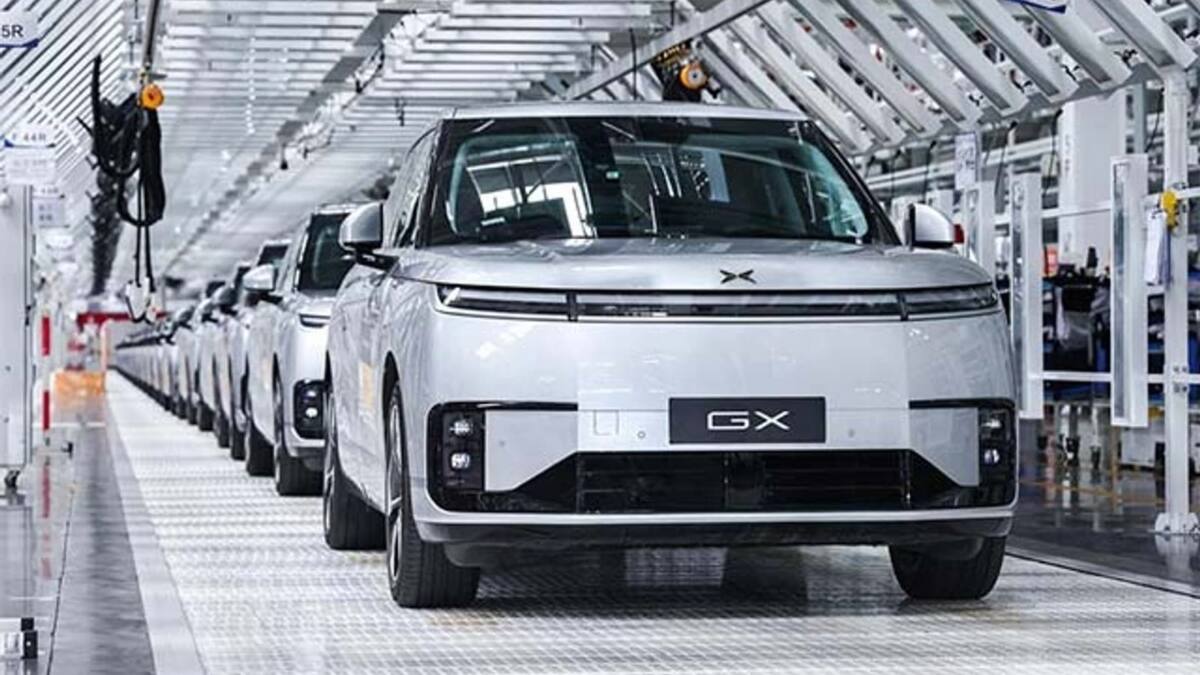
Xpeng has started mass production of its first robotaxi in Guangzhou, a move that puts the company into the same conversation as the biggest names in autonomous driving. The vehicle is designed for Level 4 autonomy and uses four Turing AI chips with a combined 3,000 TOPS of compute. It takes a very different route from many rivals: no lidar, no HD maps, and almost everything built in-house.
That vertical approach is the real story here. While many rivals still stitch together sensors and software from outside suppliers, Xpeng is trying to own the stack from silicon to vehicle integration. It is a bold move, and potentially a cheaper one in the long run if the company can make it work at scale.
Four Turing AI chips and 3000 TOPS
The robotaxi runs on Xpeng’s GX platform and uses four Turing AI chips as its computational core. Xpeng says the setup delivers 3,000 TOPS, which places it among the most powerful production autonomous systems on the market.
That raw compute matters because city driving is messy, and messy roads punish weak hardware. The company is betting that brute-force processing plus tighter integration will beat the usual supplier-led recipe, especially in dense urban traffic where split-second decisions matter.
Pure vision instead of lidar and HD maps
What sets the car apart is what it leaves out. Xpeng says the system relies on pure vision, with no lidar and no high-precision digital maps, using AI perception and spatial modelling instead.
That puts it in the same philosophical camp as Tesla’s camera-only push, but Xpeng is folding the idea into a purpose-built robotaxi rather than a consumer car retrofitted for autonomy. If the approach holds up in unfamiliar cities, it could reduce hardware costs and make deployment faster; if it fails, there is no expensive sensor stack to hide behind.
VLA 2.0 cuts response time to 80 milliseconds
The system is coordinated by Xpeng’s VLA 2.0 model, which the company says removes the usual intermediate language-translation step seen in standard vision-language-action systems. The payoff is a claimed reaction time of 80 milliseconds.
That speed is not just a bragging-rights metric. In autonomous vehicles, latency is where good intentions go to die, so faster response times can translate directly into smoother decision-making in traffic. Xpeng also says the same VLA 2.0 base is being used in its IRON humanoid robot and future flying-car projects, which is a neat way to turn one model into a company-wide platform.
Premium cabin, pilot tests and 2027 rollout
Xpeng is also trying to sell the robotaxi as a premium experience, not just a driverless shuttle. The cabin includes athermal glass for privacy, zero-gravity-style seats, large rear-seat entertainment displays and a voice assistant for climate and media controls.
Real-world pilot testing is set for the second half of this year, with fully driverless commercial service planned for the beginning of 2027, without safety operators on board. To speed adoption, Xpeng will open its Robotaxi SDK to outside companies, and Amap has already been named as the first global partner.
The open question is whether Xpeng can turn a technical showcase into a business that scales beyond a press-friendly first run. China has become the most aggressive proving ground for autonomous vehicles, but commercialization has a habit of humiliating elegant demos.