

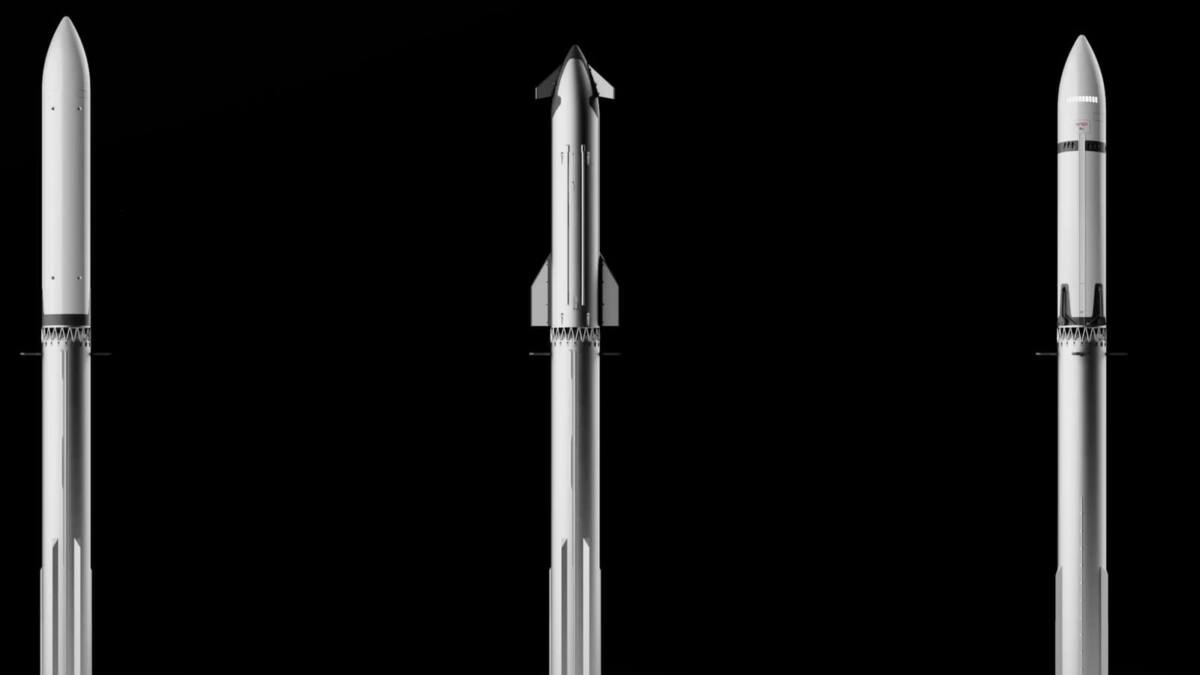
SpaceX is turning Starship into a family of spacecraft rather than a single rocket, and a new render makes the split obvious: one version to haul propellant, one to carry cargo back from orbit, and one shaped for lunar work under NASA’s Artemis program. That is the real trick here – not building one vehicle that does everything, but stretching one baseline design until it does three very different jobs.
The image, shared by popular SpaceX watcher Sawyer Merritt, shows the three Starship variants side by side. It also arrives as attention builds around the 12th test flight of Starship, which is expected on 23 May. In other words, this is not just concept art; it is a preview of the operational pipeline SpaceX wants to reach, and the company has been moving toward that model for a while, with orbital refueling now central to long-range missions.
The tanker Starship strips the vehicle down
The tanker variant is the most stripped-back of the trio. It has a smooth body, no heat shield tiles, and no aerodynamic flaps, because its job is not to survive reentry but to store and transfer methane and oxygen in orbit. That makes it the unsung workhorse in SpaceX’s ambitions for deep-space missions: no fuel depot, no far trips. Simple enough, and also brutally demanding.
That approach echoes how other launch firms have tried to specialize reusable hardware, but SpaceX is pushing the idea further by keeping the basic Starship architecture intact. It saves engineering effort, speeds production, and gives the company a cleaner path to scaling launches if the testing campaign cooperates.
Cargo Starship keeps the full return capability
The cargo version looks much closer to the Starship the public already knows. It carries the full set of control surfaces, thermal protection, and the ability to come back to Earth after launch. That makes it the obvious choice for heavy payloads, Starlink satellites, and the future Mars hardware SpaceX keeps promising with a straight face and a very long timetable.
- Tanker: orbit-only fuel storage and transfer
- Cargo: payload delivery plus Earth return
- Lunar / HLS: landing system for NASA’s Artemis work
The lunar Starship is built for a different surface
The lunar version, also referred to as HLS, is the most specialized of the lot. It has a different landing-gear setup and a structure designed for a gentle touchdown on the Moon, where ”soft landing” is less a marketing line than a survival requirement. That configuration exists because the Moon is not Earth, and pretending otherwise has a bad track record.
For NASA, the advantage is obvious: one industrial platform can be adapted for orbital logistics, cargo transport, and human landings. For SpaceX, the upside is even larger – if Starship matures, the company could sell an entire transport system rather than a single launch vehicle. The next big test is whether the hardware can keep matching the ambition.