

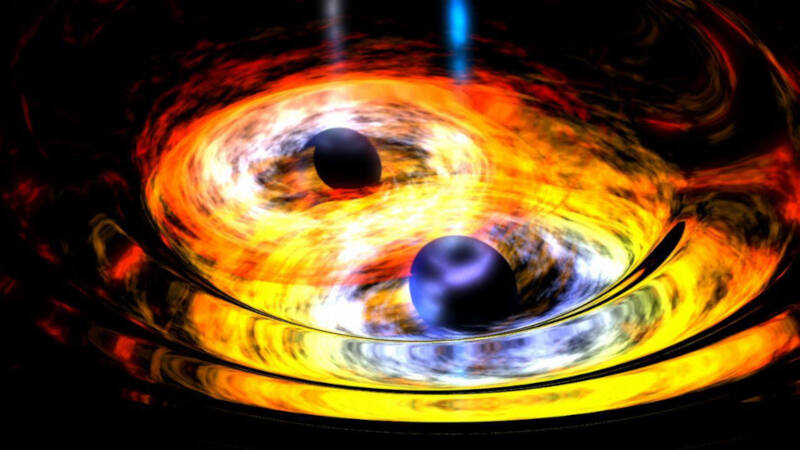
Heavy black holes detected through gravitational waves may not be born in stellar collapse at all. A new analysis of 153 mergers in the GWTC4 catalogue points to a more chaotic origin: repeated collisions inside dense globular clusters, where black holes keep running into each other and growing larger after each merger.
The dividing line appears to sit around 45 solar masses. Below that, black holes still fit the familiar story of massive stars dying in supernovae and leaving behind compact remnants. Above it, the data look increasingly awkward for a simple one-star, one-black-hole model – which is exactly the kind of headache astrophysicists like, because headaches usually mean the universe is hiding something interesting.
What GWTC4 says about black hole growth
The study focused on stellar-mass black holes, not the supermassive ones sitting in galaxy centers. These objects are found through gravitational waves, the ripples in spacetime produced when black holes collide and merge. LIGO, KAGRA, and Virgo are the instruments doing the listening on Earth, turning tiny distortions into a census of cosmic violence.
Two populations emerged from the data. The lighter black holes look consistent with direct formation after stellar death, while the heavier ones show spin patterns that better match a history of successive mergers. That matters because spin is not just a decorative number: it can preserve clues about whether an object was born once or assembled piece by piece.
Why 45 solar masses is such a messy boundary
That threshold lines up with the idea of a mass gap caused by pair-instability in very massive stars. In that scenario, some stars become so unstable before collapse that the supernova destroys them entirely, preventing a black hole of stellar mass from forming. The result is a frustrating hole in the black-hole family tree – and a convenient explanation for why the very heavy examples are so hard to produce directly.
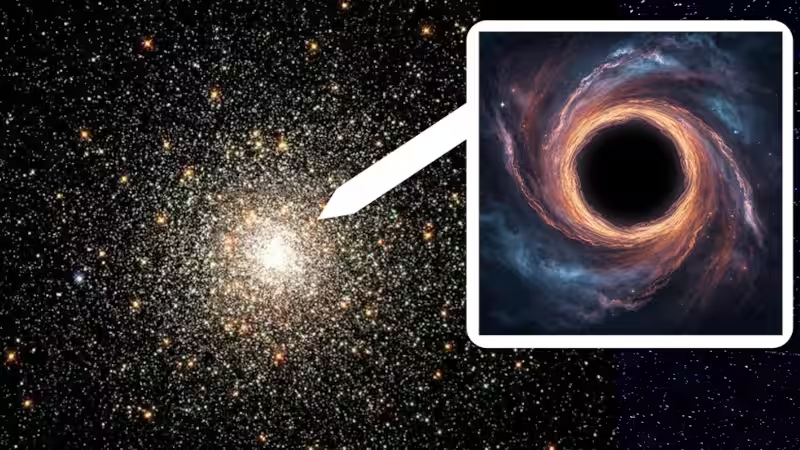
Instead, the new work makes a repeated-merger pathway look more convincing. In a globular cluster, a black hole that has already merged once comes out heavier, then has more chances to merge again. Repeat that enough times and you can build a black hole that looks far too massive to have arrived there in one clean stellar death.
What the spin of heavy black holes reveals
Isobel Romero-Shaw, one of the study’s researchers, said the heavy objects rotate faster and with more randomly oriented spins than the lighter population. That is exactly the sort of fingerprint expected from a crowded stellar environment, where black holes are repeatedly perturbed, paired up, and merged again. It is a neat answer, and also a reminder that black holes may be less like lone monsters and more like the end product of a very aggressive assembly line.
Fabio Antonini put the sharper question bluntly: do these black holes mean stellar-evolution models are wrong, or are we simply watching them form by another route? For now, the second option looks stronger. The next round of gravitational-wave detections will decide whether this is the start of a bigger recalibration of black hole origins, or just the first good map of how crowded clusters manufacture the universe’s fattest dark objects.