

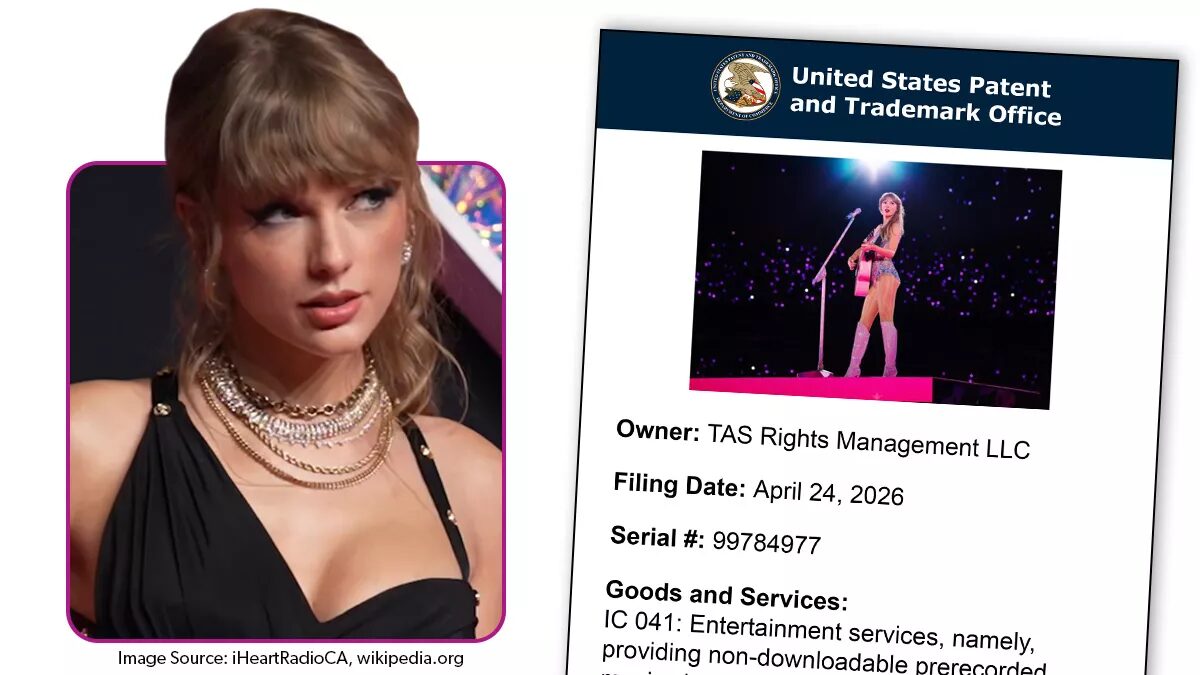
Taylor Swift has filed trademark applications aimed at protecting both her voice and a signature image, a sign that celebrities are getting more aggressive about using trademark law against AI-generated impersonation. The filings, made on April 24, cover spoken phrases associated with Swift and a distinctive stage look that fans would recognize instantly – which is exactly the point.
What Swift is trying to protect
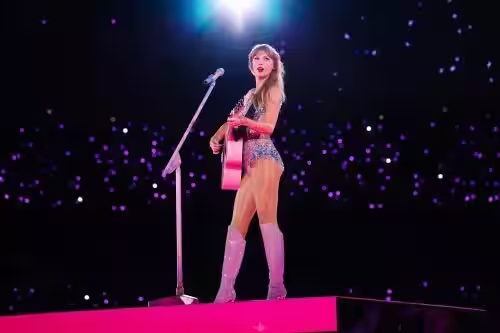
Two of the applications are sound marks for the phrases ”Hey, it’s Taylor Swift” and ”Hey, it’s Taylor.” A third filing covers an image of Swift holding a pink guitar with a black strap, wearing a multicolored bodysuit with silver accents, and boots. It is a very specific bundle of identity, which is what makes it useful in a world where AI can remix a celebrity’s look and voice without touching an original recording.
Why trademark law is being pulled into AI fights
Copyright already covers songs, and right of publicity laws can help when a likeness is used without permission. But those tools were built for a slower era, one where infringement usually meant copying an actual recording or photo. AI changes the math: a system can generate something that sounds like Swift, looks like Swift, and spreads it widely without ever lifting a single protected file.
That is where trademark law starts to look attractive. Unlike copyright, it can reach uses that are confusingly similar, not just identical, which gives lawyers a broader argument when an AI clone is close enough to fool people. The strategy is not limited to Swift either – Matthew McConaughey has filed similar applications as celebrities try to put legal fences around voice and image before the platforms do it for them.
The sound mark playbook is still unusual
Sound marks are not new; Netflix’s ”tu-dum” and NBC’s chimes are familiar examples. What is new is the attempt to register a living celebrity’s spoken voice as trademark territory. That is an inventive move, and also the kind of move that will probably need a federal court to decide how far it can go when the alleged infringer is an AI model rather than a person mimicking a voice on purpose.
- Filed on April 24
- Two sound marks for Swift’s spoken phrases
- One visual filing tied to a recognizable stage outfit and pose
- Potential use: stronger claims against AI voice clones and image fakes
The bigger question is whether trademark offices and courts will accept this as a durable AI defense or treat it as a clever stopgap. If Swift’s applications hold up, expect more celebrities to copy the playbook fast, because in an AI era, waiting for the copycats is a lousy strategy.