

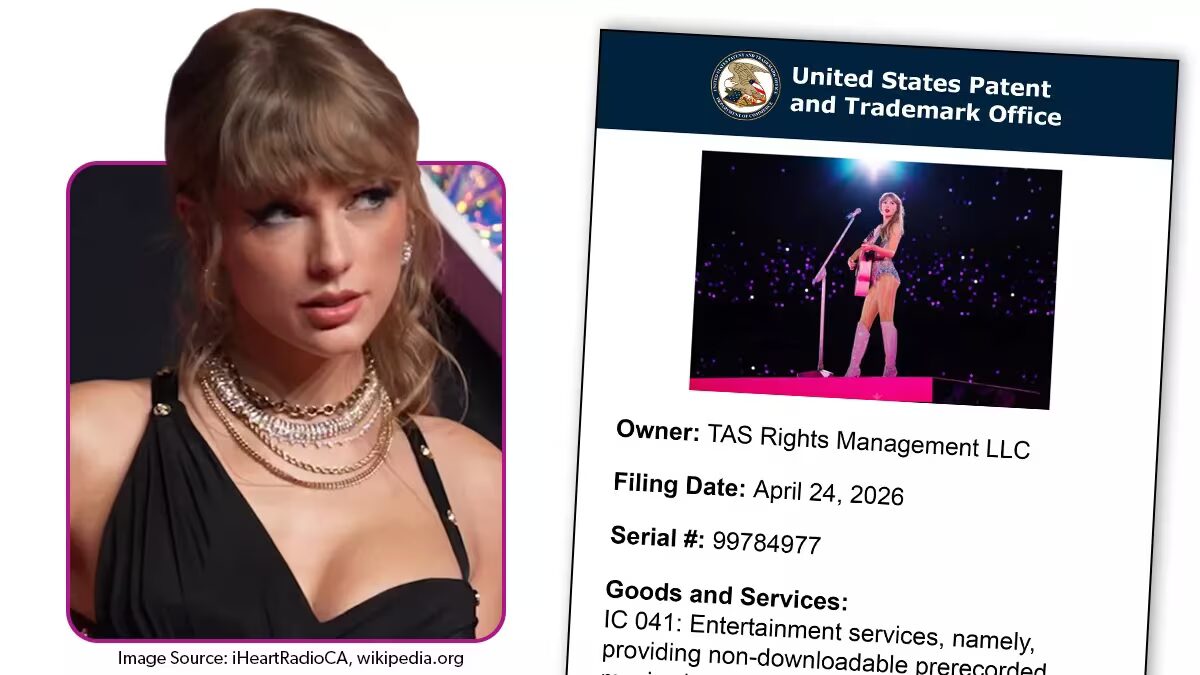
Taylor Swift is moving to legally lock down her voice and image as artificial intelligence makes it easier than ever to create fake voices and deepfake videos. On April 24, she filed trademark applications targeting the commercial use of her recognizable voice phrases and distinctive stage appearance, aiming to plug legal loopholes that have allowed AI-generated fakes to proliferate unchecked.
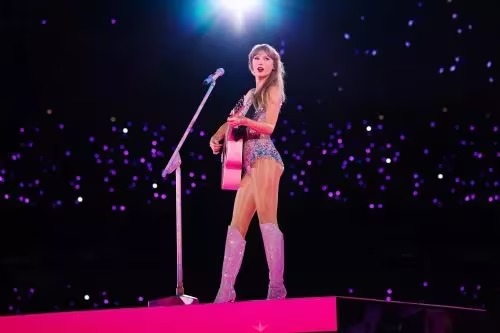
The applications include two sound trademarks: the phrase ”Hey, it’s Taylor Swift” and the shorter ”Hey, it’s Taylor.” Separately, Swift seeks to protect a visual trademark describing her signature look-playing a pink guitar, wearing a black strap, a multi-colored bodysuit with silver accents, and boots.
This move comes amid growing concern from researchers and rights advocates about generative AI’s rampant use of voices and faces without permission. Traditional legal tools like the ”right of publicity” in the US often only apply after damage has been done. In contrast, trademark law can preemptively target not just exact copies but even ”confusingly similar” imitations-giving Swift’s legal team stronger grounds to act swiftly.
What Taylor Swift is trademarking to block AI impersonations
The strategy is straightforward: if someone uses an AI-generated voice resembling Swift’s or an image closely matching her well-known stage persona, her team gains a federal legal lever to challenge it. While copyright law protects specific sound recordings, it doesn’t cover the voice itself as a distinct commercial asset. Trademarks fill that gap.
Sound trademarks themselves aren’t new. Netflix owns its iconic ”tu-dum” sound, and NBC has trademarked its recognizable chimes. What’s unusual here is registering a human celebrity voice as a trademark specifically to counter AI-powered impersonations. Other high-profile figures, like actor Matthew McConaughey, are already moving in this direction, signaling a broader industry shift. Hollywood rights holders are realizing that existing laws were designed for direct copying, not AI-generated creations made from scratch.
How trademark law provides stronger protection against AI deepfakes
Trademarks don’t just help ban unauthorized use-they also enable faster legal action, including emergency court orders and stricter rules for platforms hosting fake content. This goes beyond reputation management; it’s about controlling who profits from an artist’s identity, even when they’re offstage or silent.
Swift’s filings could serve as a blueprint for the entertainment industry’s next legal front. Currently, the focus is on a few signature phrases and visual style. Soon, lawyers may push to trademark every identifiable aspect of a celebrity’s persona, racing against AI’s ability to generate ”almost Swift” copies faster than lawsuits can be filed.
With generative AI tools becoming mainstream, expect more celebrities and companies to follow Swift’s lead, redefining intellectual property law in the age of digital twins and synthetic media.